The short answer
Private clinics lose phone bookings in two places: calls nobody answers, and answered calls that end without a slot. In our call tracking data, clinics start at around 24% of ad calls ending in a booking against a 31% to 35% target, so between one in five and one in three phone bookings are lost. Clinic missed calls are the cheaper fix: scan clinics miss 15% to 20% of morning calls.
In this article
- 1.Why the phone still decides private clinic bookings
- 2.What one in three lost phone bookings costs
- 3.Why agency reports cannot see a lost booking
- 4.How UpMedico finds where calls fail to book
- 5.Missed call and call-to-booking benchmarks for UK private clinics
- 6.The calls that end without a slot
- 7.Frequently asked questions
Why the phone still decides private clinic bookings
Most private clinic bookings are still won or lost in a conversation. In our call tracking data, 58% of ADHD enquiries in London and 47% in regional UK arrive by phone, and between 42% and 58% of ultrasound bookings do, depending on the scan.
The demand behind those calls is public. NHS England Digital counted up to 959,662 open referrals that may be for an ADHD assessment in June 2026, and the NHS waiting list for non-obstetric ultrasound stood at 668,435 patients at the end of July 2026. Someone who has waited months for the NHS wants a person and a date.
The phone matters more in some specialties than others. In our ultrasound accounts, 58% of MSK bookings arrive by phone against 42% for early pregnancy scans, because a patient with a sore knee wants to check which scan they need before paying for it.
By the time that person rings, they have often read the fee and compared two clinics. The call is the last step before a booking, and it is the step most clinics never measure. Our UK Private ADHD Clinic Growth Index and UK Private Ultrasound Clinic Growth Index carry phone figures only because the calls were tracked.
Across both specialties the pattern repeats. Clicks are counted to the penny, forms are counted when they arrive, and the call that decides the booking is counted only if it lasted long enough. What was said on it, and whether a slot was offered, sits outside every report the owner reads.
What one in three lost phone bookings costs
Start with 100 calls from ads in a month at a private ADHD clinic. Clinics typically start at around 24% of those calls ending in a booked assessment, and the target we hold them to is 31% to 35%, as set out in our seven-number scorecard for psychiatry clinics.
At 24%, the clinic books 24 assessments. At 31% to 35%, the same calls would book 31 to 35. That is 7 to 11 assessments a month the ads already paid for, or between one in five and one in three of the bookings the phone line should have made.
At the £950 median fee for a private adult assessment, the gap is £6,650 to £10,450 a month, roughly £1,500 to £2,400 a week. None of it shows in the ad account, because the calls that lasted long enough were already counted as conversions.
Put another way, each call from an ad is worth about £228 to an ADHD clinic at a 24% booking rate and a £950 fee, and about £295 to £333 at the target rate. Every figure here counts calls from ads only, so existing patients ringing to rebook do not dilute it.
The loss splits into two leaks. The first is the call nobody answers. Out of 100 calls from ads, a 20% missed rate leaves 20 people unheard, and at the same 24% booking rate that is close to five assessments, about £4,560 at £950.
Scan clinics lose the same calls at a different hour. In our call tracking data, 15% to 20% of inbound calls to ultrasound clinics go unanswered between 9:00 and 11:30, with peaks of 24%, which we estimate at £1,800 to £2,400 or more in lost scan bookings per site every month.
That morning peak overlaps the 8:30 to 11:00 window a same-day scan campaign runs in, so a clinic can pay for the click and lose the scan within the same half hour, as we showed in The Mid-Week Scanner Deficit.
Weekends add a third pocket. In the ultrasound accounts we manage that stay closed on Sundays, 25% to 30% of weekend inbound calls go unanswered or reach voicemail. Monday’s diary carries no trace of them.
The second leak is quieter. The call is answered, the caller is interested, and it still ends with “have a think and email us”. That call looks like a success in every report the clinic receives. It lasted long enough to count, and nobody listened to how it ended.

Why agency reports cannot see a lost booking
A Google Ads account can report a call. It cannot report what happened on it. Conversion tracking counts a call from an ad once it lasts longer than a minimum duration the advertiser sets, so a six-minute call about Right to Choose scores the same as a six-minute call that ends with a deposit taken.
Smart Bidding then learns from that signal. It bids for more of whatever the account calls a conversion, and a long call is not a booked patient. An account optimised on call length buys more long calls, including the ones from people who were only ever checking the NHS route.
Forms hide the problem from the other side. When an enquiry form is the primary conversion, the account counts the form when it arrives and never learns whether anyone rang the patient back. Either way, the conversion is recorded before the booking is won or lost.
Missed calls disappear in the same way. Call reporting uses Google forwarding numbers to log each call, and without it the clinic loses the timestamp that would show which hours ring out. Google also lets advertisers schedule a call asset to show only when the business is answering phone calls, yet a call asset left without a schedule shows the number whenever the ad runs.
The fix already exists inside the platform. Importing call conversions lets a clinic match the calls tracked through Google forwarding numbers with the outcomes it records afterwards, so a booked assessment can be sent back to the call that produced it. Without that link, the account optimises for conversations, not patients.
The test for any agency report is simple. Ask how many of last month’s calls ended in a booking, and at which hours calls went unanswered. If the answer needs a week of digging, the account is not measuring the phone.
Nobody set this up to mislead the owner. The report shows what the account was built to measure, and in most clinic accounts that stops at the ring. The phone is where a generalist template ends and a clinic’s revenue begins. We covered the form side of the same blind spot in Why 70% of your ADHD leads never book an assessment.
How UpMedico finds where calls fail to book
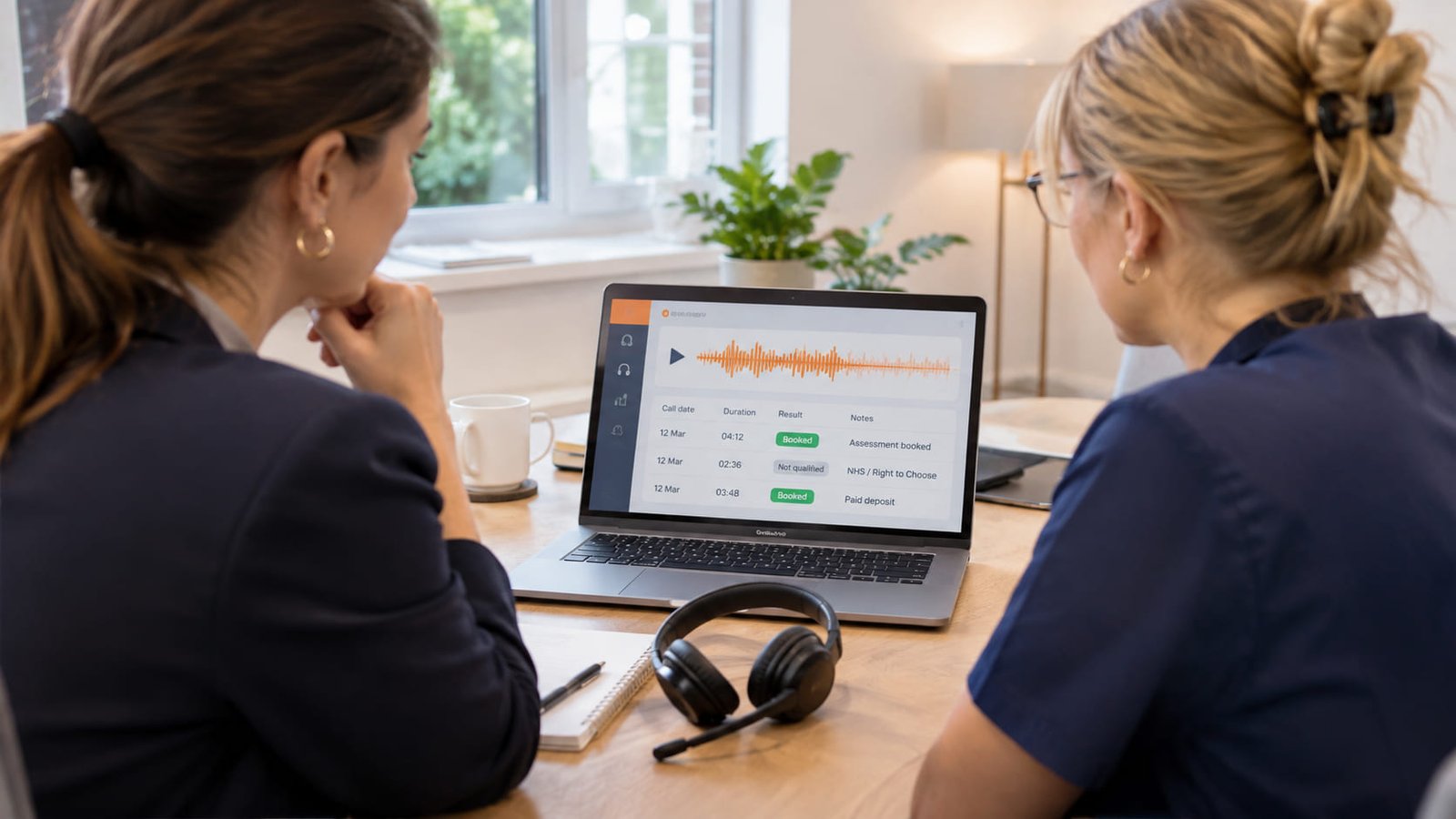
UpMedico starts from the recording, not the keyword report. Every call from an ad is tracked to the keyword that produced it, recorded with consent and scored against the clinic’s own intake script, so the owner sees where calls fail and which campaign sends the calls that fail.
Nothing here needs a new phone system. It runs on call tracking, recording and booking data a clinic can already switch on, joined so that each booked patient can be traced back to the call and the keyword that produced it.
Track every ad call to its keyword and hour
Each call from an ad carries its keyword, time and duration through Google forwarding numbers and a call tracking platform. Missed calls are reported by hour, never as a monthly average, because a Monday 9:30 gap disappears inside a monthly figure.
Fix the rota before the script
If more than 20% of ad calls go unanswered in any hour, the first change is who answers at that hour and when the call asset runs. The target is 4% or less of ad calls unanswered.
Record with consent and score every answered call
A consent message plays before the call connects. Each answered call is scored on four points: a greeting that confirms what the caller needs, a budget question within the first minute, a straight answer to the NHS question, and a close that offers two specific slots.
Send bookings back and calibrate every fortnight
Booked assessments and scans are imported back to Google Ads against the call that produced them, so bidding learns from bookings rather than call length. Reception and the owner review real recordings every two weeks and adjust the script together.
The order matters. A script cannot convert a call nobody picks up, so staffing comes before wording, and wording comes before any change to the budget. A clinic that raises spend while 20% of calls ring out is buying more of the calls it already misses.
Calibration is short and practical. The owner and the reception lead listen to a handful of booked and unbooked calls side by side, agree one change to the script, and check its effect in the next fortnight’s numbers.
The clearest proof is an adult ADHD and psychiatry practice in Central London and the South East. At the start it spent £4,500 a month on Google Ads and received 112 calls, of which 27 became booked assessments: a call-to-booking rate of 24.1%.
The recordings showed why. Reception spent the first two minutes explaining Right to Choose before checking whether the caller could pay privately, and 44% of calls ended without a specific slot being offered. The four-point scorecard and fortnightly calibration changed both.
After 90 days, with ad spend unchanged, the practice received 118 calls and booked 35 assessments, 29.6% of calls. That is 8 more assessments a month, about £7,600 of additional fee at £950 without a pound more on ads. The rate rose 5.5 percentage points, a relative gain of 22.8%.
That relative gain is above the up to 20% within 90 days the framework commits to, and it comes from one practice. Plan around the framework’s figure, not this one.
Missed call and call-to-booking benchmarks for UK private clinics
The table brings the phone figures from both specialties into one place. Every row carries its source, and the rows marked as estimates are modelled from our accounts rather than measured in a single dataset.
| Metric | Benchmark | Source |
|---|---|---|
| Enquiries arriving by phone, ADHD | 58% London, 47% regional UK | Call tracking data |
| Bookings made by phone, ultrasound | 42% to 58%, by scan type | Call tracking data |
| Calls unanswered 9:00 to 11:30, ultrasound | 15% to 20%, peaks of 24% | Call tracking data |
| Weekend calls unanswered, clinics closed on Sundays | 25% to 30% | Call tracking data |
| Missed call rate target | 4% or less (alarm above 20%) | Call tracking data |
| Call-to-booking rate, ADHD start point | Around 24% | Call tracking data |
| Call-to-booking rate target, ADHD | 31% to 35% | Call tracking data |
| Lost scan bookings from missed calls, one site | £1,800 to £2,400 or more a month | UpMedico working estimate |
| Form enquiries lost waiting for a callback | 30% to 40% | UpMedico modelled estimate |
| Case study call-to-booking, 90 days, same spend | 24.1% to 29.6% (27 to 35 bookings) | UpMedico client data |
Read the missed call rate against the call-to-booking rate before anything else. A clinic missing 20% of its calls has to book nearly 39% of the calls it answers to reach 31% overall; at 4% missed, about 32% of answered calls will do. Staffing comes first because it is the cheaper half of the target.
The weekend row is the one owners dispute. A clinic closed on Sundays sees no loss in its diary, yet 25% to 30% of weekend calls in our ultrasound accounts reach nobody or voicemail, as we showed in The Weekend Capacity Trap. The diary never records who tried to book.
Moving patients to a form does not remove the call either. In our modelled estimate, 30% to 40% of form enquiries are lost waiting for the callback, which is why Instant booking vs enquiry forms treats the phone as a booking route in its own right.
The case study row sits between the ADHD start point and the target. At 29.6% after 90 days the practice was still below the 31% to 35% target, and that is the honest reading of it: the first quarter closes the largest leaks, and the scorecard target is the level to work towards after it.
The calls that end without a slot
Missed calls are a staffing problem with a clear number attached. Answered calls that do not book are harder, because they sound fine. The caller was polite, the receptionist was helpful, and nothing was booked.
In the practice above, 44% of calls closed without a time on offer. Someone who hangs up without a slot has to decide twice, often after an evening spent reading about the free route. The recording is the only place that moment is visible.
The NHS question needs a straight answer in the first minute. Some callers are better served by Right to Choose, and saying so early is part of a clinic’s authority. What loses bookings is spending the first two minutes on the free route before learning whether the caller wanted it.
Scan clinics lose answered calls differently. The caller is usually ready to pay but unsure which scan fits, or asks for a gender scan in a week when it cannot yet be done. The booking is lost when nobody asks the question that settles it, as we set out in Wrong-week bookings.
The Call-to-Booking Framework™
UpMedico’s Call-to-Booking Framework™ combines healthcare-compliant call tracking, call recording, and structured intake analysis to identify why patient calls fail to convert, improving call-to-booking conversion by up to 20% within 90 days.
Recording is what makes that pattern measurable. Each answered call is scored against the four points of the intake scorecard with the keyword alongside, so a campaign that sends price-checkers looks different from a reception rota that runs out of hands at 9:30. The wording your team can adapt is in our clinic phone script.
The scores also separate a campaign problem from a staffing one. Low scores on calls from one keyword point to the campaign; low scores across every keyword at one hour point to the rota.
Recording patient calls means processing data concerning health, which is special category data under UK GDPR. It is set up accordingly: a consent message before the call connects, a defined retention period, and access limited to the people who need it. Our guide to call tracking for clinics covers the platform side.
What this looks like with UpMedico running your Google Ads
UpMedico manages Google Ads exclusively for private healthcare clinics in the UK and Ireland. Every engagement includes compliant campaign build, keyword-level call tracking and recording, and monthly analysis through our Call-to-Booking Framework™, so you see exactly which keywords produce booked assessments and scans, not just clicks.
If your current agency reports on clicks and impressions but can’t tell you your cost per booked patient, request a 20-minute Clinical Campaign Audit. We’ll show you the gap in your own account.
Frequently asked questions
How many calls do private clinics miss?
In our call tracking data, 15% to 20% of inbound calls to ultrasound clinics go unanswered between 9:00 and 11:30, with peaks of 24%, and clinics closed on Sundays miss 25% to 30% of weekend calls. The target we hold clinics to is 4% or less of calls from ads, with anything above 20% treated as an alarm.
What is a good call-to-booking rate for a private clinic?
For private ADHD and psychiatry clinics, the target we use is 31% to 35% of calls from ads ending in a booked assessment. Clinics typically start at around 24%, partly because many callers are still weighing a free NHS route. Read the rate by keyword and by hour, not as a single monthly figure.
How much revenue does a missed call cost a clinic?
It depends on the fee and the booking rate. At a private ADHD clinic, 20 unanswered calls out of 100 from ads cost close to five assessments at a 24% booking rate, about £4,560 at a £950 fee. For a single ultrasound site, we estimate missed calls cost £1,800 to £2,400 or more in lost scan bookings every month.
Can a private clinic record patient calls in the UK?
Yes, with safeguards. A call about a health concern contains data concerning health, which UK GDPR treats as special category data, so the clinic needs an Article 9 condition alongside its lawful basis. Callers should hear a consent message before recording starts, recordings need a defined retention period, and access should be limited to the people who need it.