
The short answer
Often, yes. When no competitor bids on a clinic’s name and its site ranks first, many brand ad clicks would have arrived free: Google’s research found only about half of ad clicks are incremental alongside a top organic result. Brand bidding in a private clinic’s Google Ads account earns its budget when someone else is in the auction. Otherwise cap it and move the money to generic search, where £1,000 buys about three London ADHD assessments.
In this article
- 1.What paying for your own name costs a clinic group
- 2.Why brand campaigns flatter the agency report
- 3.When paying for your own name is worth it
- 4.How UpMedico isolates the patients brand ads actually add
- 5.What £1,000 a month buys when it leaves an uncontested brand campaign
- 6.Which brand calls come from new patients
- 7.Frequently asked questions
What paying for your own name costs a clinic group
Most clinic groups never decide to spend half their search budget on their own name. It happens by default: an agency builds a brand campaign at launch, gives it the same daily budget as everything else and never revisits it.
A multi-site scan clinic we spoke to this autumn, mentioned in our guide to splitting a scan clinic’s ad budget, found brand searches on the same daily budget as generic ones, although no competitor was bidding on its name. Most of those clicks came from people already typing the clinic’s name.
Put pounds on it with an illustration. Take a four-site scan group spending £4,000 a month on Google Ads, £1,000 per site, with half of it going to brand.
Google’s own study of paused search ads, published in 2012, found that when an advertiser already holds the top organic result, on average only 50% of its ad clicks are incremental. The other half would have reached the site through the free listing. On that average, about £1,000 of the group’s monthly spend buys visits it would have had anyway.
Moved to generic search, that £1,000 at the £24 to £36 cost per booked early pregnancy scan published in the UK Private Ultrasound Clinic Growth Index buys roughly 28 to 42 scans. At a £70 to £95 fee that is about £1,940 to £3,960 a month, or £23,000 to £47,500 a year in scan fees the group is not booking.
In ADHD the booking is rarer and larger. For a London group, £1,000 at the £340 cost per qualified assessment in the UK Private ADHD Clinic Growth Index is about three booked assessments a month, roughly £2,790 of fees at the £950 median. A brand click from someone who has already chosen the clinic books nothing extra.
Two limits apply to these numbers. The 50% is an average across advertisers, and for a name nobody else bids on the share can be far lower: in eBay’s field experiments, published in Econometrica in 2015, brand keyword ads had no measurable short-term benefit. And the generic figure only holds if generic campaigns are turning searchers away for lack of budget, which is the third step below.
Why brand campaigns flatter the agency report
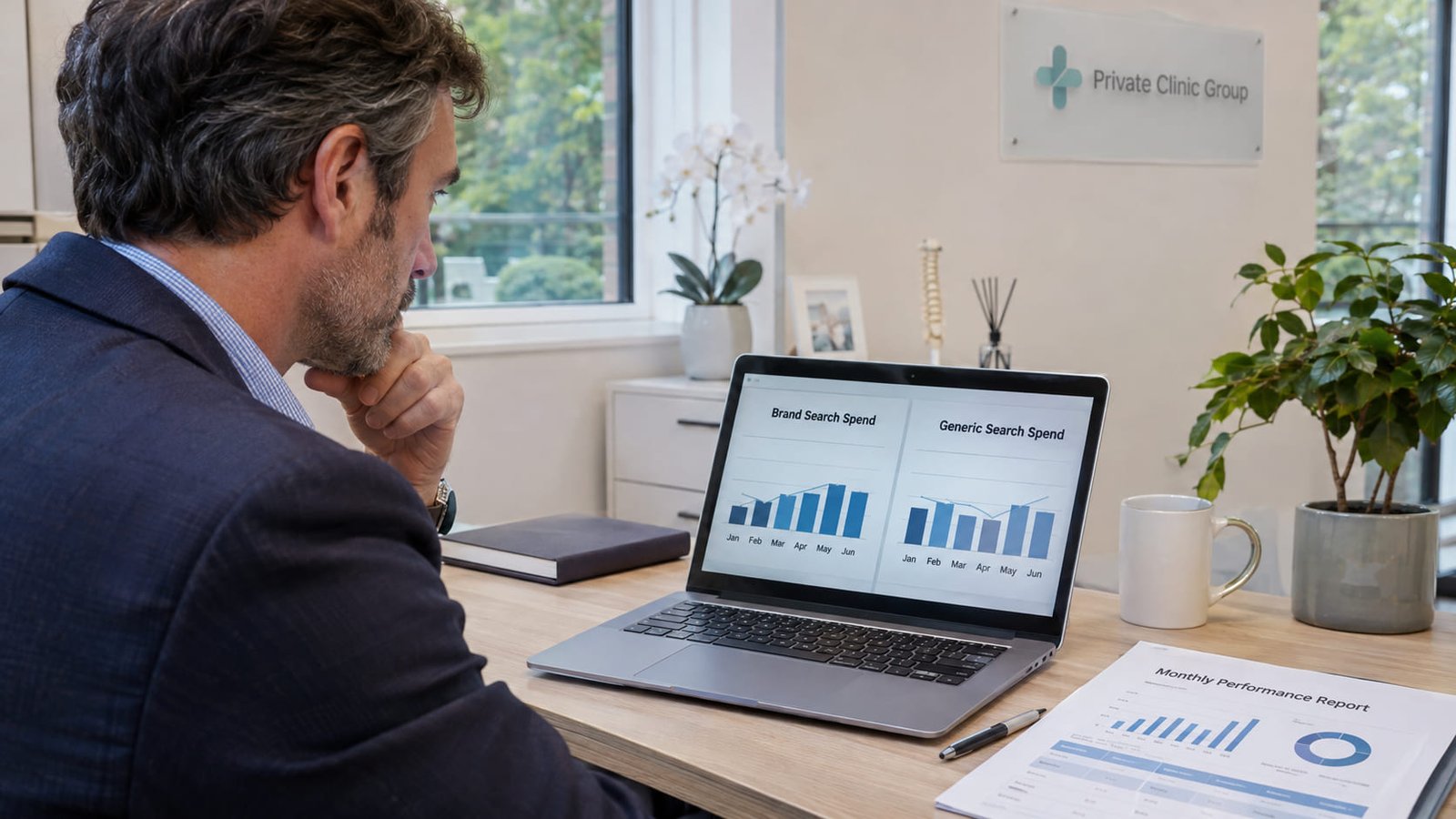
A brand campaign is the best-looking line in any account. The people clicking already know the clinic, so conversion rate is high and cost per conversion is low, and the account average improves every month the brand budget grows. Nothing in that report says how many of those patients would have booked without the ad.
The bidding makes it worse. Maximise conversions is built to get the most conversions “while spending your budget”, so a brand campaign given the same daily budget as generic will look for ways to spend it. Brand searchers convert easily, which is exactly what the strategy rewards.
Nor is an uncontested brand click automatically cheap. When an ad is the only one eligible, Google charges a reserve price set by Ad Rank thresholds, and its own help page warns that “your ad could be relatively expensive, even when no ads show immediately below it.”
Then there is matching. A brand campaign on broad match can drift onto generic searches such as “private scan near me”, while Performance Max and broad generic campaigns pick up the clinic’s name and claim those bookings. Google offers brand inclusions and brand exclusions to keep each in its lane; an account without both cannot say which campaign found which patient.
In ADHD accounts the brand line also collects existing patients. Someone halfway through titration who searches the clinic’s name for its phone number, taps the call button on the ad and talks for a few minutes is a call from an ad that Google counts as a conversion. The report shows a new booking; the diary shows a follow-up the clinic already had.
The fee is the last piece. Where an agency charges a percentage of media spend, every pound on brand raises the invoice as well. That does not make the agency dishonest, but the party setting the brand budget gains from a larger one, so the clinic should see the test that justifies it.
When paying for your own name is worth it
Brand bidding is not always waste. Anyone can bid on a clinic’s name: Google’s trademark policy does not restrict trademarks used as keywords, only certain uses in ad text. When a competitor, a directory or a booking platform appears on searches for the clinic’s name, the brand ad is defending patients already halfway through the door.
Auction insights answers the question for the brand campaign. Read it over 30 to 90 days: other domains with a meaningful impression share mean brand should be funded to hold the top position. A list with no other domain, or only a few with marginal overlap, means the clinic is bidding against itself.
Groups have two more reasons. A new site with no reviews may not rank first even for its own name plus town, and the paid and organic report shows where. When Google sends a search for the clinic in Manchester to the wrong location, a brand ad with the right final URL fixes the route. Both are reasons to fund brand per site, not across the group.
How UpMedico isolates the patients brand ads actually add
UpMedico treats a brand campaign as a hypothesis, not a fixture. The question is how many booked patients it adds that the organic listing would not have delivered, and a group with several sites already has the control it needs to answer it. Five steps, in this order.
Split brand demand cleanly
Brand inclusions on the brand campaign, brand exclusions on Performance Max and every generic campaign, and a monthly read of the search terms report. Until each search lands in one place, no campaign’s cost per booking can be trusted.
Read the auction before setting the budget
Auction insights on brand terms over the last 90 days, plus the paid and organic report once Search Console is linked. If no other domain competes and the site ranks first organically, the brand budget is capped at what exact brand searches actually spend.
Check whether generic search is short of money
Search lost impression share (budget) on each generic campaign shows the share of auctions missed for lack of budget. If it is close to zero, moving money from brand buys little; if it is high, the budget is turning patients away.
Run a site holdout
Switch brand ads off around one or two sites for four weeks and leave them running at the others. Compare brand clicks, paid plus organic, and booked patients per site with the previous four weeks and with the sites still running. A remote ADHD service splits by region instead; a single site compares four weeks off with the four before and the same weeks last year.
Reset the budget on booked patients
Brand keeps the budget the holdout justifies, and the rest moves to the generic campaigns losing most impression share to budget. Bookings return to Google as offline conversions, so every campaign is judged on patients in the diary, new and returning counted apart.
We have run this test on one of our client accounts, where no competitor bid on the clinic’s name and the site ranked first organically. Switching the brand campaign off pushed the account’s average cost per conversion up, because the cheap brand conversions dropped out of the monthly dashboard.
The budget it freed went into high-intent generic searches from patients who did not yet know the clinic. New patients arriving at the clinic rose, and so did total revenue, while the dashboard looked worse than before. That is the trade to expect: a higher reported cost per conversion and more new patients in the diary.
The holdout carries a small risk. If a competitor starts bidding on the name during the test, a weekly search on the clinic’s name and the paid and organic report will show it, and brand goes back on at that site. Testing by site limits the downside to one or two locations for a month, which is why groups can run it and single sites need the longer comparison.
Performance Max needs the same discipline, because it reaches brand searches unless told not to. We set out the wider controls in our Performance Max guide for healthcare providers; brand exclusions are the first of them in any account that also runs a brand campaign.
What £1,000 a month buys when it leaves an uncontested brand campaign
The table sets the published cost per booking for ADHD and scan services against £1,000 a month, next to the public research on how many paid clicks are incremental. Each row carries its source: costs from accounts UpMedico manages, incrementality from Google’s and eBay’s published experiments.
| Metric | Value | Source |
|---|---|---|
| Ad clicks that are incremental when the advertiser holds the top organic result | 50% on average | Google research, 2012 |
| Ad clicks that are incremental with no organic result for the advertiser | 100% on average | Google research, 2012 |
| Short-term benefit of brand keyword ads (eBay field experiments) | None measurable | Blake, Nosko and Tadelis, Econometrica, 2015 |
| Cost per qualified ADHD assessment: London / regional UK | £340 / £275 | UpMedico client data |
| Booked ADHD assessments per £1,000: London / regional UK | About 2.9 / 3.6 | UpMedico working estimate |
| Fee value per £1,000 at the £950 median: London / regional UK | About £2,790 / £3,450 | UpMedico working estimate |
| Cost per booked scan: early pregnancy / pelvic / MSK | £24 to £36 / £78 to £88 / £95 to £118 | UpMedico client data |
| Booked scans per £1,000: early pregnancy / pelvic / MSK | About 28 to 42 / 11 to 13 / 8.5 to 10.5 | UpMedico working estimate |
| Fee value per £1,000: early pregnancy / pelvic / MSK | About £1,940 to £3,960 / £2,610 to £2,950 / £1,860 to £2,320 | UpMedico working estimate |
Read the incrementality rows before the pound rows. They decide how much of the brand budget is free to move at all: none if a competitor is in the auction, about half on Google’s average if the clinic ranks first and nobody else bids, and possibly more if a holdout shows bookings hold.
Then read the pound rows as ceilings. They use average cost per booking, and an extra £1,000 on generic search buys at the margin, usually above the average. The less obvious line is early pregnancy: the cheapest booking but the widest fee range. A group selling mostly £70 scans gains less from the move than one selling £230 pelvic scans, so the service mix decides where freed budget goes.
Which brand calls come from new patients
Brand demand in a clinic group often ends on the phone. In our call tracking data, 58% of ADHD enquiries in London and 47% in regional UK arrive by phone, as do 42% to 58% of ultrasound bookings, depending on the scan. A brand ad with a call button collects existing patients as readily as new ones: rescheduling, results, prescription queries.
The holdout counts bookings; the recordings say who made them. One intake question asked the same way on every call, “Have you been to us before?”, splits brand calls into new and returning patients. The new-patient share is the only part of the brand line worth defending with budget.
The Call-to-Booking Framework™
UpMedico’s Call-to-Booking Framework™ combines healthcare-compliant call tracking, call recording, and structured intake analysis to identify why patient calls fail to convert, improving call-to-booking conversion by up to 20% within 90 days.
Applied to brand spend, the framework turns a conversion count into a patient count. Calls tagged as returning patients come out of the brand campaign’s reported results, and the cost per new patient from brand sits next to the generic figure in the same monthly report.
Recording patient calls means processing data concerning health, which UK GDPR treats as special category data, and a call about an ADHD prescription or a pregnancy scan falls squarely within it. It is configured with a consent message before the call connects, a defined retention period and access limited to the people who need it.
Where those calls fail to book, rather than who makes them, is covered in Why private clinics lose 1 in 3 bookings on the phone, and the setup behind call tracking for clinics in how call tracking drives patient growth. Both start from the same recordings.
What this looks like with UpMedico running your Google Ads
UpMedico manages Google Ads exclusively for private healthcare clinics in the UK and Ireland. Every engagement includes compliant campaign build, keyword-level call tracking and recording, and monthly analysis through our Call-to-Booking Framework™, so you see exactly which keywords produce booked assessments and scans, not just clicks.
If your current agency reports on clicks and impressions but can’t tell you your cost per booked patient, request a 20-minute Clinical Campaign Audit. We’ll show you the gap in your own account.
Frequently asked questions
Should a private clinic bid on its own brand name in Google Ads?
Only when someone else is in the auction or the clinic does not rank first for its own name. Google’s 2012 research found that, on average, only 50% of ad clicks are incremental when the advertiser already holds the top organic result. If auction insights shows no competing domain, cap the brand budget and test it with a holdout before funding it like generic search.
How can I tell if competitors are bidding on my clinic’s name?
Open auction insights for the brand campaign over the last 30 to 90 days. Any other domain listed with a meaningful impression share is competing for your name. Check the paid and organic report too, which needs Search Console linked to Google Ads, to see whether your own site ranks first for the same searches.
Can a competitor use my clinic’s name in their Google Ads?
As a keyword, yes: Google’s trademark policy does not restrict trademarks used as keywords. Ad text is treated differently. The policy restricts a trademark used in an ad from a direct competitor, or in a confusing or misleading way, and the trademark owner can submit a complaint to Google. Where a rival bids on your name, a brand ad is how your clinic competes for the top position.
How do you test whether brand ads bring in new patients?
Run a holdout. A clinic group switches brand ads off around one or two sites for four weeks and compares paid plus organic brand clicks and booked patients with the sites still running. A remote ADHD service can split by region. If bookings at the test sites hold, most of that brand spend was buying patients who already knew the name.