Most private clinics running Google Ads in 2026 are still looking at the wrong numbers.
They count form submissions, phone calls and cost per lead. Then they use those figures to judge whether a campaign is working. The report may look fine, but it often misses the point.
Did those enquiries turn into patients? A form submission does not mean someone booked. A missed call does not mean a consultation happened. And 80 leads in a Google Ads dashboard say little if those people never attended an appointment, paid for treatment or came back to the clinic.
This matters because private healthcare demand is still rising. By March 2026, 7.1 million people were waiting for NHS treatment. At the same time, private healthcare is taking on more demand, with annual admissions moving towards one million treatments.
More clinics are putting budget into paid search to reach those patients. The problem is that many are still feeding Google weak signals.
Without offline conversion tracking, Google cannot separate a £400 cosmetic consultation from a quick price enquiry that never goes anywhere. It simply follows the event you tell it to value.
So if the main conversion is a form fill, Google will try to bring in more form fills. Some will be useful. Others will keep your team busy without ever turning into revenue.
In this guide, we look at how offline conversion tracking for UK clinics works, why it matters for Google Ads performance and how to connect campaign data with real patient outcomes.
⚠️ Before you build: GDPR, ICO guidance and the consent trap
Offline conversion tracking is useful, but in healthcare it needs a stricter setup from the start.
The issue is not the GCLID on its own. The issue starts when that click ID is linked to what happened later in the clinic, for example a booked consultation, an attended appointment or a treatment outcome.
At that point, the data may reveal something about the care a person was looking for. It might show that someone contacted a fertility clinic, asked about a dermatology concern or booked a private GP appointment. For a private clinic, this is much more sensitive than a normal marketing lead.
Under the UK GDPR, health-related data falls under special category data. That means the clinic needs to be clear about:
- what data is collected
- why it is being used for advertising measurement
- how long it is stored
- who can access it
- whether the setup matches ICO guidance
This is where many clinics fall into the consent trap.
A patient may agree to send an enquiry or request a callback. That does not automatically mean they have agreed for their appointment outcome to be used inside Google Ads to improve bidding.
Before importing any offline conversion data, the clinic should review the process with its Data Protection Officer or legal team, update the privacy notice and make sure consent and data retention are handled properly.
Offline conversion tracking for UK private clinics involves handling health-seeking behaviour data, which may qualify as special category data under the UK GDPR. Before building any workflow, review these risks with your Data Protection Officer.
Consent at the collection point. Your privacy notice must inform patients that enquiry data may be used to measure advertising effectiveness. A buried footer link is not sufficient under ICO accountability principles. If your consent mechanism does not cover downstream attribution, importing outcome data to Google Ads is a breach — regardless of whether the GCLID is technically anonymous.
GCLID retention and data minimisation. GCLIDs combined with appointment outcomes may constitute health-adjacent data under Article 9 UK GDPR. Retain GCLIDs only for the length of your attribution window — typically 90 days — apply role-based access controls in your CRM, and document the processing in your Record of Processing Activities (ROPA), as required by the ICO’s accountability framework.
Consent Mode V2 attribution gaps. Patients who decline tracking consent on your landing page generate no GCLID. Consent Mode V2, mandatory since March 2024, models estimated conversions for non-consenting users but does not pass individual data. Your offline import will never be complete. This is expected, compliant behaviour — not a configuration error. Do not attempt to reconstruct non-consented GCLIDs using server-side workarounds, as this creates ICO exposure.
What offline conversion tracking actually does for a UK clinic?
Offline conversion tracking connects the moment a patient clicks your Google Ad with what happens afterwards inside your clinic.
When someone clicks an ad, Google adds a GCLID to the landing page URL. Your website captures that ID and passes it into the booking form or Healthcare CRM when the enquiry is submitted. From there, every later outcome linked to that lead, such as a booked consultation, attended appointment or paid treatment, can be traced back to the original ad click.
That outcome is then sent back to Google as an offline conversion event.
Google can match it to the campaign, keyword and bidding decision that generated the click. Over time, your campaigns stop learning from basic enquiry data and start optimising around real patient outcomes.
The Offline Conversion Tracking Workflow
Offline conversion import closes the loop between the ad click and the actual patient visit — the data Google needs to optimise for outcomes that matter.
What counts as a qualified patient outcome?
For a UK private clinic, each stage of the patient journey should be treated as a separate conversion action in Google Ads, with its own value.
Do not merge everything into one generic event. A form submission, a booked consultation and a completed treatment do not have the same commercial value. Tracking them separately helps Google understand which clicks are actually bringing in patients, not just leads.
Patient Outcome Conversion Hierarchy
Captures intent but contains no quality signal. Includes price enquiries, duplicate submissions, and non-converting visitors. Should not be used as a primary bidding signal.
Patient has selected a date, provided clinical details, and received a booking confirmation. First meaningful signal that the enquiry had genuine clinical intent behind it.
Patient arrived for their consultation. The clearest signal that the ad-driven lead was genuine, qualified, and that your clinic captured real patient value. Import this as your core bidding signal.
For elective procedures, the deposit or payment event. For insured patients, a confirmed pre-authorisation from AXA Health, Bupa, or Aviva. Assign the highest conversion value to this event.
Offline conversion tracking in healthcare: YMYL and E-E-A-T
Healthcare advertising sits in a more sensitive category than most other sectors. Google treats healthcare as YMYL, or Your Money or Your Life, because the information a patient sees can influence real decisions about their health, safety and treatment.
That means a private clinic running Google Ads is not working in the same environment as an e-commerce brand or a local service business. Google looks more closely at healthcare campaigns, from the wording of the ads to the quality of the landing page and the signals used by the bidding system.
Why signal quality matters more in healthcare?
In a YMYL category, weak or misleading signals create a problem. If your campaigns optimise around raw form fills, Google learns from enquiries that may never become patients. Some may be price checks. Others may be duplicated, incomplete or clinically unsuitable.
This gives the algorithm a poor view of what a valuable patient actually looks like.
Offline conversion tracking helps correct that. Instead of training campaigns on basic lead volume, it allows Google to learn from outcomes that matter to the clinic, such as booked consultations, attended appointments and paid treatments.
For healthcare providers, this creates a cleaner feedback loop: Google receives stronger signals, and your campaigns are pushed toward enquiries with genuine clinical and commercial value.
E-E-A-T signals that support your Google Ads account
E-E-A-T stands for Experience, Expertise, Authoritativeness and Trustworthiness. In healthcare, these signals matter because patients need to understand who is treating them, what the clinic offers and whether the provider is credible.
Landing pages connected to Google Ads should show clear proof of trust, including:
- Named clinicians with relevant GMC, GDC or HCPC registration
- Transparent pricing or clear guidance on consultation costs
- CQC references where relevant
- Clear patient pathways, from enquiry to consultation and treatment
- Accurate, medically responsible content that avoids exaggerated claims
Offline tracking and E-E-A-T work best together. One improves the quality of the data sent back to Google. The other improves the trust signals patients and Google see before a conversion happens.
Landing page content that reflects the real patient pathway at your clinic — not generic treatment descriptions. Case-oriented, specific to your service lines.
Named clinicians with GMC, GDC, or HCPC registration numbers visible on pages linked from your ads. Professional profiles, not anonymous team pages.
Citations to credible clinical sources, presence in medical directories (Doctify, TopDoctors, WhatClinic), and links from authoritative healthcare publications.
Accurate pricing information, a transparent complaints policy, CQC inspection reports, HTTPS across all pages, and clear data collection notices that cover GCLID tracking.
Strategy 1: Map your Healthcare Healthcare CRM stages to Google Ads conversion events
The foundation of offline conversion tracking is a clean Healthcare CRM workflow.
Before you configure anything in Google Ads, your practice management system or Healthcare CRM needs to capture and store the GCLID against each patient record. This allows every later stage, from enquiry to booked consultation, attended appointment or paid treatment, to be linked back to the original ad click.
For medical practices with three or more locations, this becomes even more important. A tiered campaign structure usually gives better control than one consolidated campaign. Each clinic location builds its own offline conversion data, so Google can optimise bidding based on the actual performance of each site, rather than averaging everything together.
Assigning conversion values by service line
Using the same conversion value for every service is one of the most common mistakes in multi-specialty or multi-site clinics.
A dermatology consultation, an aesthetic procedure, an orthopaedic pathway and diagnostic imaging do not generate the same revenue. They should not be treated as equal inside Google Ads.
A better approach is to assign values based on the average commercial value of each service line. For example:
- Dermatology consultation: £120 to £200
- Aesthetic procedure: £250 to £450
- Orthopaedic consultation leading to surgery: £500 to £800
- Diagnostic imaging: £80 to £150
These values do not need to be perfect. They need to be proportionally accurate.An aesthetic clinic that assigns £300 to a filler consultation and £800 to a surgical consultation gives Google a much clearer signal than a clinic that assigns £1 to every lead. Over time, this helps smart bidding prioritise the clicks that are more likely to produce meaningful revenue, not just more enquiries.
“In our experience working with UK private clinics, the single most expensive misunderstanding in Google Ads is treating a form fill and an attended appointment as equivalent conversion events. They are not. One is an expression of interest; the other is proof of patient acquisition. Until those two things are separated in your tracking, you are asking Google’s algorithm to optimise for the wrong outcome — and it will do so perfectly.”
Strategy 2: Qualify phone call conversions with UK call tracking
Phone calls are still one of the most important enquiry channels for UK private clinics.
Patients considering surgery, chronic condition management or a clinical procedure they have never had before often want to speak to someone before they book. They may need reassurance, pricing guidance or a clearer idea of the next step.
Form tracking alone does not capture that behaviour, which leaves a major gap in your conversion data.
How NHS and private patient calls differ?
Not every phone call has the same intent. A patient coming from an NHS pathway, for example someone looking for a second opinion or faster access to a private GP, is often earlier in the decision process. Their call may be shorter, more exploratory and less likely to turn into a booking straight away.
A self-pay patient enquiring about an elective private procedure is usually further along. They may have already compared prices, checked treatment options and shortlisted clinics. At that point, the call is often about trust, availability and how responsive your team feels.
This is where UK call tracking platforms such as ResponseTap, Infinity and Mediahawk become useful. They can connect phone enquiries back to the original Google Ads click, so call outcomes can be passed back into Google as offline conversion data.
Why call transcripts matter for private clinic marketing?
At UpMedico, we use WhatConverts as our preferred call tracking platform for UK private clinic accounts.
It does more than connect phone enquiries to the original Google Ads click. WhatConverts also records and transcribes every inbound call, and that transcript layer is where the real value sits.
Our team reviews call recordings alongside transcripts to help clinics understand which enquiries show genuine patient intent and which fall into lower-value categories, such as price comparison, misdials or existing patient admin.
Over time, this analysis also reveals useful patterns in the way front-of-house teams handle enquiries:
- the questions patients ask most often
- the moments where calls drop off before a booking
- the language that helps move a patient from enquiry to appointment
For clinics that want to improve both paid search efficiency and telephone conversion rates, this combination of tracking data and transcript review gives far more insight than duration-based call signals alone.
Setting up call outcome segmentation
A basic “call received” event is not a strong conversion signal. It tells Google that someone called, but not whether that call had any value.
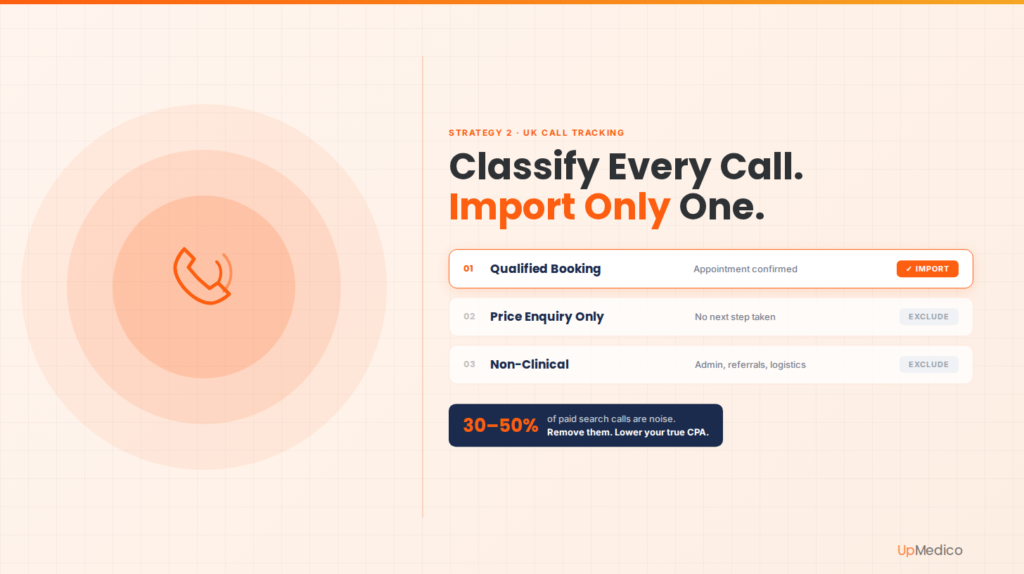
Your front-of-house team or virtual receptionist should classify every inbound call into clear outcome categories, such as:
- Qualified booking, appointment confirmed
- Price enquiry only, no next step taken
- Existing patient or non-clinical, admin, referrals, logistics
Only the first category should be imported into Google Ads as a conversion.
This may make campaign performance look weaker at first, because the platform will report fewer conversions. But the data becomes far cleaner. Instead of optimising for every call, Google starts learning from the calls that actually turn into patient acquisition.
For many clinics, this removes a large amount of noise from paid search reporting and gives a more accurate view of the real cost of acquiring a patient.
Strategy 3: Configure value-based bidding once offline data is flowing
Once your offline conversion events are being imported with assigned values, you can move from lead-based optimisation to value-based bidding.
This is where Target ROAS becomes useful. Instead of asking Google to generate as many conversions as possible, you ask it to optimise toward a specific return on ad spend, based on the value of the conversions it is trying to win.
For example, a UK aesthetic clinic with a £35 median CPA and an average treatment value of £350 could set a Target ROAS of 1000%. In simple terms, that tells Google to aim for £10 in treatment value for every £1 spent on ads.
The setup only works well once there is enough data. Google generally recommends at least 50 conversions per month per campaign before smart bidding becomes stable.
For lower-volume service lines, it is better to aggregate data first, then separate campaigns later once each service has enough conversion volume to support its own bidding model.
“The clinics getting the best results from smart bidding are not the ones with the biggest budgets. They are the ones with the cleanest data. A small aesthetic clinic feeding 40 genuine attended-appointment conversions per month into a Target ROAS campaign will outperform a large multi-site group optimising on form fills every time. The algorithm is only as good as what you give it.”
Offline conversion tracking vs related measurement approaches
Clinic directors sometimes confuse offline conversion tracking with enhanced conversions or standard call tracking.
They are connected, but they do different jobs.
Understanding the difference matters because it helps you decide what to set up first, what data to trust and how to improve your Google Ads performance without adding unnecessary complexity.
Technical enhancements: schema, GA4 alignment and key terms
Start by adding MedicalOrganization schema to your clinic’s main website pages. This should include key details such as the clinic name, medical specialty, address, telephone number and relevant credentials, including GMC, GDC or HCPC registration numbers where applicable.
For location-specific pages, pair this with LocalBusiness schema. This helps Google understand each clinic location as a separate entity, with its own address, phone number, services and local relevance.
If your Google Ads landing pages include FAQs, add FAQPage schema as well. This can help structure your content more clearly for search engines, AI Overviews and answer engines such as ChatGPT and Perplexity.
For healthcare GEO and AI search visibility, GA4 needs to be cleaned up before you start comparing channels.
The first thing to check is naming. If Google Ads imports an offline event called attended appointment, GA4 and your Healthcare CRM should use the same wording or something very close to it.
Otherwise, reporting becomes messy fast. Google Ads may show one set of outcomes, GA4 another, and the Healthcare CRM another again.
A better setup is to build the reporting around the same patient milestones:
- Booked consultation
- Attended appointment
- Completed treatment
That way, the clinic is not comparing random lead metrics across different systems. It is looking at the same patient journey from three angles.
Conversion Tracking Glossary for Clinic Teams
Is offline conversion import compliant with UK GDPR for a private clinic?
Our clinic uses Cliniko or Pabau — can we capture GCLIDs for offline import?
How many conversions do I need before switching to Target ROAS bidding?
Will offline conversion tracking reduce the lead numbers in my reports?
What is the ROI compared with standard Google Ads tracking?
Ready to Track What Actually Matters?
Offline conversion tracking is a long-term patient acquisition asset. UpMedico works with UK and Irish private clinics to build GCLID passback workflows, qualify call conversions, and configure value-based bidding that trains on attended appointments — not noise.
Book a Free Consultation →