The short answer
Most private ADHD clinics in England are not losing enquiries to price. They are losing them to Right to Choose, a legal NHS route to a funded assessment from an independent provider. Enquirers find it after the reception team has already spent time on them. The fix is a pre-qualification step you control: five filter questions on the enquiry form and a ten-minute triage call, both completed before a clinician sees a single patient name.
On this page
- The NHS waitlist shopper your ads keep buying
- The drop-off map: where your ADHD assessment conversion rate breaks
- Five form questions that handle lead qualification before a call
- The ten-minute triage call that fixes ADHD clinic patient intake
- Why the script only works when you can hear it
- What this looks like with UpMedico running your Google Ads
- Frequently asked questions
The NHS waitlist shopper your ads keep buying
The enquiry that costs an ADHD clinic the most is not the one that complains about your fee. It is the one that has not yet discovered Right to Choose.
Under patient choice rules in England, someone can ask their GP to refer them to any clinically appropriate provider holding an NHS contract, at no charge to them. ADHD assessment sits squarely inside that right.
What makes it dangerous is the spread. One national provider quoted a two week wait for an adult assessment in late August 2026. Two weeks later another quoted 20 to 24 weeks on the same route. Same legal right, a five month gap.
Your enquirer does not know which they will land. They do know, within minutes of searching, that a funded option exists. Against that, a median private assessment fee of £950, with one national provider adding £750 for titration, is not a price objection. It is a comparison you were never part of.
Demand is not the problem. NHS England Digital counted up to 959,662 open referrals that may be for an ADHD assessment in June 2026. Your form fills because the queue is real. It converts badly for the same reason.
Our account data puts it at 65% of enquiries reaching a private ADHD clinic coming from people who will find that route before they pay. Not bad leads. Leads nobody qualified, and one question decides them. Background in our guide to growing a private ADHD and autism clinic.
The drop-off map: where your ADHD assessment conversion rate breaks
Map the funnel end to end before you approve another budget increase. Measured across our UK accounts, ADHD clinic lead generation is wide at the top and pinched in one specific place.
Multiply the last two steps and the headline stops being rhetorical. Of the forms that arrive, 48% reach a triage call and 58% of those book, so fewer than three enquiries in ten become an assessment.
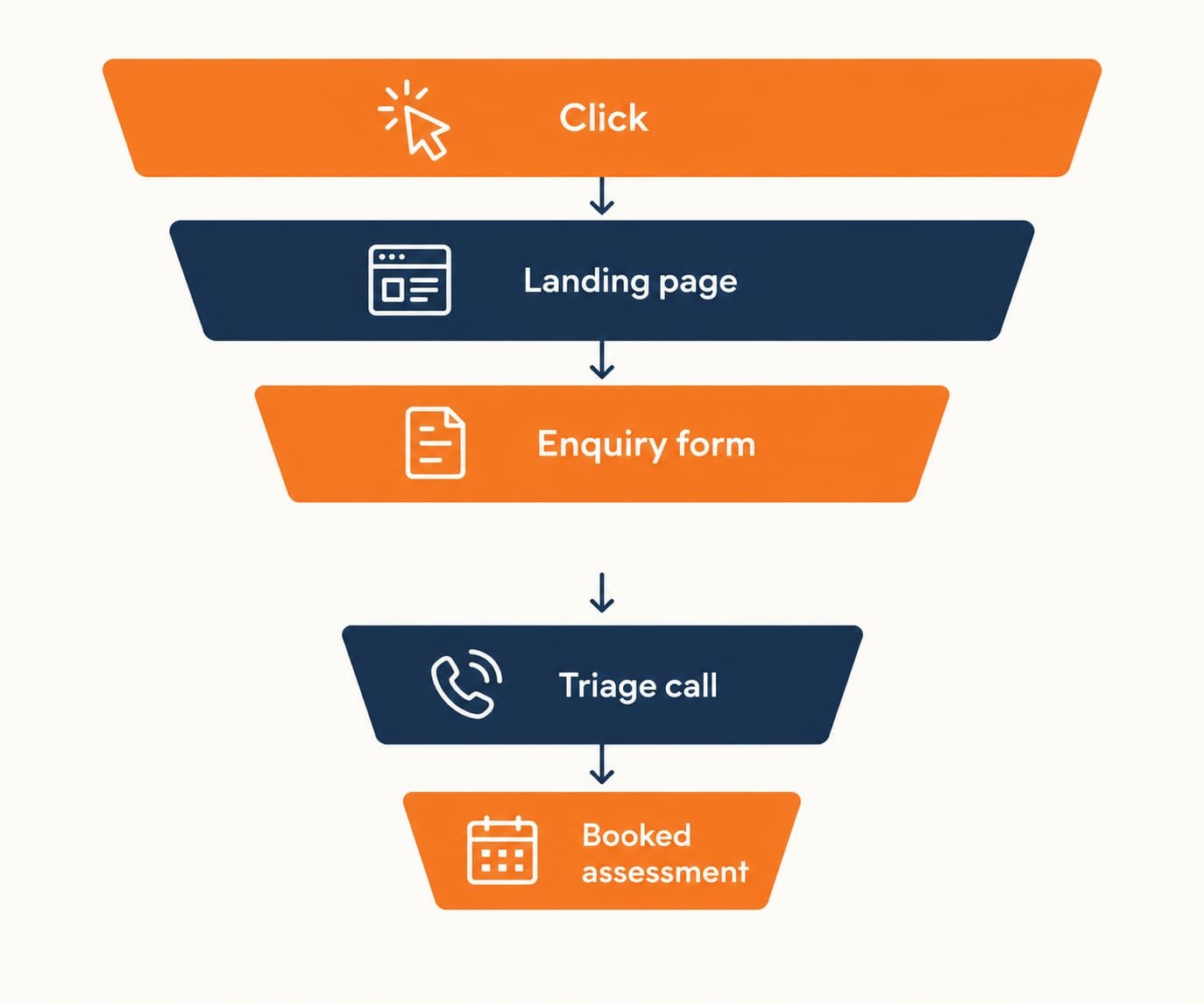
The biggest single loss is between the form and the triage call. Not because the call goes badly. Because there is usually no call at all until the next working day, and the free-route search happens that same morning.
A generalist agency reads that stage as a win. A form fill is a conversion in the Google Ads interface, so the dashboard climbs while the clinical diary stays half empty. The bidding then optimises towards the cheapest form, which is exactly the one a waitlist shopper completes fastest.
Put the leak in sterling. Each unqualified enquiry absorbs roughly 18 minutes of reception and coordinator time, which at the 2026/27 band 3 rate is about £4 of wages before on-costs, spent on somebody who was never going to pay.
Every rate above is drawn from the UK private ADHD clinic growth index, with cost per acquisition by specialty in our healthcare paid search report. Neither replaces your own numbers.
Five form questions that handle lead qualification before a call
Private clinic lead qualification belongs in the form, not the call. Each question below costs you submissions, and that is the point of it.
1. Have you already asked your GP about NHS Right to Choose?
Removes the free-route shopper at zero admin cost. A yes is not a lost patient, it is a patient whose comparison is already running, and the autoresponder can answer it instead of a paid call.
2. Are you aware this is a private, self-funded service the NHS does not cover?
The cheapest question you will ever run. It filters whoever read your ad as an NHS route, and removes the refund conversation that follows a diagnosis somebody assumed was funded.
3. Our assessment is priced at X and titration at Y. Does that match what you planned for?
Price before contact details, not after. Submissions fall. So do the coordinator hours spent revealing, one call at a time, a figure the form could show in three seconds.
4. What is your timeframe for assessment?
Intent, not politeness. Somebody needing a report for an employer, a university or a driving matter by a fixed date is buying speed, which no funded waiting list can promise.
5. Does your GP accept shared care agreements for ADHD medication?
The question nobody asks and everybody regrets. Where a GP declines shared care the patient carries ongoing private prescribing costs, and reads that as something your clinic concealed.
None of the five are clinical and all are answerable in under a minute. Route a failed answer to a short email, not a dead end.
The ten-minute triage call that fixes ADHD clinic patient intake
Ten minutes, run by an administrator, with nothing clinical inside it. A triage call that drifts into symptoms has become a clinical conversation held by somebody not registered to hold one.
Four movements, in order: confirm intent, check budget, fix the timeline, ask for the booking. The booking ask is the movement most reception teams skip, and it is the only one that produces revenue.
What to say
Say the Right to Choose sentence out loud. Ask whether they have looked into it and explain briefly what it involves. This feels like handing away the sale, and sometimes it is. The alternative is losing the same person after three hours of admin and a held clinician slot.
Then name the trade honestly. You are selling a date, not a diagnosis: a slot inside weeks against a route that may run to five months and a titration list far longer than that.
What not to say
No symptom discussion. No view on whether somebody sounds like they have ADHD. No promise of an outcome. The assessment produces the finding, and anything said before it is a claim the clinic has to stand behind afterwards.
Close with the calendar open and a deposit taken on the call. A booking without one is a held slot, and a held slot nobody attends costs exactly what an empty one costs. Our clinic phone script covers the wording your team can adapt.
Why the script only works when you can hear it
Form filters only reach the people who use the form. In London 58% of ADHD enquiries arrive by phone, 47% across regional UK, so more than half your qualification happens out loud.
A script you cannot hear is a script you cannot correct. Every clinic believes its reception team asks the qualifying questions, and the recordings tend to disagree.
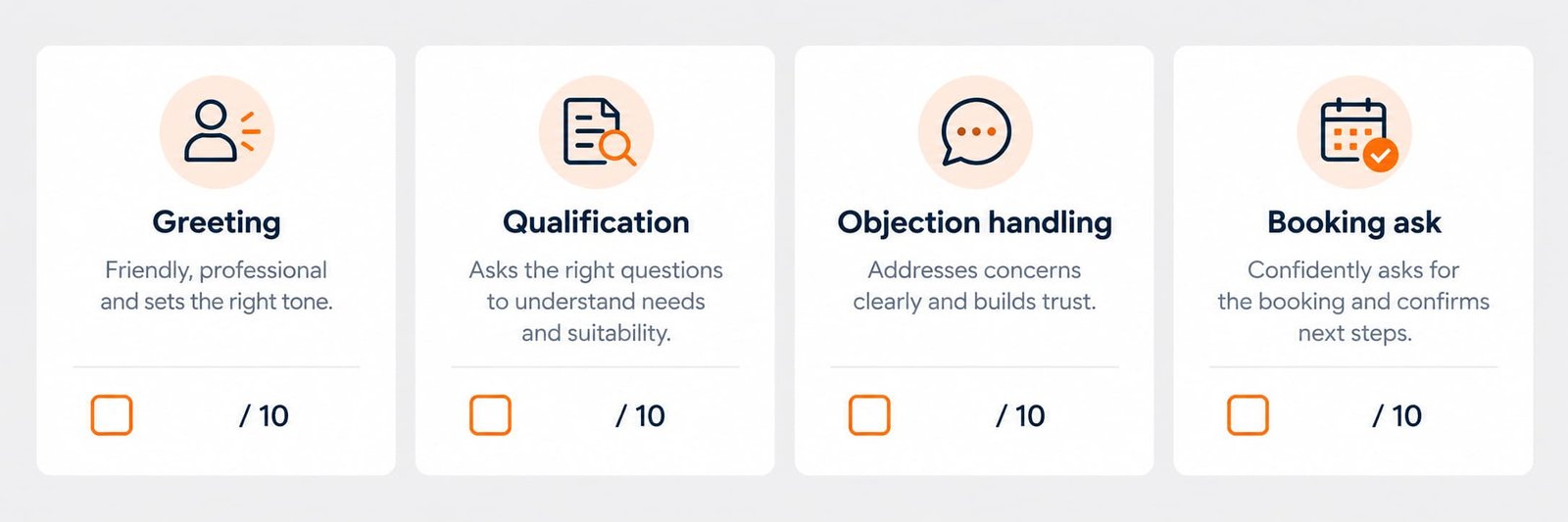
Score each call on four parts: greeting, qualification, objection handling, booking ask. Objection handling is where the money sits, because one objection turns up in nearly every ADHD call and almost no team has a prepared answer for it.
The objection is “is this NHS-funded?”. Listen to ten recordings and the pattern repeats: a pause, an apology, a price, a goodbye. It stays invisible as a training issue until somebody can point at the timestamp. Our note on call tracking for clinics covers the setup.
The Call-to-Booking Framework™
UpMedico’s Call-to-Booking Framework™ combines healthcare-compliant call tracking, call recording, and structured intake analysis to identify why patient calls fail to convert, improving call-to-booking conversion by up to 20% within 90 days.
One compliance point before recording is switched on. A call about an ADHD assessment is health data, which UK GDPR treats as special category, so you need an Article 9 condition alongside your lawful basis and the caller has to be told before recording starts.
What this looks like with UpMedico running your Google Ads
UpMedico manages Google Ads exclusively for private healthcare clinics in the UK and Ireland. Every engagement includes compliant campaign build, keyword-level call tracking and recording, and monthly analysis through our Call-to-Booking Framework™, so you see exactly which keywords produce booked assessments and scans, not just clicks.
If your current agency reports on clicks and impressions but can’t tell you your cost per booked patient, request a 20-minute Clinical Campaign Audit. We’ll show you the gap in your own account.
Frequently asked questions
Four questions clinic founders raise once the triage step is on the table, answered from an intake and advertising standpoint rather than a clinical one.
Does NHS Right to Choose apply outside England?
No. It is an England-only patient choice right, so a clinic advertising into Scotland, Wales, Northern Ireland or Ireland is competing against a different alternative and needs a different qualifying question. Segment by nation at the form stage if your campaigns run UK-wide, because the same triage script will mislead half your callers otherwise.
Should we publish our assessment price on the landing page?
Publishing the fee lowers form volume and raises the share of submissions that survive triage. For a clinic paying per click, cost per booked assessment is the number that decides it, and that figure usually improves when the price appears before the contact fields rather than after them.
Can administrative staff run the triage call, or does it need a clinician?
Administrative staff can run it, provided the call stays on intent, funding, timing and availability. The moment it touches symptoms, likelihood of diagnosis or any advice on treatment, it belongs to a registered clinician, and a documented boundary in the script protects both the patient and the clinic.
Do we need consent to record patient enquiry calls?
Recording a health enquiry means processing special category data under UK GDPR, so a lawful basis alone is not enough and a separate Article 9 condition is required. Callers must be informed before recording begins. Consent is one available route and not always the most appropriate one, so take your own advice on which condition fits.