The short answer
A wrong-week booking is a scan a patient books before her pregnancy is ready for it, such as a heartbeat check before 6 weeks or a 4D scan at 20 weeks. In UpMedico’s working estimate, each one refunded on the day wastes £84 to £109 on a 20-minute slot, with no revenue. The fix is a pregnancy scan booking journey that asks the week first and only offers scans whose window fits the appointment date.
In this article
- 1.What a wrong-week booking costs the clinic
- 2.Why booking journeys built for retail let the wrong week through
- 3.Where wrong-week bookings come from
- 4.How UpMedico builds the week check into the booking journey
- 5.Gestational windows and the cost of a wrong-week booking
- 6.The phone call where nobody asks the week
- 7.Frequently asked questions
What a wrong-week booking costs the clinic
A wrong-week booking is paid for twice before anyone notices it. The clinic has already bought the click that produced it, and it has set aside a slot that the scan cannot use. In the ultrasound accounts UpMedico manages, a booked early pregnancy scan costs £24 to £36 to acquire, as published in the UK Private Ultrasound Clinic Growth Index.
Then the patient arrives. Someone who booked a heartbeat check at five weeks, or a 4D scan at 20, meets a sonographer who cannot give her what the booking promised. The British Medical Ultrasound Society notes that a heartbeat is usually detected by 6 weeks, and an NHS trust that runs its own 4D service says the best results come between 26 and 30 weeks.
UpMedico’s working estimate puts a fully loaded scanner hour at £180 to £220, as set out in The Mid-Week Scanner Deficit. If the clinic books early scans in 20-minute slots, each slot carries £60 to £73 of cost. Add the £24 to £36 of acquisition and a wrong-week booking refunded on the day costs £84 to £109 and earns nothing.
Rebooking keeps the fee and doubles the cost. The clinic gives two slots, £120 to £147 of scanner time, for one early scan at £70 to £95, and the second slot is one a new paying patient could have had.
Some wrong-week scans are never refunded, because the scan goes ahead and settles nothing. When an early scan shows no heartbeat yet, NICE guidance for the NHS is to repeat the scan at least 7 days later before making a diagnosis, or 14 days later if the scan was transabdominal. She waits a week, and the clinic charges for a second scan she did not expect or gives it away.
A deposit does not fix this. It protects a slot against a patient who fails to turn up, not against a booking the journey should never have accepted. The CMA’s consumer guide says “cancellation charges must be a genuine estimate of the business’ direct loss”, and keeping money from a patient the booking form let through is a hard position to defend at the front desk.
Put a number on the month. A £1,750 Google Ads line buys roughly 49 to 73 booked early scans, as set out in our guide to splitting a scan clinic’s marketing budget. If five of those land in the wrong week and are refunded on the day, between one in ten and one in fifteen, the leak is £420 to £547 a month, or £5,040 to £6,560 a year.
A multi-site scan clinic we spoke to this autumn knew the pattern. Patients were booking in the wrong time frame, and each one ended in a refund or a rescheduled appointment. Its new booking system now asks for the week of pregnancy before it shows a slot.
Why booking journeys built for retail let the wrong week through
The advert cannot know how far along she is. Google’s policy on health in personalized advertising lists treatments for pregnancy among its sensitive examples, so no audience setting can sort searchers by week of pregnancy. Some search terms carry the week, such as “8 week scan”. Most, like “baby scan near me”, carry nothing.
The search terms that do carry a week are rarely used either. A query like “gender scan 13 weeks” tells the account exactly which patient is early, and in most generalist accounts it lands on the same page, with the same calendar, as everyone else. The one signal the advert does get is thrown away.
So the week has to be asked somewhere between the click and the slot, and in most accounts nobody asks it. Generalist accounts often send every pregnancy search to one page that lists every scan, with a calendar that wants a name, a date and a time. The patient picks the scan, and the system takes her word for it.
Instant booking made the gap wider. Early pregnancy pages with a live calendar regularly convert at 9% to 11% in our accounts, against an 8.2% average, as set out in Instant Booking vs. Enquiry Forms. Removing the callback also removed the one moment someone asked how far along she was.
Then the measurement goes wrong. Google Ads records the conversion when the booking is made. A refund issued on the day of the scan never reaches the account unless someone uploads a retraction through conversion adjustments, which removes the conversion and sets its value to zero.
Without that step, Smart Bidding learns from bookings that were later handed back. The search terms that produce wrong-week bookings look as cheap as any others, and a Target CPA strategy keeps buying them. The report shows a healthy cost per booking while the diary fills with scans the clinic will refund.
The habit comes from retail, where a product suits any customer on any day and a return goes back on the shelf. A pregnancy scan has a window, and a slot spent on the wrong week does not come back.
Where wrong-week bookings come from
Wrong-week bookings are rarely careless. Most come from one of four honest mistakes, and each one needs a different answer in the booking journey.
The first is counting. Pregnancy is dated from the first day of the last period, not from conception, and Tommy’s spells it out: “Your period and ovulation are counted as the first 2 weeks of pregnancy.” A patient who counts from conception is two weeks further along than she thinks, and a menu sold by window will sell her the wrong scan.
The second is anxiety. Someone with spotting at five weeks wants to see a heartbeat today, and a calendar with a free slot this afternoon will take the booking. The scan that would answer her question is usually a week or two away, and the kindest thing the journey can do is say so before she pays.
The third is excitement. Gender and 4D scans are planned and shared, and the date is often chosen around a weekend or a visit from family rather than the gestation. A 4D scan booked for 20 weeks suits the family diary six weeks before it suits the baby.
The fourth is the blood test. Antenatal Results and Choices explains that NIPT can be performed from 10 weeks, and that before then it is difficult to collect enough cell-free DNA from the sample. A test taken at nine weeks risks a second appointment for the same fee.
Most private menus sell all four kinds of scan side by side. The NHS offers its own scans at 11 to 14 weeks and between 18 and 21 weeks, and a private clinic sells into the gaps around them, which means a single pregnancy can touch five or six different windows before it reaches term.
How UpMedico builds the week check into the booking journey
UpMedico starts from the scan menu, not the keyword list. The first output is a window map: every scan and test the clinic sells, the gestational range it is offered in, its fee, and the date each patient’s window opens. The booking journey and the campaigns are then built to that map, in four steps.
Ask the week before showing a scan
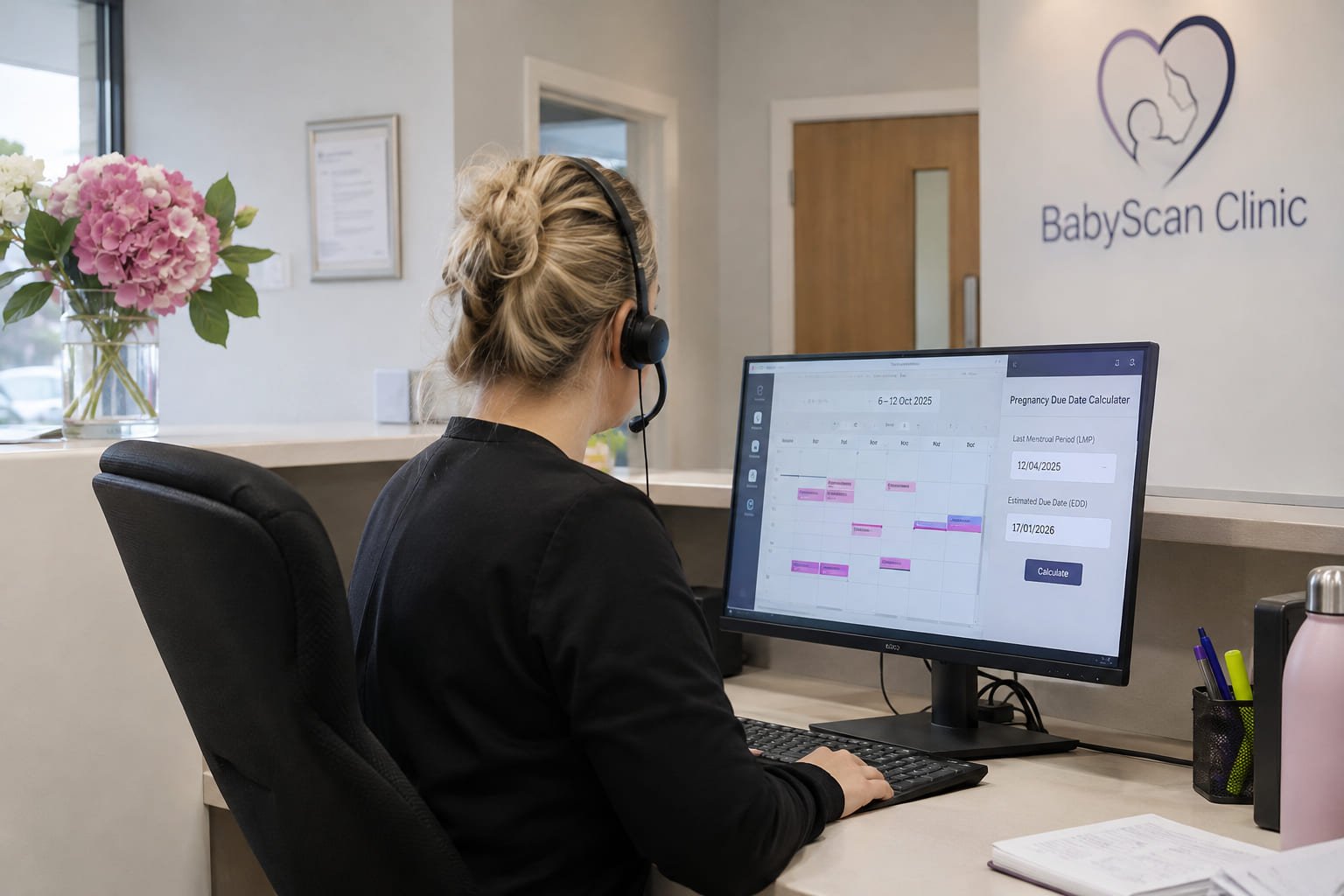
The first question in the online calendar, and on the phone, is the estimated due date or the first day of the last period, held as an administrative field. The system works out the week on the appointment date, because a patient who books at 14 weeks for a slot three weeks away will be 17 weeks on the day. The sonographer confirms gestation at the scan.
Offer the right scan, or the right date
Scans outside the patient’s window stay visible, with the date her window opens and an offer to book her then. A 4D enquiry at 20 weeks becomes a confirmed booking at 26 weeks instead of a refund.
Match each search to a page with its window in the heading
Searches that carry a week, such as “7 week scan” or “4D scan”, land on a page for that scan with the gestational range in the heading. Following ASA guidance, the page says what the scan can and cannot assess at that stage.
Retract refunds so bidding learns from booked scans
Every refund and reschedule is tagged in the booking system with its reason, and refunded bookings go back to Google Ads as retractions. Wrong-week refunds are reported by keyword every month, so the terms that cause them can be cut or sent to a better page.
Sonographers feel the change first. A morning list where every patient is inside her window runs to time, with no awkward conversation in the scan room about a booking that was never going to work. The difficult news, when there is any, is clinical rather than administrative.
The week check adds one field to the calendar. It also feeds what comes after the first scan: the due date captured at booking is the same field that times consented reminders for later scans, as set out in The 3-Scan Patient Pathway, so the question that prevents a refund also books the next scan.
The first scan still has to be bought well, and the early pregnancy scan growth guide covers that campaign. On the search side, the method is the one behind London Private Ultrasound, a central London clinic offering abdominal, pelvic and pregnancy scans, where the rebuilt account produced 603 qualified leads and a 20% increase in total bookings against the previous quarter, with cost per lead down 41% after optimisation.
Gestational windows and the cost of a wrong-week booking
The table sets the public gestational windows a booking journey has to respect next to what a wrong-week booking costs in the accounts UpMedico manages. The windows come from clinical and NHS sources, the costs from our data and working estimates, and every row names its source.
| Metric | UK private pregnancy scanning, 2026 | Source |
|---|---|---|
| Heartbeat usually detected | By 6 weeks | BMUS |
| Repeat scan when no heartbeat is seen | At least 7 days later (14 if transabdominal) | NICE NG126 |
| Earliest NIPT blood test | From 10 weeks | Antenatal Results and Choices |
| NHS scans in England | 11 to 14 weeks; 18 to 21 weeks | NHS |
| Best results for a 4D scan | 26 to 30 weeks | Royal United Hospitals Bath |
| Cost per booked scan, early pregnancy | £24 to £36 | UpMedico client data |
| Average early pregnancy scan fee | £70 to £95 | UpMedico client data |
| Fully loaded cost of one scanner hour | £180 to £220 | UpMedico working estimate |
| Cost of a 20-minute slot | £60 to £73 | UpMedico working estimate |
| Wrong-week booking refunded on the day | £84 to £109, no revenue | UpMedico working estimate |
| Early pregnancy bookings made by phone | 42% | Call tracking data |
Read the wrong-week row against the cost per booked scan before anything else. At £84 to £109, one refunded slot costs as much as acquiring roughly three early scans that were booked correctly, and it is spent in sonographer time the clinic has already paid for.
The table also shows why the cost is easy to miss. None of the clinic’s usual reports carries the wrong-week row: the cost per booked scan looks normal, the fee was taken, and the refund sits in the till rather than the ad account. It only appears when refunds are tagged by reason.
Then read the windows as a set. Five of them fall between 6 and 30 weeks, and a menu that sells into all of them cannot expect patients to know which one applies to them today. The same check has to run on the phone, where 42% of early pregnancy bookings arrive.
The phone call where nobody asks the week
Nearly half of early pregnancy bookings never touch the calendar. In our call tracking data, 42% of early pregnancy scan bookings arrive by phone, and the call is where the week is most often left unasked, because the caller already sounds sure which scan she wants.
The morning makes it worse. Between 9:00 and 11:30, 15% to 20% of inbound calls to ultrasound clinics go unanswered, with peaks of 24%. A receptionist clearing a queue books the slot the caller names and moves on to the next line.
The Call-to-Booking Framework™
UpMedico’s Call-to-Booking Framework™ combines healthcare-compliant call tracking, call recording, and structured intake analysis to identify why patient calls fail to convert, improving call-to-booking conversion by up to 20% within 90 days.
Applied to intake, the analysis scores every recorded booking call on one question: did reception confirm the week of pregnancy before offering a slot? Calls where it was skipped are matched to the refunds that followed, so a script change is judged on the same evidence as a campaign change. Practical wording for reception is in our free clinic phone script.
The recordings also catch what the booking system cannot. A caller at 13 weeks asks for “the gender scan on Saturday” and is offered Saturday at ten. Two days later the refund is logged as an ordinary cancellation, and nothing in the diary or the ad account says the booking was wrong from the start. The call is the only place it shows.
Recording patient calls means processing data concerning health, which UK GDPR treats as special category data, and the week of a pregnancy falls within it. It is configured with a consent message before the call connects, a defined retention period and access limited to the people who need it. The wider case for call tracking in clinics is set out separately.
What this looks like with UpMedico running your Google Ads
UpMedico manages Google Ads exclusively for private healthcare clinics in the UK and Ireland. Every engagement includes compliant campaign build, keyword-level call tracking and recording, and monthly analysis through our Call-to-Booking Framework™, so you see exactly which keywords produce booked assessments and scans, not just clicks.
If your current agency reports on clicks and impressions but can’t tell you your cost per booked patient, request a 20-minute Clinical Campaign Audit. We’ll show you the gap in your own account.
Frequently asked questions
How can a private scan clinic stop patients booking the wrong scan for their stage of pregnancy?
Ask for the due date or the first day of the last period before showing any scan, and work out the week on the appointment date, not the booking date. Show scans outside the window with the date they open and an offer to book then. In UpMedico’s working estimate, a wrong-week booking refunded on the day costs £84 to £109.
How early can a private scan show a baby’s heartbeat?
The British Medical Ultrasound Society says a heartbeat is usually detected by 6 weeks. When an early scan shows no heartbeat yet, NICE guidance for the NHS is to repeat the scan at least 7 days later, or 14 days if it was transabdominal, before making a diagnosis. A booking journey should steer earlier bookers to a later date.
When is the best time to book a 3D or 4D baby scan?
Royal United Hospitals Bath, which runs its own 4D service, says the best results come between 26 and 30 weeks, while there is plenty of fluid around a baby that is still relatively small. A clinic calendar that knows the due date can offer a patient at 20 weeks a confirmed slot at 26 weeks instead of a scan that disappoints.
Do refunded scan bookings still count as conversions in Google Ads?
Yes, unless the clinic tells Google. A conversion is recorded when the booking is made, and a refund issued later only reaches the account if it is uploaded as a retraction through conversion adjustments. Without it, Smart Bidding keeps buying the search terms that produce wrong-week bookings, because they look as cheap as any others.