There were 594,677 live births in England and Wales in 2024, and nearly every one of those pregnancies began with several weeks of waiting. No scan, no heartbeat, no information. That waiting period is the entire commercial basis of a private early pregnancy scan clinic.
Most ultrasound clinic owners already know the demand is there. What they usually do not have is a repeatable system that turns an anxious 2am search into a paid slot on Saturday morning. This article sets out the growth stack UpMedico builds for private scan clinics in the UK, strategy by strategy, with the compliance boundaries that apply to each one.
In this article
- 1.Three compliance risks that can sink an early scan campaign
- 2.Why early pregnancy scan demand behaves differently
- 3.Strategy 1: build the funnel around a 48-hour decision window
- 4.Strategy 2: Google Ads built for early pregnancy scan intent
- 5.Strategy 3: convert the enquiry into a booked slot within the hour
- 6.Strategy 4: own the local and AI search results parents use
- 7.What to measure once the bookings start coming
- 8.Frequently asked questions
Three Compliance Risks That Can Sink an Early Pregnancy Scan Campaign
Early pregnancy scanning is one of the most heavily scrutinised categories in UK private healthcare advertising. Before you spend a pound on acquisition, the three risks below need to be closed off, because a single upheld ruling can force you to pull an entire campaign and rewrite every page it points to.
Why Early Pregnancy Scan Demand Behaves Differently From Every Other Private Service
A patient researching a private dermatology consultation might take three weeks to decide. Someone who has just seen two lines on a test and has spotting at seven weeks does not behave that way at all. The decision window is measured in hours.
The clinical timeline is what creates the gap you sell into. In England the NHS offers the first dating scan at around 10 to 14 weeks, which leaves a two-month gap with no imaging at all. Early miscarriage, meanwhile, affects 10 to 20 in every 100 pregnancies and most of it happens inside those first 12 weeks.
There is also a well-evidenced reason parents want to see a heartbeat early. Tommy’s notes that a study of women with recurrent miscarriage found a 98% chance of the pregnancy continuing once a heartbeat was seen at eight weeks. Your marketing is not creating that need. It is meeting it.
Three practical consequences follow for anyone running a scan clinic:
- Search volume is spiky and personal. It peaks in the evening and at weekends, when nobody is answering the clinic phone.
- First contact usually wins. Parents rarely shortlist four clinics; they book the first one that answers with a clear price and an available slot.
- One booking is rarely one booking. An early scan at seven weeks often becomes a dating scan, a gender scan at 16 weeks and a growth scan later, which changes what you can afford to pay to acquire the first one.
That last point is the one most clinics underprice. If the average patient returns twice, a £35 cost per booking is not a £35 cost per patient relationship, and your bidding should reflect it.
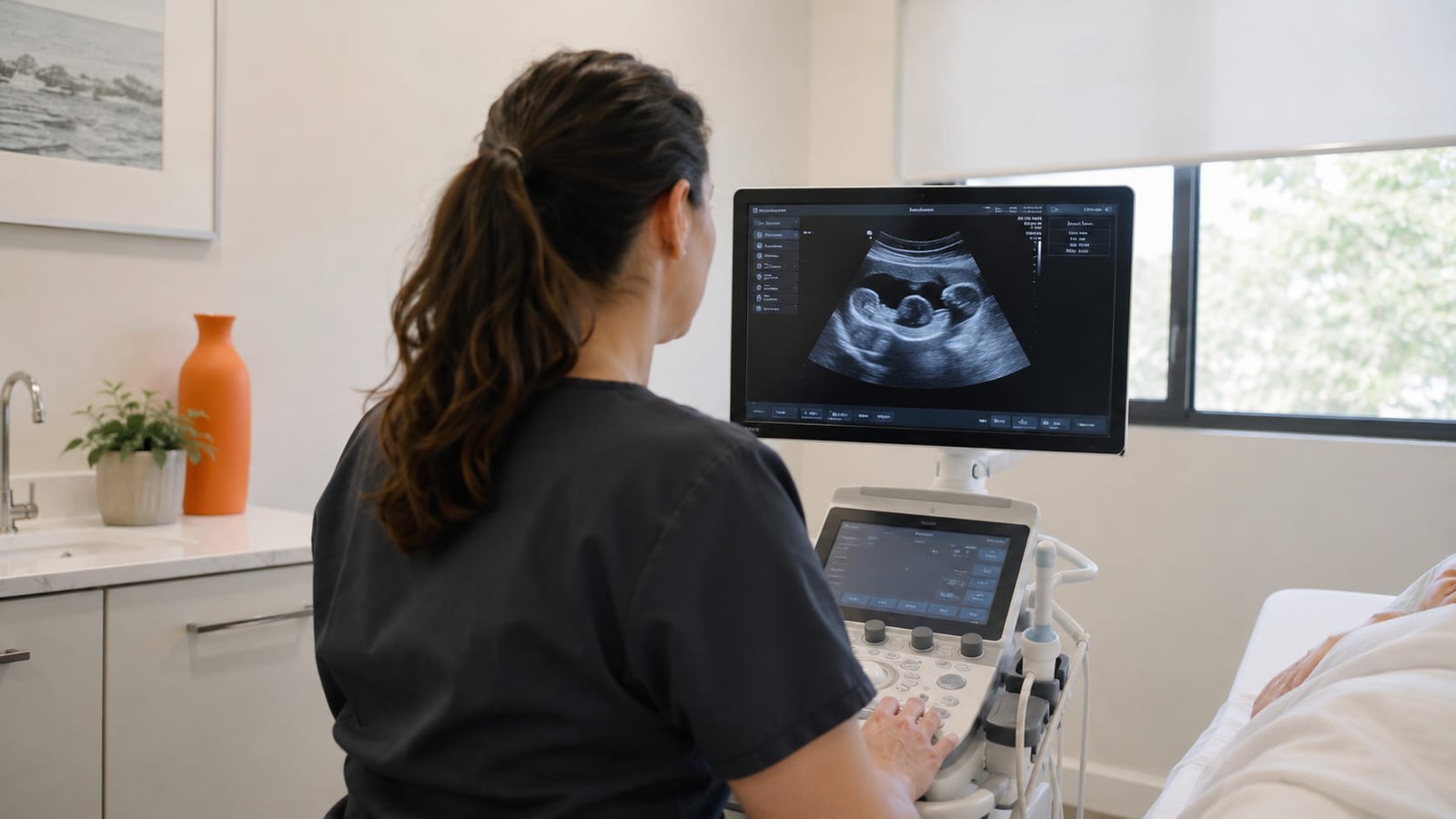
Strategy 1: Build the Booking Funnel Around a 48-Hour Decision Window
This is the five-part booking funnel UpMedico builds for scan clinics, and it starts from a blunt assumption: the visitor will decide within two days and will not read a second page to find your price.
Most ultrasound clinic websites are built the other way round. They open with the history of the practice, list fourteen scan types on one page, and hide the fee behind an enquiry form. Every one of those choices adds friction at exactly the moment the patient has the least patience for it.
Give Every Scan Type Its Own Page
Someone searching “early pregnancy scan 7 weeks near me” and someone searching “private gender scan” want different pages, different prices and different reassurance. Merging them costs you on both queries: the ad relevance drops and the visitor has to work out which paragraph applies to them.
Give each scan its own URL, its own gestation window in the heading, and its own booking button. Our team covers the structural detail in nine landing page practices for doctors, and it applies almost unchanged to scan clinic landing pages.
Put the Price and the Limitations in the Same Eyeline
Publishing your fee is a conversion decision and a compliance decision at once. A visible £99 or £129 price removes the main reason people bounce back to Google, and pairing it with a short, honest note on what the scan assesses at that gestation satisfies the ASA qualification rule in the same block of text.
Clinics often resist this, worried about being undercut. In practice the clinics that publish fees convert far better, because an anxious patient is buying certainty, and a hidden price is the opposite of certainty.
Strategy 2: Run Google Ads Campaigns Built for Early Pregnancy Scan Intent
Paid search is where early scan demand is actually captured, because the searches happen at the exact moment of need and the keywords are specific enough to buy cheaply. A generic healthcare Google Ads template will underperform badly here, and the reason is the mix of queries the account has to separate.
“Early pregnancy scan Birmingham” is a booking. “How early can you see a heartbeat” is a reader. “Free pregnancy scan NHS” is neither. An account that cannot tell those apart burns most of its budget on the last two, which is the single most common problem UpMedico finds when auditing an ultrasound clinic’s existing campaigns.
A worked example makes the economics concrete. Take £1,200 of monthly spend at a £2.40 average cost per click and 500 clicks. At an 11% booking rate that is 55 booked scans, or roughly £22 per booking against a £99 scan fee.
Those figures are illustrative, not promised, and they move with your city and competition. In our experience a typical range for a UK private ultrasound booking sits somewhere between £20 and £40 per booking once the account is properly structured. You can see the approach applied in our Numi Scan Birmingham case study and with London Private Ultrasound.
Want Your Scan Campaigns Reviewed?
See how we structure Google Ads accounts for private ultrasound and pregnancy scan clinics.
Strategy 3: Convert the Enquiry Into a Booked Slot Within the Hour
Acquisition gets the attention, but for scan clinics the biggest single lever is usually response speed. A clinic paying £25 a lead and converting 40% of them is paying £62 a patient; move that to 70% and the same spend buys a patient for £36.
Design the Response Around Evenings and Weekends
Scan enquiries do not arrive during office hours, so a response process that only works Monday to Friday leaks money continuously. The sequence below is the one UpMedico implements with scan clinics alongside the campaign build.
None of this needs new software. A practice management system such as Cliniko or Pabau, a call tracking number and one clear rota will run all five steps, and the gain shows up in your cost per patient within a month.
Strategy 4: Own the Local and AI Search Results Parents Actually Use
Paid search buys the click today. The four assets below are what keep the phone ringing when you pause the budget, and they matter more each year as answers move into AI summaries. Health queries already trigger a Google AI Overview 43% of the time.
Write the Questions Parents Ask, Not the Keywords You Bid On
The searches that feed AI answers are conversational: how early can a scan detect a heartbeat, is a private scan at six weeks too early, what happens if nothing is seen. Answer each one on its own page, with a named sonographer and a review date, and you become the source those systems quote.
This is standard healthcare SEO work extended into generative engine optimisation, and it compounds. Pages written this year are still being cited two years later, which is not true of any ad you run.
Scan Pages That Convert on a Phone at 11pm
We design landing pages for UK clinics with pricing, availability and compliance built in from the start.
What to Measure Once the Bookings Start Coming
Most scan clinics measure enquiries. Enquiries are a poor proxy, because a clinic with a slow phone and a clinic with a fast one can generate identical enquiry counts and completely different revenue. Measure booked, attended, paid scans instead.
The checklist below is what UpMedico works through with scan clinics at the end of the first quarter. Anything left unticked is usually where the money is going.

Frequently Asked Questions
Growing an early pregnancy scan clinic is not a traffic problem. It is a sequencing problem: compliant pages, campaigns that separate booking intent from research, a response process that works at 9pm on a Sunday, and measurement that counts attended scans rather than form fills.
If you want to see how this works for other UK clinics, our insight hub and compliance FAQs cover the detail, and we work with private clinics across the UK. Start with whichever of the four strategies above is weakest in your clinic today.
Ready to Fill More Scan Slots?
Book a call with UpMedico. No fluff, no sales pitch, just honest feedback on your current setup.