More health-related searches now happen directly on AI platforms and healthcare queries on Google increasingly trigger an AI Overview before patients reach the traditional organic results.
For UK and Irish private clinics, this is already changing how patients find, compare and choose healthcare providers online.
Generative Engine Optimization (GEO) is the process of making your clinic more likely to appear, be referenced and be trusted inside AI-generated answers.
This glossary explains what GEO means, how it works in healthcare marketing and why private clinics that ignore it risk losing visibility to competitors already building authority in AI search.
What Does GEO Stand For? A Definition for Private Clinics
GEO stands for Generative Engine Optimization. The word “generative” refers to large language models (LLMs), the technology behind tools such as ChatGPT, Perplexity AI, Google’s AI Overviews and Microsoft Copilot.
These tools work differently from traditional search engines. Instead of showing users a ranked list of links, they generate direct answers based on the sources they understand, trust and decide to reference.
For private clinics, this shift matters. SEO helps your website appear in organic search results. GEO helps your clinic appear inside the AI-generated answer itself.
That difference can affect how patients choose a provider. Someone searching for “best private dermatologist in Manchester” or “private fertility clinic Dublin” may read the answer in ChatGPT, Perplexity or Google’s AI Overview and form an opinion before visiting any website.
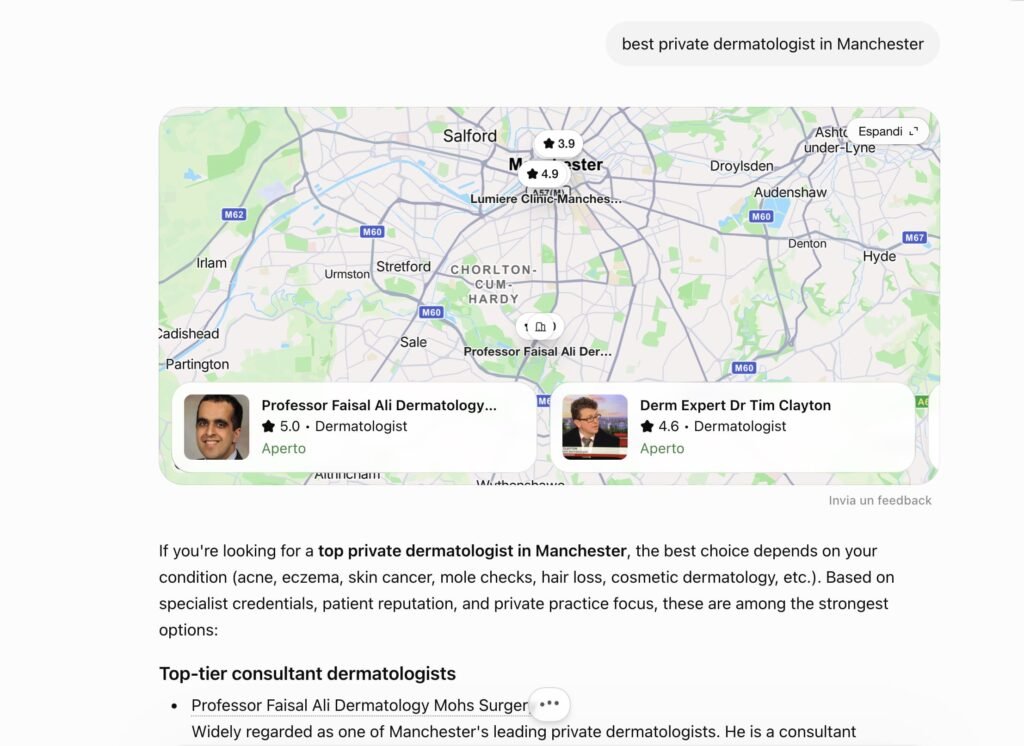
The clinic mentioned in that answer is likely to enter the patient’s shortlist first. Clinics listed further down the page may receive less attention, even when their organic SEO is strong.
How Does GEO Work for Healthcare Providers?
GEO for healthcare providers works differently from traditional SEO. Search engines mainly evaluate pages through signals such as links, keywords, technical structure and on-page optimisation.
AI engines work in a different way. They are designed to generate answers that feel accurate, useful and trustworthy. In healthcare, that standard is much higher because the content can influence patient decisions. For this reason, AI systems look closely at source credibility, clinical accuracy and regulatory compliance.
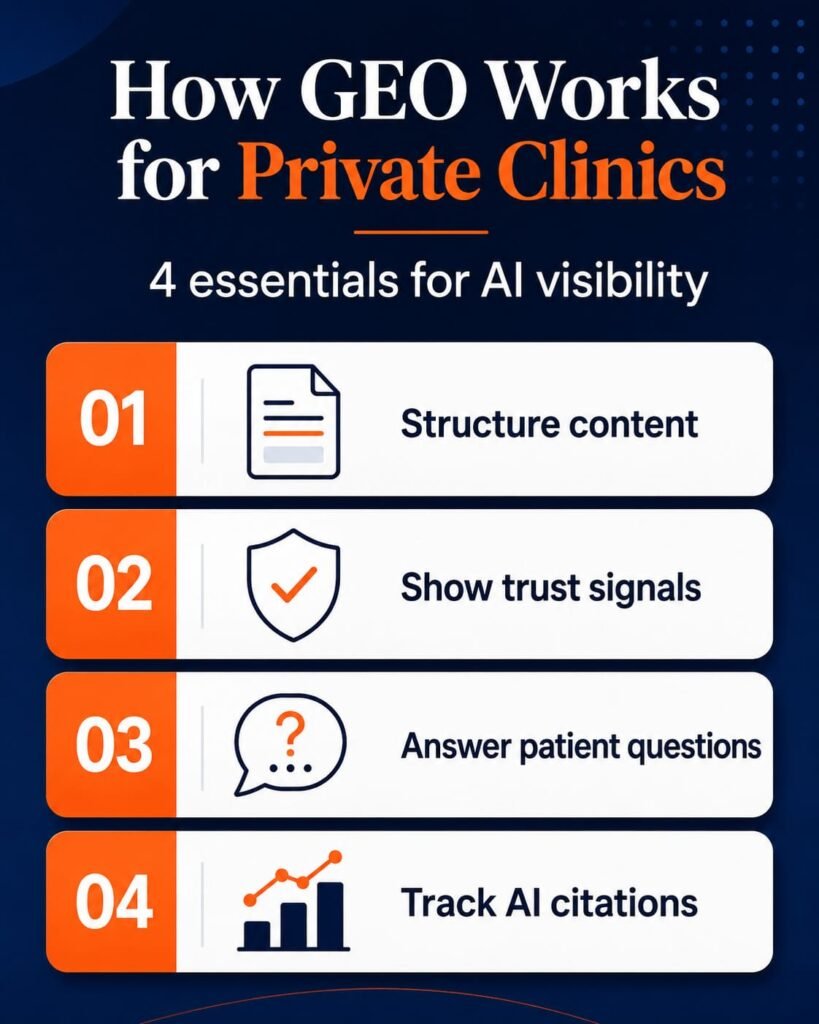
For private clinics, appearing in AI-generated answers usually depends on four connected steps.
GEO is an ongoing programme — AI models retrain frequently, so citation patterns shift over time.
Step 1: Structure Your Content for Extraction
AI models need content they can read, understand and summarise with confidence.
That means your pages should include short answer paragraphs below clear headings, FAQs with direct question-and-answer formats, numbered steps, summary tables and concise definitions.
Long blocks of unbroken text are harder to extract from. Each page should begin with a clear, jargon-free explanation of the topic, then move into more detailed guidance.
This follows the same pattern AI systems often use when building answers: answer first, context second.
Step 2: Embed Trust Signals Visibly on the Page
Healthcare content is judged more carefully because it falls into the YMYL category, meaning it can affect a person’s health, finances or safety.
AI engines look for visible trust signals before citing a page. These include named clinicians, professional credentials, GMC or GDC registration numbers where relevant, institutional affiliations, author bios with verifiable qualifications and clear sources for statistics or clinical claims.
A clinic page may perform well in traditional search, but if these signals are missing, it is less likely to be selected for AI-generated healthcare answers.
Step 3: Align Content With Conversational Query Patterns
Patients do not usually speak to AI tools in short keywords. They ask full, specific questions.
Instead of searching only for “dermatologist Manchester”, a patient may ask: “What is the best private dermatologist in Manchester for acne scarring?” or “How do I choose a private fertility clinic in Dublin?”
This is why GEO needs content built around conversational intent, not keyword density alone.
Patients do not search in the same way when they use AI tools. They ask longer, more specific questions, often while comparing clinics, checking treatment risks or deciding whether to book a consultation.
For this reason, clinic pages need to answer the real questions patients are likely to ask. That means covering practical concerns, eligibility, risks, costs, recovery times, clinician experience and what happens before and after treatment.
Long-tail healthcare queries are also more likely to trigger AI Overviews than short searches, so patient-led questions should be part of the content strategy from the start.
Step 4: Monitor AI Citations and Iterate
Traditional SEO can be tracked through rankings, impressions and clicks in tools such as Google Search Console. GEO needs a different approach.
Clinics need to check whether their pages are being cited in ChatGPT, Perplexity, Google AI Overviews and other AI search experiences.
Tools such as BrightEdge, Semrush AI Toolkit and specialist GEO platforms can help track where a clinic appears, which pages are being cited and which competitors are being referenced instead.
For healthcare providers, GEO works best as an ongoing content programme. The goal is to keep improving the clinic’s visibility, authority and citation potential as patient search behaviour changes.
Types of GEO for Private Clinics
GEO is not a single tactic. For private clinics, it includes several areas that affect how AI engines understand, trust and cite healthcare content.
Each area supports a different part of the citation process: how information is written, how it is structured, how credibility is shown and how consistently the clinic appears across the web.
In healthcare, the requirements are stricter than in many other sectors because clinics need to account for GMC or GDC credentials, CQC compliance and ASA-regulated claims.
Citation Optimisation
Citation optimisation focuses on making your content easier for AI engines to trust and reference.
Research from Princeton University found that pages including direct quotations from credentialed sources gained 41% more AI visibility, pages with statistics gained 32% more, and pages with explicit citations gained 30% more.
For UK private clinics, this means adding sourced statistics, quoting named consultants and referencing trusted clinical guidance, such as NICE, GMC or CQC material, directly within the page content.
These references should not sit separately as afterthoughts or footnotes. They need to be woven naturally into the main body text, where AI models can identify, extract and use them in generated answers.
Structured Content and Schema Optimisation
AI engines process structured information more reliably than loose, unorganised prose.
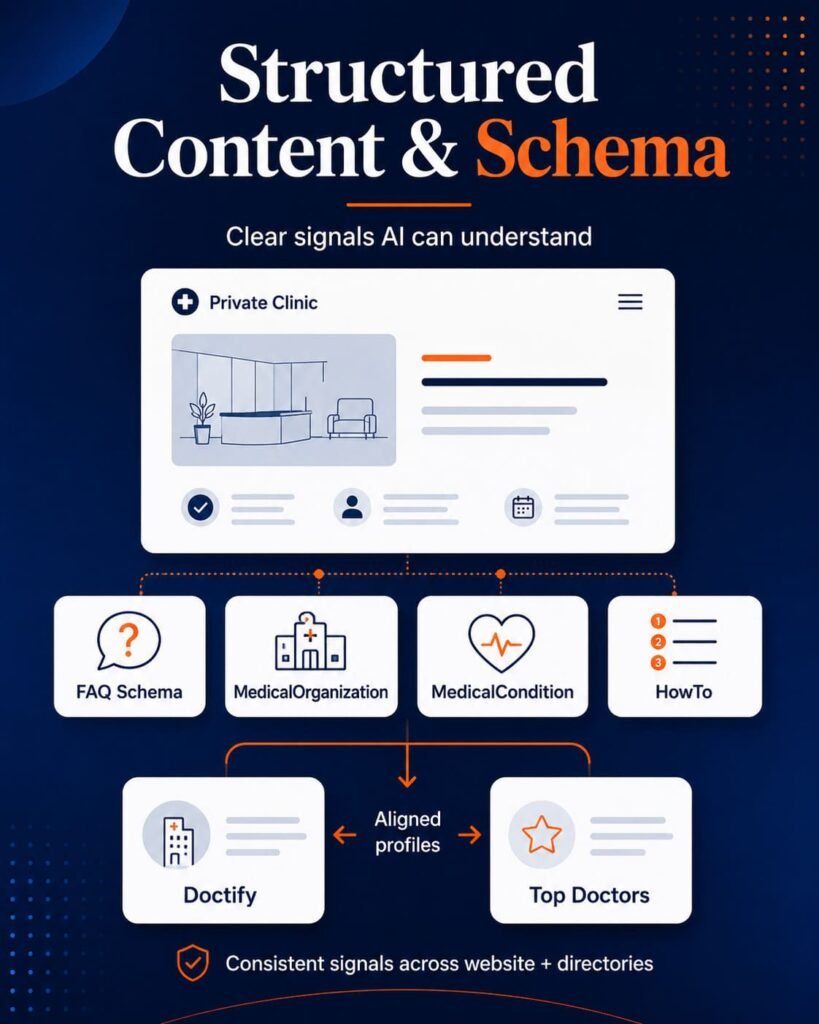
This is where schema markup becomes important. FAQ schema, MedicalOrganization schema, MedicalCondition schema and HowTo schema help signal what a page is about and how its content should be interpreted.
For private clinics, structured content should also extend beyond the clinic website. Profiles on platforms such as Doctify and Top Doctors should use descriptions that match the tone, terminology and service information used on the main website.
This creates more consistent signals across different domains and helps AI systems connect the clinic, its clinicians and its services more clearly.
Entity and Authority Building
AI engines do not only read pages. They also interpret clinics and clinicians as entities, meaning structured representations of real-world people, businesses and organisations.
A clinic becomes easier to trust when its core details appear consistently across reputable sources. This includes the clinic name, address, phone number, clinician names, specialisms and credentials.
Entity GEO involves checking that this information is aligned across Google Business Profile, NHS directories, medical associations, WhatClinic, private healthcare directories and relevant local press mentions.
For clinics, this external footprint matters because AI systems use repeated, consistent signals to understand whether a healthcare provider is credible, established and relevant.
UpMedico’s healthcare marketing team supports clinics with this authority-building process as part of broader GEO programmes.
Conversational and Voice GEO
More patients now use AI tools in a conversational way, including through voice search, Siri, Google Assistant and dedicated AI devices.
Conversational GEO adapts content to the way patients actually ask questions. That means using natural phrasing, direct questions, concise answers and patient-led wording.
A page may rank well for a keyword such as “rhinoplasty London”, but still fail to appear when someone asks: “Where can I get rhinoplasty in London without a long wait?”
Conversational GEO helps bridge that gap through dedicated Q&A content, podcast transcripts, interview-style articles and service pages that reflect spoken search behaviour.
For private clinics, this is especially useful because many patient searches are specific, personal and decision-led. The closer your content gets to those real questions, the more useful it becomes for AI-generated answers.
Private clinics that only think about GEO at the page level are missing most of the opportunity. The clinics winning in AI search have built authority at the entity level: their clinicians, their location, their specialism, so that AI models can speak about them with confidence, not just cite a page.
GEO in Healthcare: YMYL and E-E-A-T Explained
Healthcare content sits in a special category for both Google and AI engines. This matters because it affects whether your clinic’s pages are considered trustworthy enough to appear in AI-generated answers.
YMYL: Your Money Your Life
Google classifies health content as YMYL, which stands for “Your Money or Your Life”. This category includes topics where inaccurate or misleading information could affect a person’s health, safety or financial wellbeing.
Because of this, healthcare content is judged against a much higher quality standard than lifestyle, travel or entertainment content.
For private clinics, the implications are clear. Every clinical claim on your website needs to be accurate, sourced and aligned with current medical guidance. General statements, vague promises or unsupported treatment claims are much harder for AI systems to trust.
AI engines are trained to favour sources that show clear evidence of credibility. In healthcare, that means content should include named specialists, relevant qualifications, clinical references, review dates and transparent information about who wrote or reviewed the page.
This is especially important for treatment pages covering areas such as cosmetic surgery, fertility, dermatology and orthopaedics. Pages without named clinicians, GMC or GDC registration details, and a clear clinical review process are less likely to be selected for AI-generated healthcare answers, even if they still perform reasonably well in traditional organic search.
E-E-A-T: Experience, Expertise, Authoritativeness, Trustworthiness
Google’s E-E-A-T framework is the quality model used to assess whether a page is reliable enough for sensitive topics. AI engines apply similar signals when evaluating healthcare content.
For private clinics, E-E-A-T means showing that your content is written, reviewed and supported by people with real clinical knowledge.
GEO vs SEO vs AEO vs PPC: What Matters for Private Clinics?
Clinic directors often come across GEO, SEO, AEO and PPC when planning their digital marketing strategy. These terms are connected, but they do not mean the same thing.
Each one supports patient acquisition in a different way, with its own cost structure, timeline and visibility model.
| Channel | Full Name | Where It Appears | Cost Model | Typical Timeline |
|---|---|---|---|---|
| GEO | Generative Engine Optimization | ChatGPT, Perplexity, Google AI Overviews, Gemini, Copilot | Content investment; no per-click cost | 3–6 months to citation activity |
| SEO | Search Engine Optimization | Google, Bing organic ranked results | Content + links investment; no per-click cost | 6–12 months to ranking momentum |
| AEO | Answer Engine Optimization | Featured snippets, People Also Ask, voice results | Overlaps with SEO and GEO investment | 2–4 months for featured snippets |
| PPC | Pay-Per-Click (Google Ads) | Google Ads results above organic listings | Cost per click; stops when budget stops | Immediate visibility; ongoing spend |
Why GEO Matters More for Private Clinics in 2026?
For private clinics, GEO is becoming a central part of patient acquisition. AI-generated answers are now shaping how people search for treatments, compare providers and decide which clinic to contact.
The AI Overview effect
Treatment and procedure searches increasingly trigger AI Overviews on Google. When a clinic is referenced in that answer, it receives an immediate trust signal before the patient has even visited a website.
This matters because the patient’s first impression is often shaped by the AI-generated summary. The clinic mentioned in that answer enters the decision process early, while clinics listed only in the organic results below may receive less attention.
Clinics cited in AI Overviews tend to attract more clicks than competitors shown only in traditional results. Clinics that are missing from AI answers risk losing visibility at the exact moment patients are comparing providers and deciding who to contact.
For clinics that rely on inbound enquiries, working with a specialist healthcare GEO agency is becoming a practical way to protect and grow visibility in AI-led search.
Zero-Click Searches
A growing share of Google searches now ends without a website visit. Patients read the AI summary, find the information they need and move on.
This is where zero-click search becomes a real challenge for private clinics. If your clinic is not mentioned in the answer, the patient may never reach your website, even if your page ranks well below the AI box.
GEO addresses this by improving the chances that your clinic’s name, services, authority signals and contact path appear within the answer the patient actually reads.
Patient Acquisition at Scale
AI-referred traffic is growing quickly and healthcare is one of the sectors most affected by this shift.
For private clinics, even a small increase in qualified visibility can have a meaningful commercial impact. A new patient may be worth hundreds or thousands of pounds in lifetime revenue, depending on the specialism, treatment pathway and follow-up care involved.
This is why GEO should not be treated as an experimental add-on. It is becoming part of the same acquisition strategy as SEO, paid search, local search and conversion tracking.
Clinics that build AI visibility now are more likely to appear where patients are already searching. Clinics that delay may find that competitors have already become the trusted sources AI engines prefer to cite.
The clinics that act on GEO now are building a compounding asset. Every well-structured page, every clinician bio and every cited statistic becomes a signal that accumulates over time. In twelve months, that compound effect could be the difference between being the clinic AI systems recommend and being the clinic patients have never heard of.
⚠️ GEO Compliance Risks for UK Private Clinics
Three compliance risks you must address
Optimising for AI visibility does not reduce a clinic’s compliance obligations. It adds another layer of responsibility. These are three risk areas that can create issues for UK private clinics if they are not reviewed properly.
Frequently Asked Questions About GEO for Private Clinics
-
What is the difference between GEO and SEO?SEO focuses on your clinic’s position in the ranked list of links in Google and other search engines. GEO focuses on getting your clinic’s content cited within AI-generated answers, including the summaries that appear above those links on Google and the responses generated by ChatGPT, Perplexity and Gemini. Both share some foundations, but GEO places more emphasis on direct quotations, named clinical authors, schema markup and conversational content formats that AI systems can extract reliably.
-
How long does GEO take to produce results for a private clinic?Most clinics begin to see measurable AI citation activity within three to six months of a structured GEO programme. Entity-level signals, including consistent business listings, clinician profiles and medical directory entries, often build faster than content-level signals. Clinics with an established SEO foundation usually see GEO results at the lower end of that range.
-
Is GEO for healthcare subject to different rules than other industries?Yes. Healthcare content is classified as YMYL, meaning Your Money or Your Life, by Google, and AI engines apply a higher quality threshold to this type of content. Healthcare GEO requires named clinician authorship, explicit clinical citations, GMC or GDC registration details where relevant, ASA-compliant claims and CQC-consistent service descriptions.
-
What GEO metrics should a clinic director actually track?The most useful GEO metrics are AI citation frequency, share of voice in AI answers for target queries, branded AI search impressions and AI-referred sessions in Google Analytics 4. Traditional keyword rankings remain relevant for SEO, but they do not capture AI visibility directly.
-
Does Google penalise clinics for using AI-assisted content in GEO programmes?Google does not penalise AI-assisted content simply because AI was used in the production process. The problem is low-quality, inaccurate or manipulative content. In healthcare, AI-assisted content should be medically reviewed by a named clinician, accurately sourced and genuinely useful to patients. The critical requirement is human clinical review before publication.
-
What is the ROI of GEO compared to Google Ads for private clinics?Google Ads delivers immediate, measurable traffic at a cost per click. GEO builds compounding AI visibility with no direct per-click cost, but it takes longer to produce results. The return on GEO investment usually becomes more meaningful after six to twelve months. Most clinic directors benefit from running both: Google Ads for immediate patient acquisition and GEO for long-term presence in AI search.
Conclusion: GEO Is Now Essential for Private Clinic Growth
GEO is no longer something private clinics can leave for next year.
AI-generated answers are already changing how patients search, compare and choose healthcare providers. As more healthcare queries trigger AI Overviews and AI-referred traffic continues to grow, the gap between clinics with GEO-optimised content and those without it is becoming more visible.
Every time an AI model is updated or retrained, clear, well-structured and credentialed pages have more opportunities to build citation authority.
Pages without visible trust signals, structured answers or clinical review are harder for AI engines to reference, especially in healthcare.
Waiting makes the work harder later. It gives competitors more time to become the clinics AI systems recognise, trust and cite.
For more healthcare marketing glossary terms, visit the UpMedico insights hub.
To discuss a GEO programme for your clinic, book a consultation with the UpMedico team.
Ready to Put GEO to Work for Your Clinic?
GEO is a long-term patient acquisition asset. UpMedico works with UK and Irish private clinics to build AI-cited authority that compounds over time.
Book a Free Consultation →