For private clinics, search engine optimisation can be one of the most cost-effective ways to generate new patient enquiries. Yet many clinic directors still find it difficult to define clearly or explain what it actually involves. That matters because a large share of patients now turn to Google and other search engines before choosing a provider, comparing treatments, or deciding whether to book. Clinics that appear prominently in those search results are far more likely to be considered.
This glossary is designed to give UK and Irish private clinic directors a practical understanding of SEO in a healthcare setting. It explains the key terms in plain English, from the meaning of the acronym itself to the way SEO works in a sector where trust, accuracy and compliance matter as much as visibility.
What Does SEO Stand For?
Search Engine Optimisation is the full term behind SEO. In American English, it is written as “Search Engine Optimization”, but the meaning is exactly the same. For UK and Irish clinics, the British spelling is the right one to use.
Put simply, SEO is the process of improving your website and wider online presence so that search engines are more likely to show your pages for relevant searches. The key point is that these are organic results, meaning unpaid listings. You are not paying Google to appear there. Instead, your pages earn visibility because the search engine considers them useful, trustworthy and well put together from both a content and technical point of view.
That is what separates SEO from paid search. With paid search, you bid for ad space. With SEO, you are trying to earn your place in the organic results. Those listings usually sit below the ads and often carry more trust with patients. According to BrightEdge, 53% of all website traffic globally comes from organic search, which helps explain why it remains such an important channel for healthcare websites.
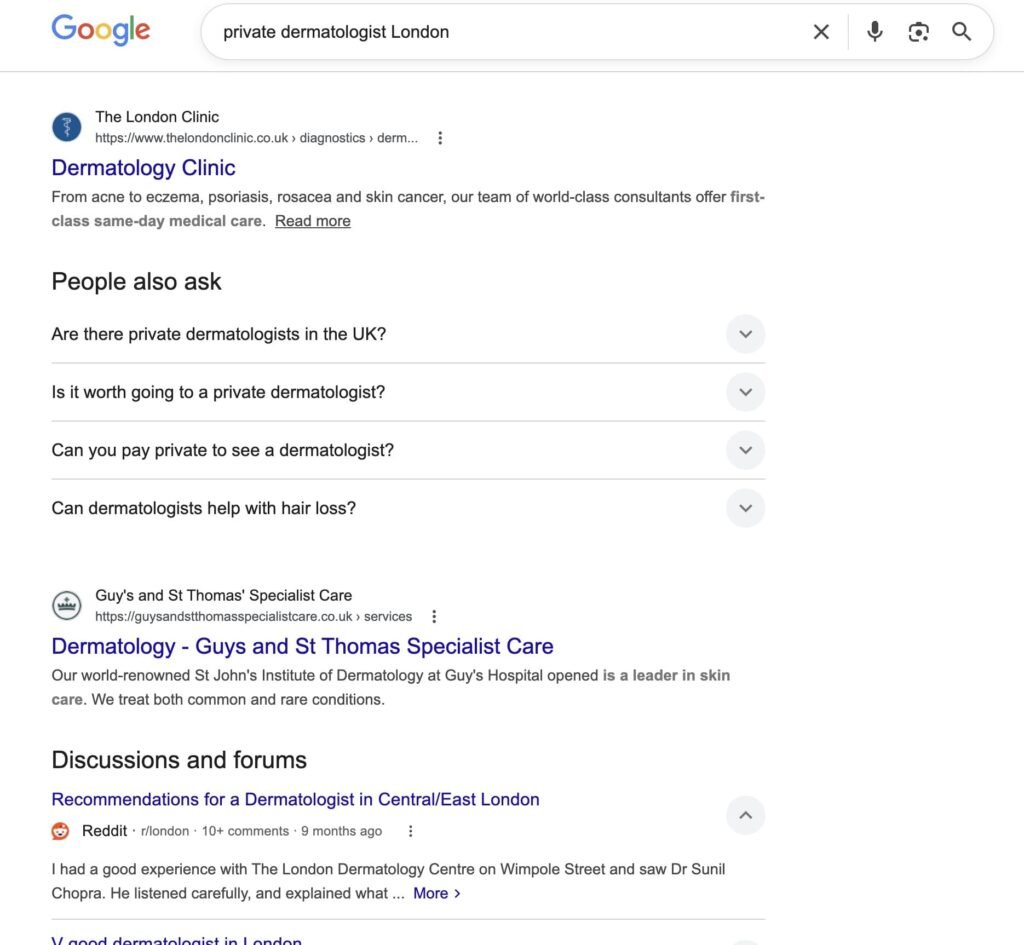
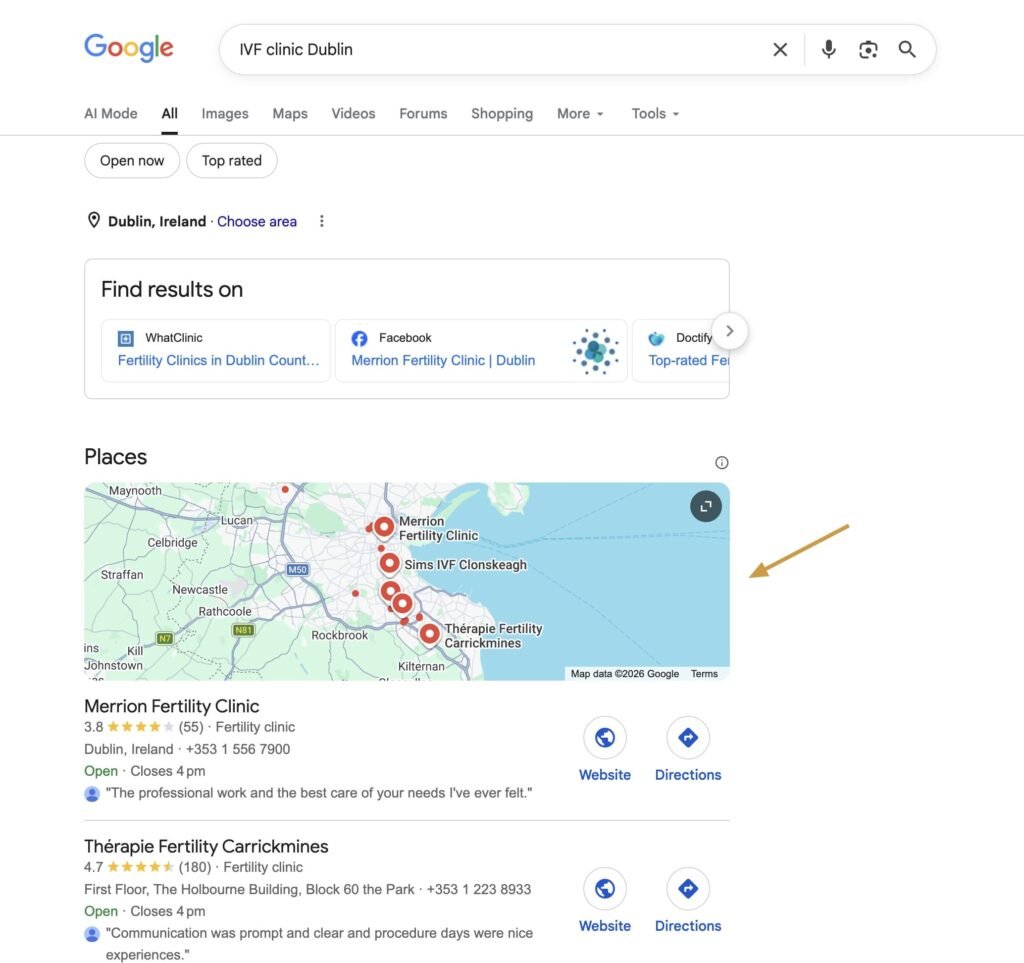
For a private clinic, the practical impact is simple. When someone searches for terms like “private dermatologist London” or “IVF clinic Dublin”, SEO plays a major role in whether your clinic appears in those results and whether it shows up high enough for a potential patient to click.
What Is the Difference Between SEO and Healthcare SEO?
SEO follows the same core principles in every industry: improve visibility in search, attract relevant traffic and turn that visibility into enquiries or sales. But healthcare is not a standard market. Private clinics operate in a space where trust, compliance, clinical accuracy and patient sensitivity all shape how content needs to be written and how websites need to perform.
That is where the difference becomes important. A general SEO agency may know how to improve rankings in broad commercial sectors, but healthcare SEO requires a much more specialised approach. The aim is not just to bring more people to the website, but to reach the patients who are genuinely likely to enquire or book. In healthcare, that takes more than standard SEO basics. Pages need to feel trustworthy, the information needs to be clearly checked, and the overall experience hØas to help someone feel more confident about taking the next step.
It also requires a proper understanding of the sector itself. Private clinics cannot market themselves in the same way as most other businesses. The wording around treatments needs to be carefully handled, imagery has to be used with caution, and trust signals such as reviews, clinician profiles, and local reputation carry much more weight.
That is why working with a healthcare SEO agency is not quite the same as hiring a generalist. The job is not simply to push rankings higher. It is to help the clinic become more visible in a way that feels credible, reassures potential patients and reflects the standards expected in healthcare.
| Area | General SEO | Healthcare SEO |
|---|---|---|
| Main objective | Increase visibility and enquiries | Increase visibility while supporting patient trust and compliant acquisition |
| Content strategy | Built around keywords and search intent | Built around keywords, patient intent, clinical accuracy, and regulatory sensitivity |
| Trust signals | Reviews, backlinks, brand reputation | Clinician credentials, medical review, patient reviews, trusted healthcare directories, and reputation signals |
| Compliance | Usually limited to standard advertising rules | Must account for healthcare advertising rules, treatment claims, and stricter sector expectations |
| Google quality standards | Important for all sectors | Much stricter because healthcare falls under YMYL |
| Conversion journey | Often transactional or lead-based | Often higher-stakes, more research-driven, and influenced by trust before contact |
| Local search | Useful for most businesses | Critical for clinics, where Google Business Profile, map visibility, and location intent strongly affect enquiries |
| Agency expertise required | Broad SEO knowledge may be enough | Requires SEO knowledge plus an understanding of healthcare marketing, patient behaviour, and compliance risk |
How Does SEO Work in the Healthcare Sector?
Organic search visibility is the product of four sequential processes that every search engine runs continuously. Understanding the chain helps clinic directors make better decisions about where to focus their investment.
your pages
in Google’s DB
200+ signals
to the patient
The four-stage search process: crawl → index → rank → serve
Step 1: Crawl
Googlebot is the system Google uses to discover pages across the web. It moves from link to link, scanning websites and finding new or updated content. If your clinic website is hard to access because important pages are blocked, links are broken, or the site structure is confusing, Google may struggle to find the content at all.
That is why crawlability matters. Before a page can rank, Google first has to be able to reach it. A big part of technical SEO is simply making sure search engines can move through the site properly and access the pages you actually want patients to find.
Step 2: Index
Once Google finds a page, it does not automatically mean that page will appear in search results. First, Google looks at the content and decides whether to store it in its index, which is the vast database it uses to retrieve pages when someone searches.
If a page is not indexed, it cannot rank. That is why indexation matters so much. Google is less likely to index pages that feel thin, repetitive, or low value, which is something many clinic websites run into when service pages are too short or too similar to one another.
Step 3: Rank
When someone searches for a treatment, symptom or clinic, Google looks at the pages it has already indexed and works out which ones are the best fit for that query. It weighs a wide range of signals, including the quality of the content, the trust signals behind it, page speed, backlinks, mobile usability and how clearly the page is structured.
For healthcare websites, the bar is higher. Because medical content can affect real health decisions, Google applies stricter quality standards than it does in many other sectors. That is why clinics need more than basic keyword optimisation. The content also has to feel accurate, credible and genuinely useful to the person searching.
Step 4: Serve
Once Google has decided which pages are most relevant, it shows them on the search results page, often called the SERP. But that page no longer looks the way it used to. Traditional organic listings now compete for space with AI Overviews, featured snippets, local map results and People Also Ask boxes, all of which can appear before the standard blue links.
For clinics, that shift matters. Being first in the organic results is still valuable, but it is no longer the only position that counts. In many searches, the most visible space is now higher up the page, in the features that appear before the classic results.
Types of SEO
SEO is not one single activity. It is made up of four main areas and each one affects a different part of how your clinic appears in search. For most private clinics, the best results come when all four are working together rather than in isolation.
On-Page SEO
On-page SEO includes all the elements you can directly manage on your own website. That covers things like the page title, the main heading, the meta description, the way subheadings are organised, the internal links between your service pages and the content itself.
For private clinics, it also includes structured data, often called schema markup, which helps Google understand exactly what kind of page it is looking at, whether that is a treatment page, a doctor profile, or an FAQ. When on-page SEO is done properly, it gives every other part of your SEO strategy something solid to build on.
Off-Page SEO
Off-page SEO is about the signals your clinic picks up from elsewhere on the web, rather than from your own website. The best-known example is backlinks, which are links from other sites pointing to yours. Google tends to read those links as signs of credibility, but not all links carry the same value. A mention from a respected medical publication means far more than a link from a generic directory.
For private clinics, off-page SEO can also include profiles on trusted healthcare platforms such as Doctify, Top Doctors, and WhatClinic, along with press coverage, citations and links from recognised professional organisations. These signals help strengthen your clinic’s reputation online and can support both search visibility and patient trust.
Technical SEO
Technical SEO is the part of SEO that makes sure search engines can access, interpret and process your website properly. It covers the behind-the-scenes elements that support visibility, such as page speed, mobile usability, secure HTTPS pages, clear URL structures, canonical tags and a well-maintained XML sitemap.
When those technical basics are in place, Google can move through the site more easily and understand what each page is for. When they are not, even strong content can struggle to perform. In other words, a technically healthy site gives your SEO a fair chance to work, while unresolved technical issues can hold rankings back.
Local SEO
Local SEO focuses on the searches people make when they are looking for a clinic in a specific area, for example “private GP Harley Street” or “aesthetic clinic Manchester”. For most private clinics, these are some of the most valuable searches because they often come from patients who are actively looking to book nearby.
In practice, local SEO depends on a few key things: a fully completed and well-managed Google Business Profile, consistent clinic details across directories and strong location pages on your website for each city or clinic address you want to be found for. This matters even more on mobile. Around 63% of healthcare searches happen on mobile devices, where local results often take up most of the screen before users even reach the standard organic listings.
SEO in Healthcare: YMYL and E-E-A-T Explained
Healthcare SEO works to a stricter standard than SEO in most other sectors. That is not accidental. Google treats medical content more carefully because it can influence decisions about a person’s health, treatment and wellbeing. For private clinics, that means visibility in search depends not just on good optimisation, but on meeting higher expectations around accuracy, trust and credibility. Two of Google’s main frameworks shape those expectations and both are worth understanding.
YMYL: Your Money Your Life
Google classifies healthcare content as YMYL, short for Your Money or Your Life, because inaccurate medical information can cause real harm. Pages in this category are judged more strictly than content in lower-risk sectors such as travel, lifestyle, or home interiors. A clinic article about appendicitis symptoms, for example, is held to a much higher standard than a recipe post, because bad information could delay urgent care.
For private clinics, the practical takeaway is clear. Content needs to show real clinical expertise, not just good copywriting. That usually means having pages written or reviewed by named, qualified clinicians, with visible author bios, medical credentials and review dates. In a YMYL context, these are not small trust extras. They help show both patients and Google that the content is credible.
E-E-A-T: Experience, Expertise, Authoritativeness, Trustworthiness
E-E-A-T stands for Experience, Expertise, Authoritativeness and Trustworthiness. It is the framework Google uses to judge the quality of content, especially in sensitive sectors such as healthcare. The extra “E” for Experience was added in December 2022, reflecting a stronger focus on first-hand and demonstrable knowledge.
First-hand clinical experience demonstrated through case-oriented content, treatment outcome descriptions, and patient pathway explanations.
Named clinicians with verifiable credentials, GMC or GDC registration numbers, and links to professional profiles.
Citations from authoritative sources, backlinks from medical publications, and presence on respected medical directories.
Accurate clinic information, transparent pricing where possible, clear complaints and data policies, and HTTPS security.
For private clinics, E-E-A-T is not an abstract SEO concept. It shows up in practical details such as named clinicians, clear qualifications, accurate medical information, strong review signals and a website that feels credible from the first visit. In other words, Google wants to see the same trust markers that patients look for themselves.
That overlap matters. According to Connect Media Agency, 94% of patients used online reviews in 2026 to assess healthcare providers. So E-E-A-T is not just about performing well in search, it reflects how people decide whether a clinic feels trustworthy enough to contact.
SEO vs. SEM vs. PPC: What’s the Difference for Clinics?
These terms are often used as if they mean the same thing and even some agencies blur the lines when speaking to clinic owners. In reality, they refer to different ways of getting visibility in search and the difference matters because each comes with its own costs, pace, and expectations.
| Term | Full Name | What It Is | Cost Model | Timeline |
|---|---|---|---|---|
| SEO | Search Engine Optimisation | Earning unpaid organic rankings through content, technical, and authority signals | Monthly retainer or in-house resource | 3–12 months to significant results |
| SEM | Search Engine Marketing | The umbrella term covering all search marketing — both paid and organic | Covers both SEO costs and PPC spend | Immediate (paid) + long-term (organic) |
| PPC | Pay-Per-Click | Paid ads on search engines where you pay each time someone clicks your ad | Cost-per-click, auction-based | Immediate — live once campaigns are active |
SEO is about earning visibility in organic search results over time. PPC, on the other hand, is paid advertising, usually through platforms such as Google Ads, where you pay for each click. SEM is the broader umbrella term, covering both organic and paid search activity.
For private clinics, SEO and PPC usually work best together rather than against each other. PPC can help generate enquiries quickly, which is useful when a clinic wants to promote a service, support a new launch, or fill appointment slots in the short term. SEO takes longer to gain traction, but it can keep delivering enquiries long after the initial work has been done, without a direct cost attached to every visit.
That is why many clinics use paid search for immediate visibility while building SEO for steadier, longer-term growth. This is especially relevant in competitive specialties such as aesthetics, fertility and orthopaedics, where paid clicks can become expensive very quickly. Over time, a strong organic presence can make patient acquisition far more efficient.
Why SEO Matters More for Clinics in 2026
The landscape that SEO operates in has shifted significantly over the past 18 months and those shifts have direct consequences for private clinic patient acquisition.
The AI Overview Effect
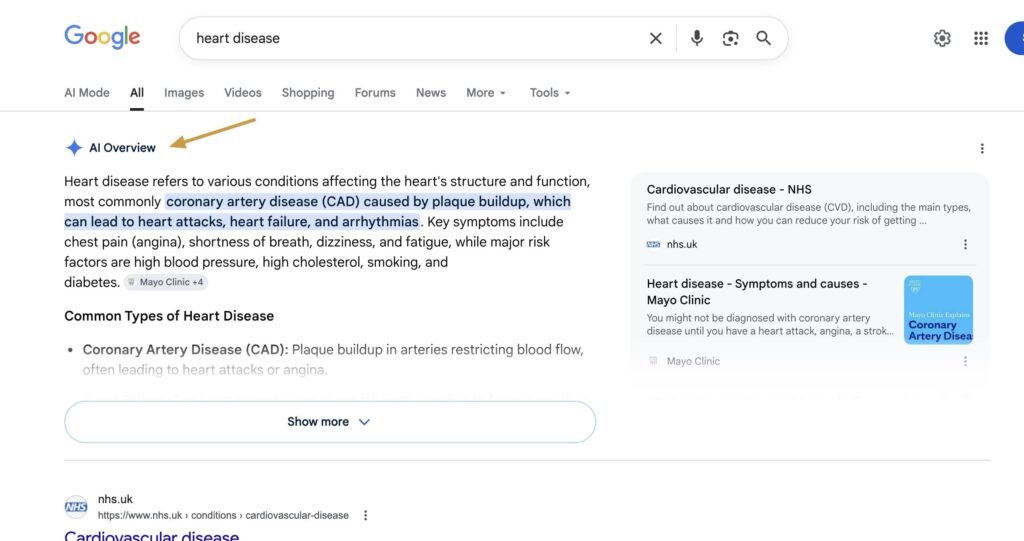
Google AI Overviews are changing search visibility in a big way. In healthcare, they show up often enough to make a real difference. Ahrefs found they appear in 43% of health-related searches, while Seer Interactive reported that organic click-through rates can drop by 61% when an AI Overview is present. That means being on page one is no longer the whole story.
Clinics that are cited inside these summaries have a clear advantage, because they are more likely to be seen and clicked. In fact, cited brands can attract around 35% more organic clicks than those left out. For private clinics, the gap is becoming harder to ignore.
It is no longer just about ranking well in the traditional sense, but about being visible in the answers Google now puts directly in front of patients. That is why Generative Engine Optimisation is starting to matter alongside classic SEO.
Zero-Click Searches
Around 60% of Google searches now end without the user clicking through to a website, according to The Digital Bloom. In other words, many patients are getting the information they need straight from the search results page. For private clinics, that changes what visibility really means.
Ranking on page one still matters, but it is no longer the whole picture. Being visible in SERP features such as featured snippets, local packs and AI Overviews is becoming just as important, because that is often where patients make their first judgement.
Patient Acquisition at Scale
Despite the zero-click shift, patients ready to book a consultation still click through. 87% of patients who find a healthcare provider online book an appointment (Google). The patients arriving via organic search are higher-intent and further along in their decision process than those arriving from social media or display advertising.For private clinics where a single new patient can represent £500-£5,000 in lifetime value, the economics of SEO remain exceptionally strong.
SEO in healthcare carries compliance risks that don’t exist in most other sectors. Clinic directors commissioning SEO work should be aware of three specific exposure areas.
Patient testimonial restrictions: The ASA CAP Code prohibits the use of before/after imagery and patient testimonials for certain regulated treatments, including most cosmetic surgical procedures. An SEO agency that publishes optimised content featuring prohibited testimonials creates a compliance problem regardless of how well the page ranks. Ensure your SEO provider understands CAP Code constraints for your specific treatment categories.
GDPR and contact forms: Pages optimised for conversion — enquiry forms, callback request buttons, live chat widgets — must comply with UK GDPR and the Privacy and Electronic Communications Regulations. Data collected via contact forms requires a lawful basis, a clear privacy notice, and appropriate consent capture. Poor technical implementation of conversion tracking can also result in CQC-reportable data handling issues.
Misleading treatment claims: Google’s quality guidelines and ASA rules both penalise content that overstates treatment efficacy, uses unsubstantiated superlatives, or implies guaranteed outcomes. Content that makes strong medical claims without clinical substantiation risks both search ranking suppression and a formal ASA ruling.
Content marketing is about creating useful pages, articles, and resources for your audience. SEO is about helping those pages get found in search. One focuses on what you publish, the other on how people discover it.
In practice, the two work best together. SEO helps you understand which topics patients are searching for and which keywords matter most, while content marketing turns that insight into pages that answer those searches clearly and convincingly. For private clinics, that often means a well-planned service page will bring more value than a large number of blog posts written without a clear search strategy.
It depends on how competitive your market is and how strong your website already is. For clinics targeting busy areas such as London, Dublin, or Manchester, SEO usually takes six to twelve months before you see meaningful ranking growth and a steady increase in enquiries. In less competitive areas, or for more specific treatment searches, you may start to see progress within three to four months.
A lot comes down to your starting point. Your existing authority, the technical condition of your site, and the level of competition in your specialty all affect how quickly results appear. SEO is slower than paid advertising, but the upside is that the work keeps building. Once a page ranks well, it can continue bringing in enquiries over time without the same ongoing cost as ads.
Yes. Healthcare content is held to a higher standard because it can influence decisions about a person’s health. In practice, that means private clinics need content that is accurate, clearly written, and backed by real clinical expertise. Pages are more trustworthy when they show named medical reviewers or authors, up-to-date information, and clear review dates where appropriate.
There is also an advertising and compliance side to consider. Private clinics cannot be as loose in their wording as brands in other sectors. Claims about treatments need to be properly supported, and certain types of before-and-after imagery are restricted. So while the goal of SEO is still visibility, healthcare clinics have to meet stricter expectations around accuracy, trust, and compliance. See our FAQ page for more compliance guidance.
Track sessions to your service pages, not the site overall. If your biggest traffic driver is a blog post about NHS waiting times, that number means nothing for patient acquisition.
For conversions, you want form submissions, phone calls (tracked, not guessed), and completed bookings. Keyword rankings matter, but only for the specialty and location terms you actually want to win. Google Business Profile is worth a dedicated look too — impressions, direction requests, and profile views tell you whether people in your area are finding you and deciding to show up.
Not simply for being promotional. The problem starts when a page feels written to sell rather than to help. If the content is vague, exaggerated, or thin on useful information, it is less likely to perform well in search.
Private clinics also have to be careful from an advertising compliance point of view. Rules around medical advertising are stricter than in many other sectors, especially around testimonials, outcome claims, comparisons, and language that creates pressure. In practice, the safest content usually works best for SEO too — clear information, realistic claims, and content that answers the questions a patient actually has.
They do different jobs, so it is better to see them as complementary rather than interchangeable. Google Ads is useful when a clinic needs leads quickly — for example after opening a new location, promoting a time-sensitive service, or filling short-term gaps in the diary.
SEO is slower, but it builds value over time. Once a service page ranks well for a strong local search term, it can keep bringing in enquiries without the same ongoing spend attached to every click. That is why many clinics use Ads for immediate demand and SEO for steady long-term growth.
Ready to Put SEO to Work for Your Clinic?
SEO is a long-term patient acquisition asset. UpMedico works with UK and Irish private clinics to build organic visibility that compounds over time — from technical foundations to AI citation strategy.
Book a Free Consultation