Google Business Profile is one of the first things patients see when they search for a private clinic online. Search “private dermatologist London” and Google does not show a clinic website first. It shows a map with three clinic listings, complete with ratings, photos, opening hours, addresses and phone numbers.
That section is the Local Pack. For private clinics, it matters because patients often use it to compare providers quickly, check trust signals and decide who to contact before they ever visit a website.
The Local Pack is powered largely by Google Business Profile data. Google uses the information in your profile, including categories, services, reviews, photos and contact details, to understand when and where your clinic should appear.
This is why GBP optimisation has become a priority for private healthcare providers. GBP signals drive 32% of Local Pack rankings, more than any other single factor. Yet many clinic directors only know that their clinic has a profile somewhere online. Far fewer have checked, updated or optimised it recently.
This glossary explains what Google Business Profile means, how it works and which GBP elements matter most for private clinics that want to improve local visibility and patient enquiries.
What Does Google Business Profile Mean for UK Private Clinics?
GBP was called Google My Business until November 2021. The name changed, but the function stayed the same: it is a free business listing managed directly inside Google Search and Google Maps, and it remains one of Google’s main data sources for local results.
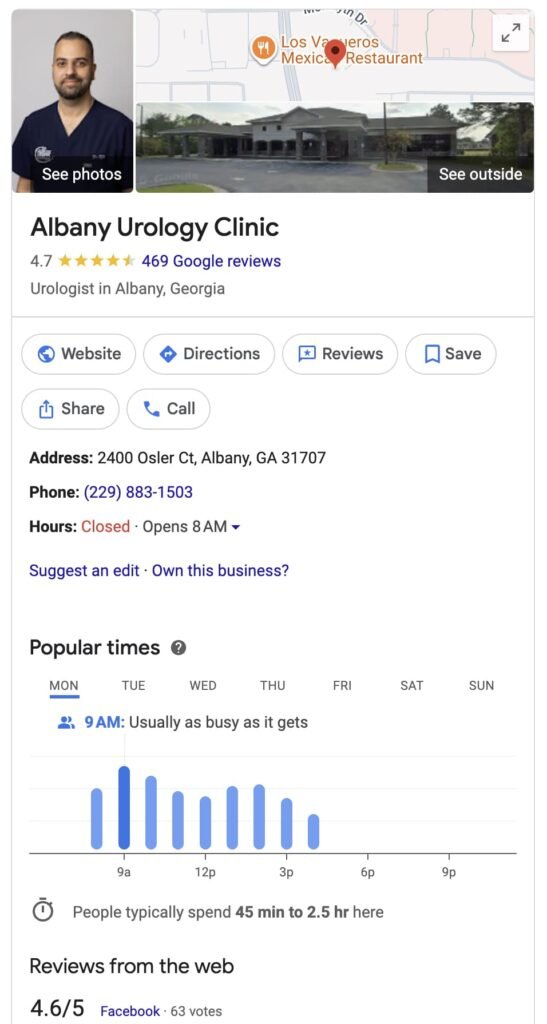
When a patient searches for “private GP Manchester” or “skin clinic Bristol”, Google uses structured information from verified GBP listings to decide which clinics appear in the map pack. That listing can show your address, opening hours, phone number, service categories, photos, reviews and whether you are currently accepting new patients.
Patients often see all of this before they ever visit your website.
That is why completeness matters. Verified profiles with complete data are 80% more likely to appear in local search results, while complete listings can receive seven times more clicks than incomplete ones.
For clinic directors building a healthcare digital marketing strategy, GBP is the foundation. Your website, paid campaigns and directory listings all work better when your Google Business Profile is accurate, complete and actively managed.
How Google Business Profile Works for a Private Clinic?
There are four phases. Each one builds on the previous. Most clinics complete phase one and stop.
Step 1: Claim and Verify
Google’s verification process has changed significantly since 2024. Features such as in-profile chat, call logs and GBP-hosted websites were removed, and verification now often requires a video walkthrough of your premises.
This matters because many clinics still have unclaimed listings, often auto-generated by Google. Until you claim the profile, incorrect information can be suggested or flagged by patients, competitors or third parties, without you having full control over it. Duplicate listings can create the same confusion.
Claim first, optimise second.
Step 2: Build Out the Profile
Many clinics add only the basics: name, address, phone number and opening hours. Then they leave important fields blank, such as secondary categories, service listings and practice descriptions.
That is a missed opportunity. Around 75% of businesses ranking in positions one to three have complete GBP descriptions, while fewer than 40% of those in positions 11 to 20 have done the same.
Google rewards completeness because it suggests that the listing is active, current and trustworthy. For a private clinic, that can make the difference between appearing in the Local Pack and being pushed below competitors.
Step 3: Generate and Manage Patient Reviews
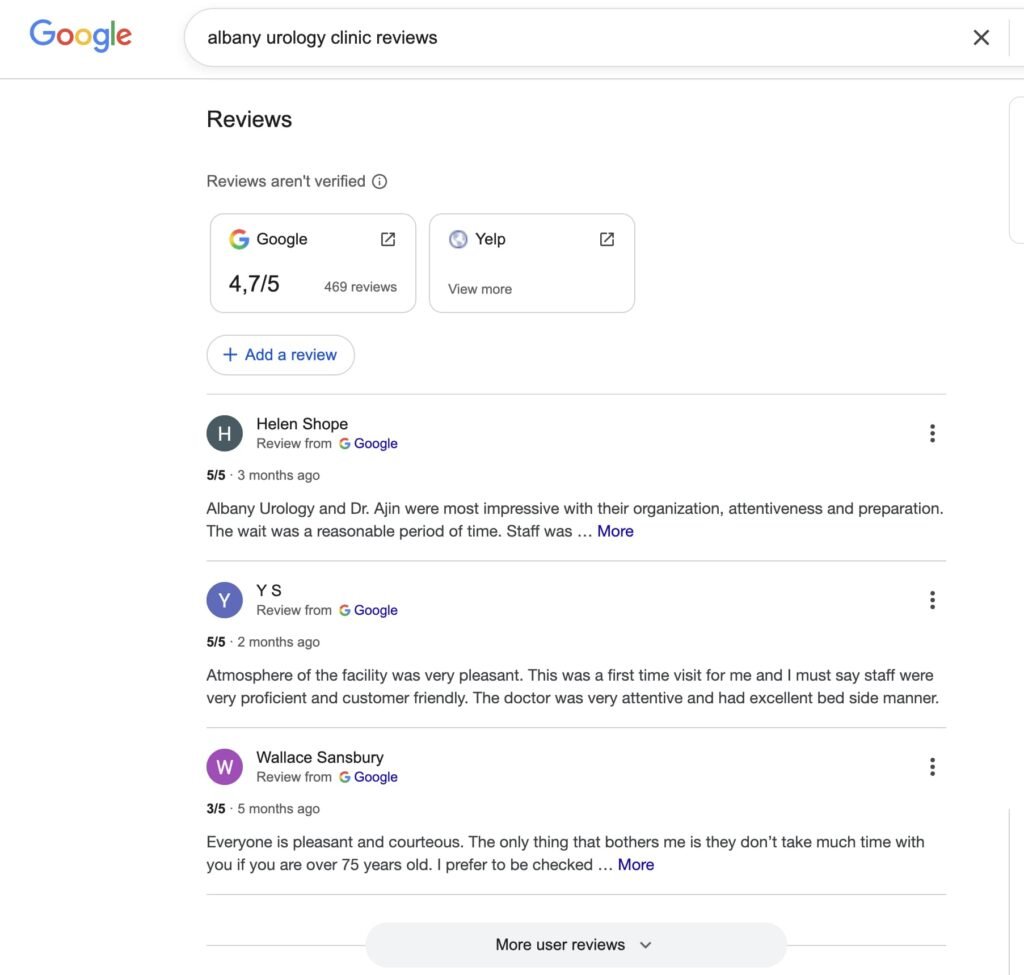
Reviews are one of the strongest trust signals in local healthcare search. Google reviews account for 81% of all online review volume and 73% of patients say online reviews are their first step when choosing a healthcare provider.
This is not just about collecting positive feedback. Responding to reviews, including negative ones, shows both patients and Google that the clinic is engaged and actively managed.Clinics that request reviews after appointments and respond consistently tend to see their average rating improve and their Local Pack visibility strengthen within three to four months.
Step 4: Post, Monitor and Maintain
GBP is not something you update once and forget. Profiles with regular posts appear 2.8 times more often in the top-three map positions.
These posts do not need to be long. A short update about a treatment, a team introduction, a seasonal health reminder or a change in opening hours can all help keep the profile fresh.
GBP Insights also shows which searches are triggering your listing and what patients do next, such as calling the clinic, requesting directions or clicking through to the website. Tracked month by month, this data helps you understand whether your optimisation is actually working.
Since late 2024, GBP data has also started feeding into Google’s AI Overviews for local queries, making accurate and regularly updated profiles even more important.
The Four GBP Signals That Drive Private Clinic Visibility
Google’s local algorithm looks at several different signals before deciding which clinics appear in the Local Pack. Categories, reviews, citation consistency and visual content all play a different role.
Getting one of them right can help. But ignoring the others usually leads to limited results.
Clinical Category Signals
Your primary category tells Google which searches your clinic is eligible to appear for.
This is critical because 86% of all GBP views come from category-based searches, such as “dentist open now” or “private dermatologist London”. If a dermatology clinic lists itself only as “Clinic”, Google may not treat it as relevant when a patient searches by specialty.
Secondary categories matter too. Google allows up to nine secondary categories, yet many UK private clinics only use one or two. Adding relevant options such as “Aesthetic medicine physician”, “Skin care clinic” or “Cosmetic surgeon” can expand the number of searches your profile can appear for, without changing anything else on the listing.
Patient Review Signals
Reviews influence both patient trust and local visibility. Google looks at review volume, average rating and review velocity, meaning how consistently new reviews are added over time.
Clinics with 50 or more Google reviews earn 266% more leads than those with fewer than 10. The average listing in the top-three map positions has around 250 reviews, while the average local business across all sectors has 39.
Responses also matter. A clinic that replies to every review, including critical ones, shows Google that the profile is actively managed. It also shows patients that feedback is taken seriously.
NAP Consistency Across Healthcare Directories
NAP stands for Name, Address and Phone Number. Google checks whether the information on your GBP matches what appears across other sources, including Doctify, TopDoctors, WhatClinic, your website and other healthcare directories.
Even small inconsistencies can create confusion. A slightly different clinic name, an old phone number, a shortened address or conflicting location details can all weaken trust in the data.
For multi-location practices, this becomes even more important. Clinics with consistent NAP across all directories see a 28% improvement in local rankings. That is why a NAP audit should usually happen before any wider GBP optimisation work.
Clinical Photography and Visual Signals
Photos help in two ways. First, they create an engagement signal because listings with images tend to attract more clicks, calls and direction requests. Second, they help patients understand what to expect before they book.
GBP listings with photos receive 42% more direction requests and 35% more website click-throughs.For private clinics, this means using real photography of the reception area, consultation rooms, treatment spaces and team members. Stock photos rarely add credibility. Patients can usually recognise them, and they do little to show what the clinic actually looks like.
Why Healthcare GBP Is Held to a Higher Standard: YMYL and E-E-A-T
A restaurant and a dermatology clinic may both use Google Business Profile, but Google does not evaluate them in exactly the same way.Healthcare sits in a more sensitive category because medical services can affect a person’s health, safety and wellbeing. That is why private clinics need to pay closer attention to accuracy, credibility and trust signals across both their GBP and their website.
How E-E-A-T applies to your clinic’s GBP
YMYL: How Google Classifies Medical Content?
YMYL stands for “Your Money or Your Life”. It refers to content and services that can influence someone’s health, safety, financial stability or major life decisions.
Private clinics fall into this category by default. A clinic is not simply promoting a local service, it is offering medical consultations, treatments or procedures that may carry real clinical risk.
In practice, this means the bar is higher. An incomplete profile or a thin website may be enough for a local café to appear in search, but it is much less likely to perform well for a private healthcare provider.
This does not mean clinics are penalised. It means Google expects stronger signals of legitimacy. Clinics with complete profiles, active review management, consistent citations and clear clinical information are more likely to look trustworthy than competitors with missing or outdated details.
In many local markets, that gap is still wide, and that creates an opportunity for clinics willing to manage GBP properly.
E-E-A-T: The Four Signals Every Private Clinic Must Build
Google uses E-E-A-T, which stands for Experience, Expertise, Authoritativeness and Trustworthiness, to assess the credibility of businesses and the content connected to them.
For a private clinic, this is very practical.
- Experience means showing real clinical activity. This can include genuine clinic photography, treatment-specific posts, patient-focused updates and reviews that mention particular services or procedures.
- Expertise means making it clear who provides the care. Clinics should name their clinicians, include qualifications and, where relevant, link to professional registrations such as GMC or GDC profiles.
- Authoritativeness comes from the wider footprint around the clinic. Listings on trusted healthcare platforms such as Doctify, TopDoctors, WhatClinic and relevant professional body directories help Google understand that the clinic is recognised beyond its own website.
- Trustworthiness is the most concrete signal. It includes accurate NAP data, transparent pricing where appropriate, clear contact details, privacy information and a visible complaints policy on the website.
Clinics with complete, trust-optimised profiles are 2.7 times more likely to be considered reputable by prospective patients. For clinic directors looking beyond traditional search, this also matters for AI visibility, because many AI-generated results rely on the same structured trust signals Google already uses.
GBP, Local SEO and Google Ads for Private Clinics: Understanding the Differences
GBP, Local SEO and Google Ads are often confused, or treated as if clinics should choose one instead of the others. In reality, they are not alternatives.
They work at different stages of the patient acquisition funnel, with different costs, timelines and roles.
| Factor | Google Business Profile | Local SEO | Google Ads |
|---|---|---|---|
| Cost | Free — management time only | Agency or in-house resource | Paid per click — ongoing budget required |
| Time to Results | 6–12 weeks for early uplift | 4–12 months for full impact | Immediate visibility |
| Traffic Continuity | Continuous once ranked | Continuous once ranked | Stops when budget stops |
| Google Maps Visibility | Yes — primary data source | Supports GBP indirectly | No |
| Patient Review Management | Core feature | Supports GBP indirectly | Not included |
| AI Overview Citability | GBP data cited directly | Website data cited | Not a factor |
| Best For Clinics | Local discovery and patient trust | Sustained organic growth | Immediate new-patient volume |
| Healthcare Regulation | YMYL, ASA CAP Code, UK GDPR | YMYL, ASA, E-E-A-T signals | ASA CAP Code, Google Ad policies |
Google Business Profile is a specific platform: a structured clinic listing that Google uses across Search and Maps. It contains the core information patients need before deciding whether to contact you, including your location, opening hours, services, reviews and photos.
Local SEO is the wider system around it. It includes GBP management, citation building, on-page signals on your website, local landing pages, link acquisition and review strategy. A strong GBP with a weak website will usually underperform. A strong GBP supported by strong Local SEO creates a more durable position, which is harder for competitors to displace.
Google Ads work differently. They can generate patient enquiries quickly, but only while the budget is active. GBP and Local SEO, instead, can continue delivering visibility and enquiries without a direct cost per click, once a strong position has been established.
For many private clinics, the best strategy is not choosing between them, but using them together. Clinics that run Google Ads alongside a well-maintained GBP often create a more consistent search presence and can benefit from stronger branded visibility, because Google has clearer signals that the clinic is a legitimate local entity.
Why Google Business Profile Is a Patient Acquisition Priority in 2026?
Three things have changed in the past two years, and each one makes Google Business Profile management more important for private clinics.
Patients are not searching in a linear way anymore. They may see an AI answer, compare clinics in the map pack, read reviews, check opening hours and call directly, all before they ever reach your website.
AI Overviews and the New Patient Search Journey
Google’s AI Overviews now appear in around 32% of local queries. They can pull information directly from GBP listings, including your profile description, service categories and review content.
This means your GBP can influence two search surfaces at once: the Local Pack and the AI-generated summary above the traditional results.
For private clinics, that makes accuracy more important. If your services, descriptions or categories are outdated, Google has less reliable information to work with. If they are clear and complete, your clinic has a better chance of being understood, surfaced and trusted.
Brands cited inside AI Overviews receive 35% more clicks than those not included, so keeping your profile current is no longer a small admin task. It is part of how patients discover and evaluate your clinic.
Zero-Click Searches and What They Mean for Clinic Visibility
Around 60% of Google searches end without a click. That does not mean patients are not taking action. It often means they are finding what they need directly on the results page.
A patient searching for “private GP Richmond” may check your rating, read your reviews, look at your opening hours and tap the phone number, without visiting your website at all.
In that moment, your GBP listing becomes the first impression of your practice. The quality of the profile can decide whether the patient calls your clinic or moves on to the next result.
GBP as a Patient Acquisition Engine
Google’s data shows that 87% of patients who find a healthcare provider online go on to book an appointment.
For private clinics, that matters. A single patient relationship can be worth hundreds or even thousands of pounds over time, especially in specialties where follow-up appointments, treatment plans or ongoing care are common.That is why GBP should be treated as a patient acquisition channel, not just a listing. Ten additional enquiries per month from a profile that has no direct cost per impression can create a level of return that is difficult to match through paid search alone.
For more on how AI-powered search is reshaping local patient acquisition, see UpMedico’s GEO strategy for healthcare providers.
Regulatory Risks Every Private Clinic Must Manage on GBP
Managing a Google Business Profile for a private clinic is very different from managing one for a coffee shop, restaurant or retail store.Healthcare listings sit in a more sensitive category because they can influence how patients choose a provider, understand a treatment or decide whether to book a consultation. For UK private clinics, this creates specific regulatory risks that go beyond visibility and rankings.
What is the difference between Google Business Profile and Local SEO for a private clinic?
Google Business Profile is a specific listing platform. It is the clinic profile that appears in Google Search and Google Maps, showing information such as your address, opening hours, phone number, services, reviews and photos.
Local SEO is the wider strategy that supports local visibility. It includes GBP management, citation building, on-page website signals, local landing pages, link acquisition and review strategy.
GBP is usually the most important single component, but it does not work in isolation. A clinic that optimises its profile but ignores local signals on its website will often struggle to compete with clinics that manage both properly.
How long does GBP optimisation take to produce results for a private clinic?
Early improvements in the Local Pack can appear within six to twelve weeks, especially if the profile was previously incomplete or outdated.
A stronger increase in patient enquiries usually takes three to six months of consistent work. This includes weekly posts, regular review requests, citation building, profile updates and ongoing monitoring.
The value compounds over time. Clinics that maintain their profiles consistently for twelve months often build positions that are much harder for competitors to displace quickly.
Is healthcare GBP subject to different rules than other industries?
Yes. Healthcare GBP is held to a higher standard because medical content falls under Google’s YMYL classification, which means Google applies stricter quality expectations to healthcare profiles and the websites linked to them.
There are also external compliance considerations. The ASA CAP Code affects what clinics can say in testimonials and Google Posts. UK GDPR and PECR apply to how patient data is collected and used for review requests. CQC requirements can also influence what registered providers publish about their services.
This is where specialist healthcare marketing matters. UpMedico works specifically at the intersection of healthcare SEO, patient acquisition and compliance, which is something a generic local SEO agency may not fully understand.
What GBP metrics should a clinic director actually track?
Clinic directors should track profile views, call clicks, direction requests, website clicks and the search queries that triggered the listing.
Review count, average rating and posting frequency are important inputs. The real outputs are the actions patients take after finding the profile.
The best approach is to review these numbers month by month. When a metric changes, look at what changed on the profile during the same period, such as new photos, updated services, more reviews or regular posts.
Does Google penalise private clinics for buying or incentivising reviews?
Yes. Buying reviews, incentivising star ratings or asking staff to post reviews as patients can violate Google’s policies and may put the profile at risk of suspension.
Asking for honest reviews through SMS, email or a QR code at reception is acceptable, provided it is handled properly and without pressure.
The ASA CAP Code adds another layer of risk. Incentivising a specific type of review, especially a positive one, may be treated as misleading advertising. For private clinics, the safest approach is to request honest feedback in a neutral and compliant way.
What is the ROI of GBP compared to Google Ads for private clinics?
GBP has no cost per impression or direct cost per click. The investment is mainly in management time, optimisation and ongoing maintenance.
Google Ads work differently. They can generate enquiries quickly, but each click has a cost, and when the budget stops, the traffic stops.
For many private clinics, the strongest return comes from using both channels together. A well-maintained GBP can support stronger organic visibility, while Google Ads can capture immediate demand in competitive locations or specialties.
UpMedico’s Google Ads for healthcare team can model both channels based on your clinic’s location, specialty and patient acquisition goals.
Building a Long-Term Local Presence for Your Private Clinic
Google Business Profile is one of the most valuable assets private clinics already have, but often underuse. When it is accurate, complete and actively managed, it can become a steady source of patient enquiries from Google Search and Maps.
The work is straightforward: claim and verify the profile, complete every relevant field, update it regularly, respond to every review as a patient interaction, and build a consistent citation footprint across platforms such as Doctify, TopDoctors and other trusted healthcare directories.
It is not complicated, but it does require consistency. And that is where many clinics fall behind. Profiles that are updated every week, supported by real reviews and aligned with the clinic’s website and directory listings are much harder for competitors to displace.
For clinic directors, GBP should not be treated as a one-off admin task. It is part of a broader healthcare digital marketing strategy, alongside Local SEO, GEO, Google Ads and content marketing.For more guidance, the full UpMedico glossary covers these topics in the same practical format. And if you want a direct review of your clinic’s Google Business Profile, the UpMedico team offers a free initial consultation.
Want a Free Review of Your Clinic’s GBP?
UpMedico works with UK and Irish private clinics on GBP optimisation, citation building, and local search strategy. Book a free consultation and we will tell you exactly where you stand.