More than 76% of patients start on Google when looking for a healthcare provider.
For private clinics, that makes Google one of the most important points in the patient journey. It is often where people compare options, check services and decide which clinic to contact.
Google Ads helps your clinic appear at that exact moment. But many clinic directors still have an unclear view of how it works. They may know that paid search can generate enquiries, but not how the auction works, why healthcare ads need stricter controls or how compliance affects performance.
This matters because a poorly managed campaign can burn through budget quickly. The wrong keywords, weak landing pages or unsupported claims can lead to low-quality clicks, fewer bookings and policy problems.
This glossary explains what UK and Irish private clinic directors need to know about Google Ads for healthcare, from campaign types and bidding to compliance, tracking and performance.
What Does Google Ads Stand For?
Google Ads is the commercial name of Google’s paid advertising platform. Until 2018, it was known as Google AdWords.
The change of name reflects how much the platform has expanded. Today, Google Ads does not cover only text ads on Google Search. It can place paid ads across Google Search, Google Display Network, YouTube, Google Maps, Gmail and partner websites.
The core model is pay-per-click advertising, often shortened to PPC or CPC. This means a clinic pays when someone clicks on its ad, not when the ad is shown. This is different from traditional advertising, where you usually pay for visibility even if nobody takes action.
For private clinics, the most important distinction is between search advertising and display advertising.
Search ads appear when a potential patient types a query such as “private GP appointment London” or “MRI scan same day Manchester”. These searches usually show clear intent. The person is already looking for a service and may be close to booking.
Display ads, instead, appear as banners or visual placements across websites and apps. They are more useful for awareness, remarketing and brand visibility, rather than for capturing patients who need care right now.
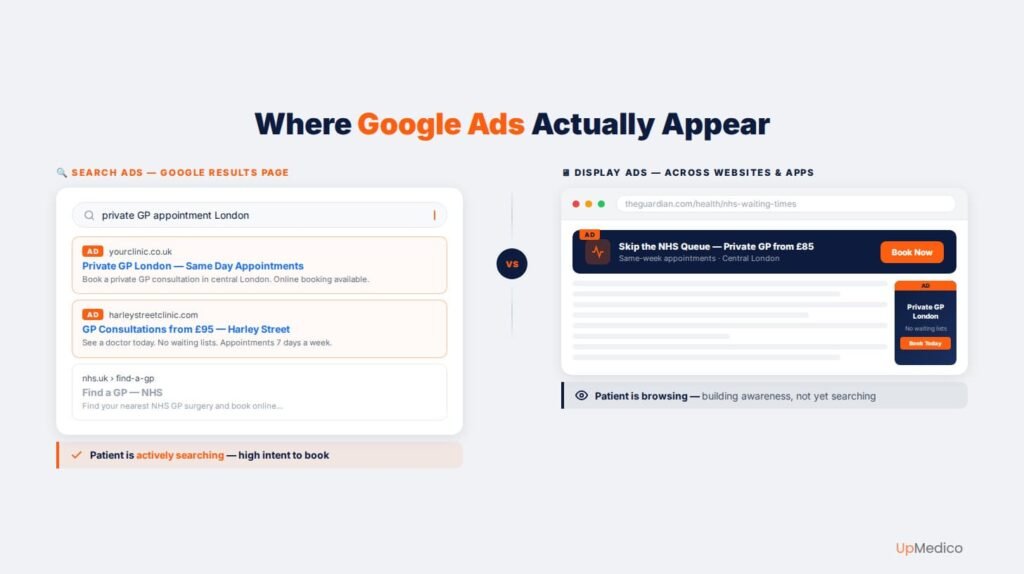
For most private clinics, search advertising delivers the strongest return because it reaches people at the moment they are actively comparing providers.
This matters even more in the current UK healthcare market. The proportion of adults accessing private healthcare rose from 9% in 2023 to 16% in 2025, while 71% of British adults say they would consider private treatment if they needed care.
Those patients are already searching online. Google Ads helps decide whether they find your clinic at that exact moment.
How Does Google Ads Work for Private Clinics?
Google Ads works through a real-time auction that happens every time someone searches on Google. The process takes only milliseconds, but it decides which clinics appear, in what order and at what cost.
Here is how it works.
Step 1 – Keyword Matching
When a potential patient types a search into Google, the platform checks which advertisers are bidding on keywords related to that query.
For example, a clinic bidding on “private dermatologist London” can enter the auction when someone searches for that service.
The level of match depends on the keyword match type:
- Broad match, which gives Google more flexibility
- Phrase match, which keeps the search closer to the keyword
- Exact match, which targets more specific searches
For private clinics, this step is critical because a small difference in wording can change the quality of the traffic. A patient searching for “private GP appointment today” is much closer to booking than someone searching for “what does a GP do”.
Step 2 – Quality Score Calculation
Google does not automatically give the top position to the clinic with the highest bid.
It also looks at Quality Score, which is based on three main elements:
- expected click-through rate
- relevance between the ad and the search query
- quality and relevance of the landing page
This means a clinic with a clear ad, a relevant service page and a smooth booking journey can outrank a competitor that is simply bidding more.
Step 3 – Ad Rank and Position
Google then calculates Ad Rank. This is based on the bid, Quality Score and other signals, such as the user’s location, device and search context.
Ad Rank decides whether the ad appears and where it sits on the results page.
For clinic directors, this is an important point: improving the landing page, ad copy and keyword structure can be just as valuable as increasing the budget.
Step 4 – Click, Cost, and Conversion
When a patient clicks the ad, the clinic pays the cost set by the auction. This is not always the full maximum bid. It is usually the amount needed to keep that position above the next advertiser.
After the click, the patient lands on the clinic’s website. From there, performance depends on what they find.
A strong healthcare landing page should make the next step clear. It should load quickly, work well on mobile and show the information patients need before booking, such as CQC registration details, clinician credentials, service information, pricing clarity and a simple enquiry or booking pathway.
In the end, Google Ads does not work well because a clinic buys clicks. It works when the full journey, from search query to booked appointment, is built around patient intent.
Quality Score means a better-built account beats a higher bidder.
Types of Google Ads Campaigns for HealthcareClinics
There are several Google Ads campaign types, but four are especially relevant for private clinics. Each one supports a different stage of the patient journey and comes with different compliance considerations.
Search Campaigns
Search campaigns are usually the foundation of healthcare PPC.
These ads appear as text ads at the top or bottom of Google’s search results when a patient searches for terms linked to the clinic’s keywords.
For private clinics, search campaigns often bring the strongest results because they capture patients with clear intent. These are people who are already looking for a specific service and comparing providers.
For example, a clinic running a campaign for “knee pain consultant UK” is reaching patients who may already be close to booking an appointment.
Performance Max (PMax)
Performance Max, often called PMax, is Google’s automated campaign type. It can show ads across Search, Display, YouTube, Gmail and Maps from one campaign.
For clinics, PMax can be useful as a support campaign, especially when there is enough conversion data and the account is already well structured.
But it should be used with care.
Healthcare advertising needs clear control over messaging, targeting and compliance. PMax offers less visibility than standard search campaigns, which can make it harder to understand exactly where ads are showing, which searches are driving results and how budget is being spent.
For this reason, PMax should usually supplement search campaigns, not replace them.
Display Campaigns
Display campaigns place visual ads, such as banners and image ads, across the Google Display Network. This includes a large number of partner websites and apps.
Display is mainly useful for awareness. A clinic opening a new location, launching a new service or promoting a specific specialism might use display ads to build familiarity before patients start actively searching.
However, display campaigns usually convert at a lower rate than search campaigns.
In healthcare, they also require extra caution. Google places strict limits on personalisation, especially when ads relate to health conditions, treatments or sensitive medical needs. For example, remarketing to users based on health-related browsing behaviour is restricted.
Local Service Ads (LSAs)
Local Service Ads, or LSAs, appear at the very top of Google search results, above standard paid search ads. They can include badges such as “Google Screened” or “Google Guaranteed”, depending on the service and market.
Unlike standard PPC campaigns, LSAs usually work on a pay-per-lead model. This means the clinic pays when a potential patient calls or sends a message through the ad, rather than paying for every click.
For healthcare providers, eligibility depends on the service category and location. In the UK, clinics need to meet Google’s verification requirements before running LSAs.
For private clinics, LSAs can be valuable where available, especially for local, high-intent searches. But they should still sit within a wider strategy that includes search campaigns, compliant landing pages and clear tracking.
Google Ads in Healthcare: YMYL, E-E-A-T, and What Makes It Different
Healthcare advertising on Google comes with two separate layers of compliance. Meeting one set of requirements does not automatically mean the clinic is compliant with the other.
This is where many clinics run into problems. Ad disapprovals, restricted campaigns and account suspensions often happen because the difference between Google’s healthcare advertising policies and UK advertising rules has not been fully understood.
YMYL: Why Healthcare Is Classified Differently?
Google classifies healthcare content as YMYL, which stands for Your Money or Your Life.
This category applies to content that can affect a person’s health, safety, financial stability or major life decisions. For private clinics, this means Google applies stricter quality and compliance standards to both organic search results and paid ads.
In practice, a healthcare ad account is not judged only against standard Google Ads policies. It also needs to comply with healthcare-specific rules covering areas such as:
- restricted medical procedures
- prescription-only medicines
- clinical claims
- treatment outcome language
- consistency between ad copy and landing page content
This last point is especially important. If an ad promises “same-day results”, the landing page needs to support that claim with clear, accurate and relevant information. Otherwise, the campaign can become a compliance risk.
E-E-A-T: The Quality Standard Shaping Healthcare Ad Accounts
E-E-A-T stands for Experience, Expertise, Authoritativeness and Trustworthiness.
It is mainly known as Google’s framework for assessing organic content quality, but it also affects paid campaigns. This is because Google Ads uses landing page quality as part of the Quality Score system.
For healthcare campaigns, the landing page needs to build trust quickly.
A patient should be able to understand who is providing the treatment, what the service includes and whether the clinic looks credible enough to contact.
Useful trust signals include:
- named clinicians
- GMC or GDC registration details, where relevant
- CQC registration information
- clear pricing
- transparent terms of service
- accurate explanations of treatments, risks and expected outcomes
When these elements are missing, performance can suffer. A weak landing page may reduce Quality Score, increase cost per click and make it harder for the ad to hold a strong position.
So trust is not only a compliance point. It affects the commercial performance of the campaign too.
Google Policies and ASA Rules Are Separate
UK clinics also need to consider the ASA CAP Code.
This adds a separate layer of responsibility. Healthcare ads need evidence behind treatment claims, clear wording and careful handling of anything linked to prescription-only medicines.
This is especially important for aesthetic clinics, private healthcare providers and any clinic promoting treatments with clinical or medical claims.
Google Ads vs SEO vs Other PPC Channels for Private Clinics
Clinic directors often group Google Ads, SEO and PPC together. They are connected, but they do different jobs.
Understanding the difference helps set the right budget, timeline and expectations.
| Area | Google Ads | SEO | Meta / Social Ads |
|---|---|---|---|
| Cost Model | Pay-per-click (CPC) | Time & resource investment; no per-click cost | Pay-per-click or per-impression (CPM) |
| Speed to Results | Days — ads live immediately | 3–12 months for consistent rankings | Days, but lower intent traffic |
| Patient Intent | High — patient is actively searching for a service | High for clinical queries; variable for informational | Low to medium — audience is browsing, not searching |
| Compliance Requirements | Google Healthcare Policy + ASA CAP Code | ASA CAP Code on-page; YMYL/E-E-A-T content standards | Platform-specific health policies; ASA CAP Code |
| Durability | Stops when budget is paused | Continues producing traffic while rankings hold | Stops when budget is paused |
| Typical UK CPC | £3.50–£6.75 (healthcare) | N/A | £0.50–£2.00 (lower intent) |
| Best Use Case for Clinics | Immediate patient acquisition for high-intent queries | Long-term visibility for treatment pages and content | Brand awareness; retargeting; new service launches |
| Conversion Rate (avg.) | ~2.6% (paid search healthcare) | Varies by query intent | Lower than paid search for clinical services |
SEO builds long-term visibility in organic search results. It helps a clinic appear for important searches without paying for every click. But it takes time. In most cases, SEO needs 3 to 12 months before it starts producing consistent results.
Google Ads works faster. A clinic can appear in front of patients as soon as the campaign goes live. The trade-off is clear: when the budget stops, the traffic stops too.
That is why the strongest patient acquisition strategies often combine both channels. SEO builds visibility over time. Google Ads captures demand immediately.
Google Ads also behaves differently from other PPC channels, such as display or paid social. Healthcare paid search ads convert at around 2.6%, often performing better than display and social media campaigns.
The reason is intent.
A patient searching for “private cardiologist near me” already has a specific need. Someone seeing a banner ad or a social media ad is usually browsing in a more passive way.
For private clinics, this makes paid search especially valuable because it reaches people when they are already looking, comparing options and moving closer to booking.
Why Google Ads Matters More for Private Clinics in 2026?
Private healthcare demand in the UK is no longer a temporary trend. It is becoming part of how many patients access care.
The UK private healthcare market reached $13.75 billion in 2024 and is projected to reach $18.56 billion by 2033. One of the main drivers is NHS waiting pressure. Between 2023 and 2025, the proportion of British adults accessing private care doubled.
And when patients start looking for private care, they often go to Google first.
For private clinics, this makes Google Ads a high-value acquisition channel. A clinic without a paid search presence may miss patients at the exact moment they are searching for treatment, comparing providers and deciding who to contact.
The AI Overview Effect
Google’s AI Overviews are also changing how patients interact with search results.
According to Ahrefs, AI Overviews now appear for around 43% of health-related queries. Seer Interactive data also indicates that click-through rates can drop by 61% when an AI Overview is present.
This creates a clear risk for organic traffic. Even well-ranked clinic pages may receive fewer clicks when Google answers part of the query directly in the results.
Paid search can help protect visibility. In many search layouts, Google Ads still appear above the AI Overview, which means clinics can remain visible even when organic clicks decline.
This is also where Generative Engine Optimisation (GEO) becomes relevant. GEO looks at how clinics appear in AI-generated search answers, while Google Ads helps capture high-intent demand directly in the paid results.
Patient Acquisition at Scale
Google Ads also matters because the numbers can work when campaigns are managed properly.
UK healthcare cost-per-click benchmarks usually range from around £3.50 to £6.75 per click, with London often sitting higher because of stronger competition. Against a new patient lifetime value of £500 to £5,000, depending on the specialism, paid search can become a profitable acquisition channel.
But performance depends on the quality of the setup.
A clinic needs accurate conversion tracking, clear campaign structure, relevant keywords, compliant ad copy and landing pages built around patient intent. Without proper tracking, clinics can lose 30 – 50% of useful data insights, which means Google optimises campaigns with incomplete information.
The result is predictable: more wasted spend, weaker enquiries and less control over cost per acquisition.In 2026, Google Ads matters because it helps private clinics stay visible where patient demand already exists. But it only works well when strategy, compliance, tracking and conversion quality are managed together.
What is the difference between Google Ads and SEO for a private clinic?
Google Ads gives a private clinic immediate visibility through paid listings at the top of search results. SEO builds organic visibility over time, usually across 3 to 12 months.
Google Ads stops when the budget stops. SEO can continue bringing traffic as long as rankings hold. Most clinics use both: Google Ads for immediate patient enquiries, SEO for long-term visibility.
How long does it take for Google Ads to generate patient leads?
A well-structured campaign can start generating enquiries within a few days.
The first 2 to 4 weeks are usually a learning phase. For reliable performance data, a clinic should allow 4 to 6 weeks and enough conversions to judge cost per acquisition. In most cases, it is better to assess results over at least 3 months.
Is healthcare Google Ads subject to different rules than other sectors?
Yes. Healthcare advertising is more restricted than many other sectors.
Clinics must follow both Google’s Healthcare and Medicines Policy and the ASA CAP Code. These are separate frameworks, so passing one does not automatically mean the campaign is compliant with the other.
What Google Ads metrics should a clinic director actually track?
The most useful metrics are:
- Cost per acquisition (CPA) — how much each patient enquiry costs.
- Conversion rate — how many clicks become calls, forms or bookings.
- Return on ad spend (ROAS) — how much revenue comes from ad-attributed appointments.
Clicks, impressions and CTR are useful, but they should not be the main measure of success.
Does Google penalise clinics for making clinical outcome claims in ads?
Yes. Claims such as guaranteed results, risk-free treatments or unsupported superlatives can lead to ad disapproval.
Serious or repeated violations can also create account-level risk. Clinic ad copy should be checked against both Google policies and the ASA CAP Code before launch.
What is the ROI of Google Ads vs other channels for a UK private clinic?
Healthcare paid search usually performs better than display or social media because it captures patients with clear intent.
If a clinic has a patient lifetime value of £500 to £5,000, a well-managed campaign with a CPA of £80 to £150 can deliver a strong return.
The best results usually come from combining Google Ads for immediate demand, SEO for long-term search visibility and GEO for visibility in AI-generated search results.
Conclusion
Google Ads does not work the same way for a private clinic as it does for a retailer, hotel or software company.
Healthcare PPC is more specialised because it involves YMYL content, stricter compliance rules and patient-sensitive decision making. Campaign setup, ad copy, landing pages and tracking all need to be handled with care.
A clinic director who understands how Google Ads works, from the auction system to campaign types and compliance limits, is in a much stronger position to make informed budget decisions and hold an agency accountable.
For more context, the UpMedico glossary hub covers the key terms private clinics need to understand across healthcare digital marketing.And if your clinic is ready to build, improve or audit a Google Ads account designed for UK and Irish healthcare compliance, get in touch with the UpMedico team.
Ready to Put Google Ads to Work for Your Clinic?
Google Ads is the most direct route from patient search to booked appointment. UpMedico builds and manages Google Ads accounts for UK and Irish private clinics — compliant with ASA CAP Code and Google Healthcare Policy from day one.
Book a Free Consultation