According to Google, 46% of all searches have local intent. In simple terms, many people are not just searching for information. They are looking for a service nearby, comparing options and deciding who to contact.
For a private clinic, this matters because patients often search in a very practical way: “private GP near me”, “dermatologist Manchester”, “physiotherapy clinic Dublin” or “IV therapy London”. These are not vague searches. They often come from people who already need a provider and are close to booking.
That is where local SEO comes in. It helps your clinic appear in Google Search, Google Maps and the local pack when patients look for healthcare services in your area.
This glossary explains what local SEO means, how it works and which elements matter most for private clinics.
What Does Local SEO Stand For?
Local SEO stands for Local Search Engine Optimisation. It is the part of SEO that helps a clinic appear when patients search for healthcare services in a specific area.For example, a general SEO query might be “what is IV therapy?”. A local SEO query is more practical and location-based, such as “IV therapy clinic Manchester”, “private GP London Bridge” or “dermatologist near me”.
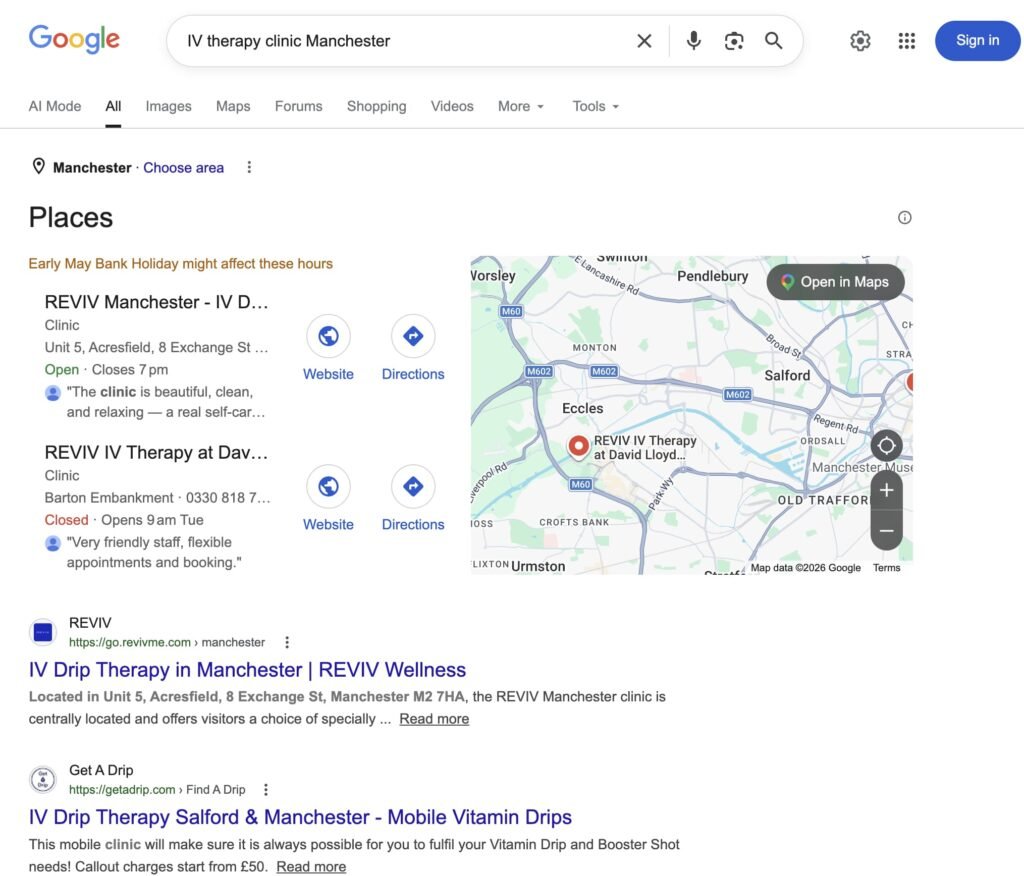
This distinction matters because local searches often come from patients who are much closer to booking. Someone typing “private physiotherapist Bristol” is usually comparing clinics, checking availability or looking for contact details.
Local SEO is also different from paid advertising. With Google Ads, visibility depends on media spend. With local SEO, your clinic earns visibility through your Google Business Profile, local pages, reviews, citations and website optimisation.
That is why the local pack and Google Maps are so valuable for private clinics: they put your clinic in front of patients at the moment they are actively looking for a nearby provider.
How Does Local SEO Work for Healthcare Providers?
Local SEO works by sending Google a series of clear and consistent signals about your clinic: who you are, where you are based, which services you offer and why patients can trust you.
For private clinics, this usually comes down to four key areas.
The four-step local SEO cycle for UK private clinics — each step reinforces the others.
Step 1: Claim and Optimise Your Clinic’s Google Business Profile
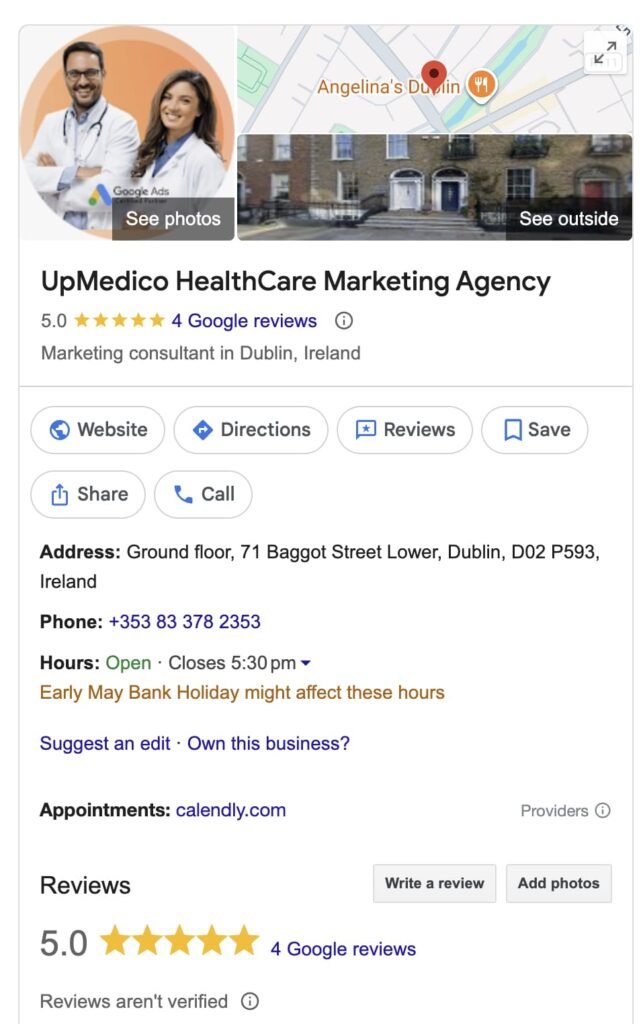
Your Google Business Profile (GBP), formerly Google My Business, is one of the most important local SEO assets you control. It feeds the information that appears in Google Maps and in the local pack, the group of business listings shown for location-based searches.
A strong profile should include every essential detail:
- clinic name,
- address,
- phone number,
- website,
- opening hours,
- services offered,
- healthcare-specific categories,
- booking options, where available.
Adding real clinic photos can also help patients understand what to expect before they visit.
Step 2: Build Consistent Healthcare Citations Across Directories
A citation is any online mention of your clinic’s name, address and phone number. These three details are often referred to as NAP.
When your NAP is consistent across directories such as Doctify, TopDoctors, WhatClinic, Yell and NHS Service Finder, Google can trust your location data more easily.
Small inconsistencies, such as a different phone number, an old address or a slightly different postcode format, can weaken that trust and make your clinic harder to rank locally.
Step 3: Generate and Manage Patient Reviews Compliantly
Reviews add the social proof layer to local SEO. For a private clinic, they help both Google and potential patients understand whether your service is active, trusted and well managed.
Businesses with 50 or more Google reviews earn 266% more leads than those with fewer than 10. For a UK private clinic, this means building a steady flow of genuine reviews from satisfied patients, while staying compliant with the ASA CAP Code on testimonials.
It is also important to respond to reviews, both positive and negative, in a professional way. This shows that your clinic is engaged, attentive and actively managing its online reputation.
Step 4: Create Locally Relevant Clinic and Treatment Pages
Your website should include dedicated pages for the treatments and locations you serve. For example, a clinic offering dermatology consultations in Manchester, Liverpool and Leeds should avoid relying on one generic page that mentions all three cities.
Instead, each location should have a clear, well-written page that reflects the needs of local patients. These pages should use location-specific language, answer the questions patients are likely to ask, and include structured data such as LocalBusiness and MedicalOrganization schema.
As AI search tools reshape how Google surfaces results, this structured and locally specific content layer is increasingly what separates clinics that appear in AI-generated answer panels from those that do not.
Types of Local SEO for Private Clinics
Local SEO is not a single tactic. It is a system made up of several connected activities, each helping Google understand where your clinic is based, what you offer and why patients can trust you.
On-Page Local SEO for Clinic Websites
On-page local SEO includes everything you optimise directly on your website.
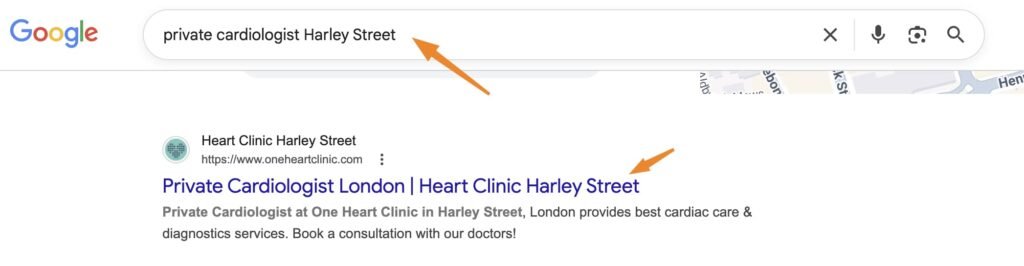
This means using location-specific keywords in page titles, headings and body copy. For example, a clinic may target “private cardiologist Harley Street” rather than the broader term “private cardiologist”.
It also includes the technical elements that help Google read your site correctly, such as LocalBusiness schema, MedicalOrganization schema, full NAP details on service pages and clear URL structures.
When these elements are well organised, Google can crawl your website more easily and connect each page to the right location and service.
Google Business Profile Optimisation for Healthcare Providers
Google Business Profile optimisation is a key part of local SEO, especially for private clinics that want to appear in Google Maps and the local pack.
A strong GBP should include healthcare-specific categories, a complete list of treatments, an actively managed Q&A section, regular Google Posts and fresh clinical photography. These details help patients understand your clinic before they even visit your website.
Google’s own data shows that customers are 2.7 times more likely to consider a business reputable when they find a complete Business Profile. For a private clinic, this matters at a very practical level: patients often compare several providers before deciding who to contact.
Healthcare Citation Building and Local Directory Management
UK private clinics have a more specific citation ecosystem than many other local businesses.
Alongside Google and Yell, healthcare directories such as Doctify, TopDoctors, WhatClinic, the GMC Find a Doctor tool and relevant professional body directories can all support local visibility.
Each listing acts as a citation. When your clinic’s name, address and phone number are accurate and consistent across these platforms, Google receives a stronger geographic signal. A structured citation audit, followed by new placements on trusted healthcare directories, can therefore become one of the most valuable local SEO activities for a private clinic.
Patient Review Generation and Reputation Management
Reviews work on two levels: they influence local rankings and they affect patient decisions.
The volume, recency, rating and diversity of your Google reviews can all influence whether your clinic appears in the local pack. At the same time, reviews help potential patients decide whether they feel confident enough to book.
For private clinics, review management needs to be both systematic and compliant. The ASA CAP Code prohibits cherry-picking testimonials or using reviews in a way that creates a misleadingly positive impression. This means every review strategy should focus on genuine patient feedback, balanced presentation and professional responses.
Local SEO in Healthcare: YMYL and E-E-A-T Explained
Private clinics face a very different local SEO landscape from a restaurant, salon or high street retailer. The main reason is Google’s YMYL classification.
What Is YMYL?
YMYL stands for Your Money or Your Life. It refers to content that can significantly affect a person’s health, financial stability, safety or wellbeing.
Healthcare content falls into one of the most sensitive YMYL categories. If a patient finds inaccurate medical information and acts on it, the consequences can be serious. For this reason, Google holds healthcare websites, including local service pages for private clinics, to a much higher quality standard.
Pages that lack credibility signals, use vague claims or fail to show professional expertise can struggle to rank, even when the technical SEO is well managed.
What Is E-E-A-T?
E-E-A-T stands for Experience, Expertise, Authoritativeness and Trustworthiness. These are the quality signals Google uses to understand whether a page is reliable, especially for sensitive topics like healthcare.
For a private clinic, E-E-A-T should be treated as a practical checklist. Local pages should make it clear who provides the service, what qualifications they have, where the clinic is based, how patients can contact the practice, and when the medical information was last reviewed.
The impact on local SEO is direct. Without strong E-E-A-T signals, even a well-optimised clinic website may underperform. Google is far less likely to show a clinic in the local pack for health-related searches if it cannot clearly understand why that clinic should be trusted.
Local SEO vs SEO vs Paid Search for Private Clinics
Clinic directors often group local SEO, general SEO and paid search together, but they work in different ways and serve different purposes.
| Factor | Local SEO | General SEO | Google Ads |
|---|---|---|---|
| Primary Goal | Google Maps & local pack for nearby patient searches | Rank for condition/treatment keywords regardless of location | Immediate paid visibility for competitive keywords |
| Cost Model | No cost per click once ranking | No cost per click once ranking | Cost per click; stops with budget |
| Time to Results | 6–12 weeks for GBP gains; 4–6 months sustained | 4–12 months depending on competition | Days after launch |
| Compounds Over Time | Yes | Yes | No |
General SEO focuses on improving a website’s organic rankings for keywords that are not necessarily tied to a specific location. For example, a clinic may want to rank for condition-led or treatment-led searches such as “what causes acne scarring?” or “how does IV therapy work?”
Local SEO, instead, targets searches where the patient’s location is central to the decision. This includes queries such as “private GP near me”, “dermatologist in Manchester” or “physiotherapy clinic Bristol”.
Paid search, usually through Google Ads, gives clinics immediate visibility for selected keywords, but every click has a cost. Once the campaign budget is paused, that visibility stops.
The three channels work best when they support each other. A strong UK healthcare marketing strategy can use local SEO to attract nearby patients, general SEO to build authority around conditions and treatments, and Google Ads to capture demand while organic visibility is still growing. This creates a more stable patient acquisition system than relying on one channel alone.
Why Local SEO Matters More for Private Clinics in 2026?
For private clinics, local SEO has become more than a way to appear for searches like “clinic near me”. It now affects how patients discover a provider, compare options and decide who feels credible enough to contact.
Search results are also much busier than they were a few years ago. A patient may see an AI summary, a local pack, reviews, maps, opening hours and paid results before reaching a clinic’s website. That means the first impression often happens inside Google itself.
The AI Overview Effect on Healthcare Search
Google’s AI Overviews are changing the space clinics have available in search. These summaries can appear above the standard organic results and give patients an answer before they scroll any further.
According to Ahrefs, 43% of health queries trigger an AI Overview. Seer Interactive also found that, when an AI Overview is present, click-through rates on the results below can fall by up to 61%.
For clinics, this makes weak content easier to ignore. A generic service page with a few city names added is unlikely to help Google understand what the clinic offers, who provides the treatment and why the information should be trusted.
This is where Generative Engine Optimisation (GEO) fits in. The focus is on clear service pages, named clinical expertise, structured data and locally specific information that AI systems can understand and reference.
Zero-Click Searches and Clinic Discovery
Many patients do not click through straight away. Roughly 60% of Google searches now end without a click, because the user finds enough information directly in the results.
For a private clinic, this makes the Google Business Profile much more important. Reviews, services, photos, address, opening hours and booking links can all shape the patient’s view before they ever land on the website.
A complete and active profile can support trust. An outdated or thin listing can do the opposite.
Local SEO as a Patient Acquisition Channel
Local searches usually come from people who are close to taking action. Someone searching for “private GP near me”, “dermatologist Manchester” or “physiotherapy clinic Bristol” is already comparing options.
That is why small changes in local visibility can matter. 78% of local mobile searches result in an offline visit or purchase within 24 hours, so better visibility in Google Maps or the local pack can translate into more calls, forms and appointment requests.
The commercial impact can be meaningful. With patient lifetime values often ranging from £500 to £5,000, depending on the specialism, local SEO is a patient acquisition channel, not just a visibility exercise.According to Google, 87% of patients who find a healthcare provider online go on to book an appointment. The local pack helps them find the clinic. The profile, reviews and website help them decide whether to make contact.
Local SEO for healthcare operates within a regulatory environment that general local businesses do not face. These three risks require proactive management.
Patient testimonial restrictions under the ASA CAP Code. The Advertising Standards Authority’s CAP Code applies to testimonials published on your website, Google Business Profile, and all other owned digital channels. Clinics offering cosmetic surgical procedures face additional restrictions: before-and-after imagery may not be used in advertising, and testimonials must not encourage unrealistic expectations of outcomes.
UK GDPR and patient contact data. Every contact form, online booking tool, or review request mechanism must comply with UK GDPR and the Privacy and Electronic Communications Regulations (PECR). Patients must understand how their data will be used, provide valid lawful consent, and be able to withdraw it. Ensure your privacy notice is current and your booking software holds a valid data processing agreement.
Misleading treatment claims in local content. Google’s quality guidelines and the ASA CAP Code both prohibit medical claims that cannot be clinically substantiated. A local landing page describing a treatment as “guaranteed to” produce a specific outcome risks both a Google quality penalty and a formal ASA complaint. Every claim on every local page — including your GBP business description — must be accurate and capable of substantiation.
What is the difference between local SEO and general SEO for private clinics?
General SEO improves a website’s organic visibility for keywords that are not necessarily linked to a specific location.
Local SEO, instead, focuses on searches where location is a key part of the patient’s decision, such as services in a specific city, borough or postcode.
In practice, private clinics need both. General SEO helps build authority around conditions, treatments and patient questions. Local SEO turns that authority into geographically relevant patient enquiries.
How long does local SEO take to produce results for a private clinic?
Early improvements in local pack visibility can often appear within six to twelve weeks after Google Business Profile optimisation.
A more consistent increase in patient enquiries usually takes four to six months. Local SEO tends to build over time, so clinics that keep optimising for twelve months or more often create a stronger gap between themselves and competitors who treat it as a one-off task.
Is healthcare local SEO subject to different rules than other industries?
Yes. Healthcare local SEO is subject to higher standards because medical content falls under Google’s YMYL classification.
This means E-E-A-T signals are especially important for private clinics. Regulatory compliance also matters. The ASA CAP Code affects testimonials and treatment claims, while UK GDPR and PECR govern how patient data is collected and used. For registered providers, CQC requirements can also influence what a clinic can publish.
What local SEO metrics should a clinic director actually track?
The most useful metrics are the ones that show whether local visibility is turning into real enquiries.
Look at Google Business Profile calls, website clicks, direction requests, review growth, local pack positions and conversions from location-specific pages.
Total traffic alone says very little unless you can see where visitors came from, what they were searching for and whether they booked or made contact.
Does Google penalise private clinics for buying reviews?
Yes. Google’s guidelines prohibit buying, incentivising or manipulating reviews.
For UK private clinics, the risk is also reputational and regulatory. The Competition and Markets Authority (CMA) has taken action against businesses using fake or incentivised reviews, so review generation needs to be handled carefully.
The safest approach is to build a legitimate review process: post-appointment messages, a clear link to the Google review page and consistent follow-up, without pressure or incentives.
What is the ROI of local SEO compared to Google Ads for a private clinic?
Google Ads can bring in enquiries quickly, but the results last only while the budget is active. Local SEO builds more gradually and can keep your clinic visible in maps, location searches and patient reviews over time.
For most private clinics, the strongest approach combines both: Google Ads to capture demand while local SEO is building, and local SEO to provide sustainable, cost-per-click-free visibility once rankings are established.
Local SEO is a long-term patient acquisition asset. UpMedico works with UK and Irish private clinics to build compliant, high-performance local visibility that compounds over time.
Book a Free Consultation →