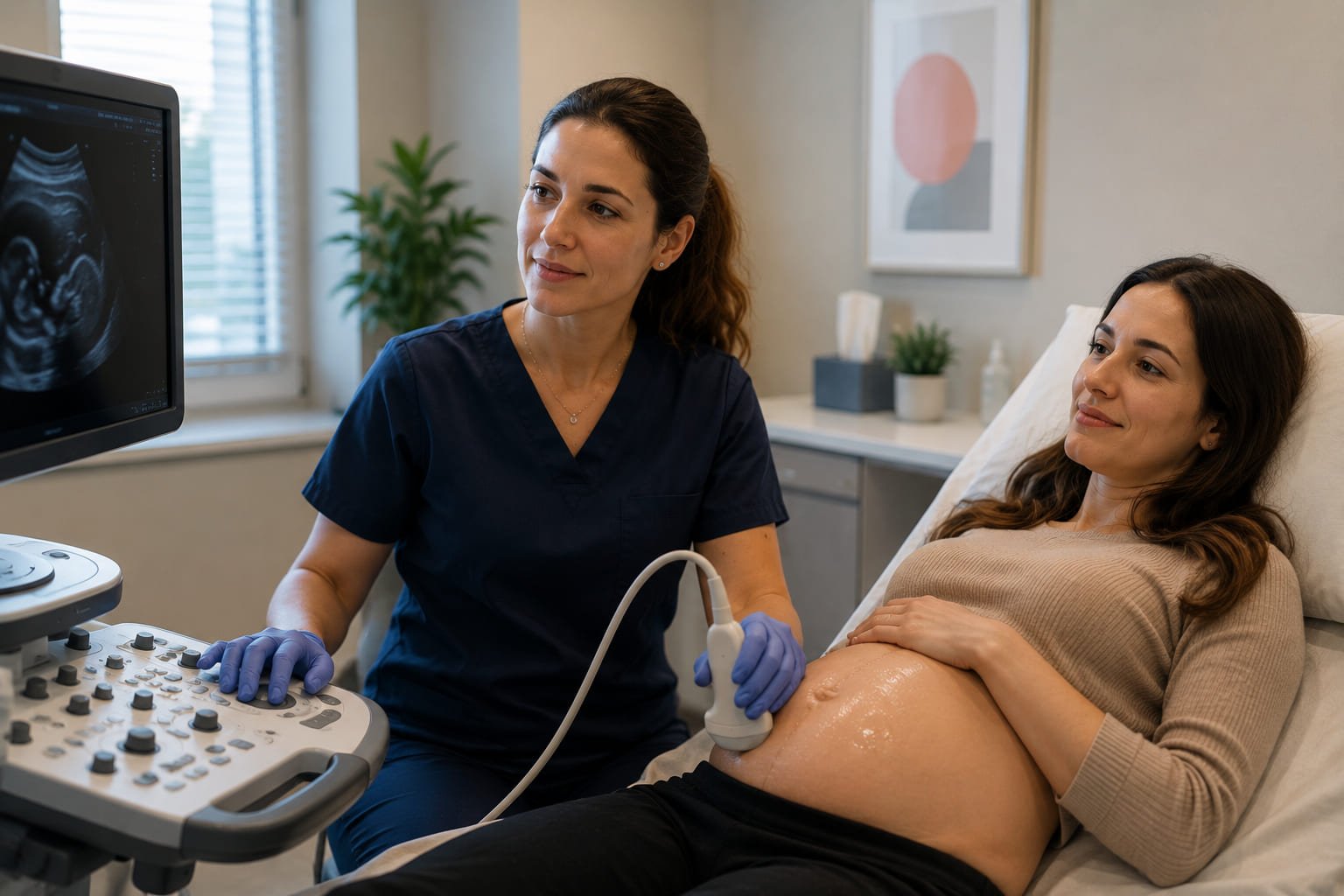
It is the entire market. Parents who cannot get an early reassurance scan, or a bonding 4D session, on the NHS timetable are already searching Google for someone who can see them this week.
The clinics that win that search are rarely the ones with the newest machine. They are the ones whose Google listing, booking page and review profile make it obvious, in under ten seconds, that a scan is available now. This is what separates a fully booked diary from an empty one, and it is entirely within a clinic director’s control.
What follows are the four growth levers UpMedico runs for pregnancy and wellbeing scan clinics, from paid search to referral partnerships, plus the compliance lines a clinic cannot cross while pulling them.
The Compliance Line You Cannot Cross When Marketing Pregnancy Scans
Before a single pound goes into Google Ads or SEO, a private ultrasound clinic needs to know where the regulatory lines sit. Getting this wrong is not a small mistake: it is the fastest way to lose an ad account, a CQC registration, or a patient’s trust in one go. Three areas cause almost every problem UpMedico sees among pregnancy and wellbeing scan clinics.
ASA CAP Code: reassurance is not diagnosis
If a scan is offered for bonding, gender reveal or general reassurance rather than clinical diagnosis, the ad copy must say so. Phrases implying guaranteed accuracy or diagnostic certainty (“100% accurate,” “confirms a healthy baby”) breach the ASA CAP Code and are a common reason clinic ads get pulled.
CQC registration must match the marketing claims
A clinic advertising diagnostic scanning or screening services beyond what its CQC registration covers is exposed on two fronts at once: an ASA complaint and a CQC compliance review. Marketing copy should be checked against the actual registered scope before it goes live, not after.
Pregnancy status is special category data
A due date captured on a booking form is health data under UK GDPR. Remarketing pixels, CRM exports and any SMS or email follow-up need explicit, PECR-compliant consent, collected separately from the booking itself, not bundled into a pre-ticked box.
Why Pregnancy and Wellbeing Scan Marketing Is Different
A parent searching for a private scan is not comparison shopping the way someone booking a haircut is. The window is narrow: an early reassurance scan only makes sense for a handful of weeks, and a bonding session usually needs to fit around a partner’s availability. The emotional stakes are high enough that friction reads as risk.
A booking page that asks someone to call during office hours, or a Google listing with no photos and a three-star rating sitting unanswered, does not just lose a click. It reads as a clinic that will not be there when it matters.
This is also a category where trust signals do more work than price. Parents rarely choose the cheapest scan; they choose the one that looks calm, professional and immediately available. That reframes the whole growth problem: it is less about beating a competitor’s price and more about being the obvious, low-friction, visibly trustworthy option in the ten seconds someone spends deciding.
“
Parents booking a pregnancy scan are making a decision in a very short window, often at 9pm on a phone. If your booking page makes them work for it, they close the tab and try the next clinic on the map. This is the one niche where removing friction matters more than almost anything else you can spend money on.
– Angelo Rosati, CEO of UpMedico
Strategy 1: Turn Google Business Profile Into a Same-Week Booking Engine
For “private pregnancy scan near me” and its variants, Google Business Profile usually outranks the clinic’s own website in the map pack, which means it is often the first, and sometimes the only, thing a parent sees. Most clinics treat it as a static listing rather than the booking engine it actually is, and it is one of the first things UpMedico audits when a scan clinic comes on board.
Do This
Add the direct booking link, not just a phone number, to the profile
Upload real clinic and sonographer photos, refreshed quarterly
Keep opening hours and same-day availability messaging current every week
Avoid This
Leaving the profile unclaimed or using stock stethoscope imagery
Routing every enquiry to a phone line with no online option
Running one generic profile for a clinic with multiple locations
Match the Listing to the Gap It Is Filling
The Google Business Profile description, the first services listed and the Q&A section should all speak directly to the NHS wait, not just describe the scan menu. A line as simple as “early reassurance scans available this week, no GP referral needed” answers the exact question a worried parent typed into Google thirty seconds earlier.
Build a Local Landing Page for Every Clinic Location
A clinic with two or three locations needs a dedicated page per site, not one generic services page. Each page should carry its own address, parking details, scan menu and reviews so it can rank locally and give local SEO something specific to work with, rather than competing against the clinic’s own homepage for the same keyword.
Strategy 2: Run Google Ads Campaigns Built for This Niche, Not Generic Healthcare Ads
Google Business Profile captures demand that already exists. Google Ads is how a clinic goes and gets the rest of it, but a generic healthcare ads template built for GPs or dermatology clinics wastes budget fast in this niche. UpMedico builds these campaigns specifically around pregnancy and wellbeing scan searches, not as a copy-paste of a broader healthcare account.
The difference shows up in the account structure itself, not just the ad copy. A clinic running the same setup as a generic private GP account will pay for clicks it should never have bid on in the first place.
Element
Generic Healthcare Google Ads
UpMedico’s Pregnancy Scan Campaigns
Keyword strategy
Broad match on “ultrasound clinic”
Niche negative-keyword list excluding NHS-referral and symptom searches
Ad copy
Generic “book your scan today”
Compliant copy built around the exact NHS-wait gap parents are searching for
Landing page
One shared services page for every treatment
A dedicated page per scan type and location
Bidding
One CPA target across every service
Separate CPA targets per package: dating, reassurance, 4D bonding
Compliance review
Rarely checked against ASA or CQC scope
Checked against the ASA CAP Code and CQC registration before every launch
“
We see this constantly: a clinic hands its pregnancy scan account to a generalist agency running the same playbook as a GP practice, and it shows in wasted spend within weeks. Every UpMedico healthcare account is built around the specific patient search behind it, which is exactly why our clients see a lower cost per booked scan than a generic setup.
– Angelo Rosati, CEO of UpMedico
See UpMedico’s Approach to Healthcare Google Ads
Built for private clinics, not adapted from a generic small-business template.
Strategy 3: Build a Booking Funnel That Removes Every Point of Friction
With 82% of bookings starting on a mobile device, a funnel that was designed for desktop, or that hands the patient off to a phone call halfway through, loses people at exactly the point they were ready to pay. The fix is a short, specific sequence rather than a full platform rebuild.
The Five-Step Booking Funnel
1
A mobile booking widget with live availability
Patients see real open slots for this week, not a generic “enquire now” form that ends in a wait for a callback.
2
A clear tiered package selector
Dating, early reassurance, gender reveal, growth check and 4D bonding shown as distinct, priced options rather than one long text block.
3
A secure deposit link at the point of booking
A small deposit confirms the slot immediately and cuts the no-shows that quietly erode a fully booked diary.
4
Automatic confirmation and reminder texts
A short SMS sequence, sent with proper PECR consent, reduces missed appointments without adding staff workload.
5
A post-scan review and referral prompt
Sent once, at the moment satisfaction is highest, rather than left to chance.
None of this requires a new website. UpMedico’s work on landing pages for medical practices with a central London same-day diagnostic imaging clinic, London Private Ultrasound, focused on exactly this: shortening the path from search click to a confirmed, paid booking, rather than redesigning the whole site. More detail on that work sits in the case studies section.
Strategy 4: Turn Reviews and Referral Partners Into a Compounding Trust Engine
With 73% of patients weighing reviews before they book, trust signals are not a nice-to-have. They sit directly in the decision path, alongside a smaller but steady stream of bookings that come through midwives, doulas and GPs.
Sonographer credentials, visible
Named sonographer bios with qualifications on the site build the E-E-A-T signal Google and worried parents both look for.
Doctify and Top Doctors profiles kept current
Directory profiles matter for this niche specifically, since parents often check a second source before booking a health decision.
Midwife, doula and GP referral partnerships
A short, well-timed information pack for local independent midwives and doulas often generates steadier bookings than another ad campaign.
Automated, well-timed review requests
One request, sent right after a positive scan experience, consistently outperforms a generic monthly blast to the whole patient list.
“
A midwife who refers three clients a month is worth more, over a year, than most one-off ad campaigns. Clinics that treat referral partners as a real channel, with a proper information pack and a point of contact, build a booking pipeline that keeps working even when ad costs rise.
– Angelo Rosati, CEO of UpMedico
See How a Landing Page Rebuild Performs
Compare booking-funnel approaches for private diagnostic and ultrasound clinics.
Track What Actually Predicts Bookings, Not Just Clicks
Click volume and impression counts are easy to report and mostly irrelevant to a clinic director’s actual goal, which is a full diary next week. The metrics below are the same ones UpMedico builds into a client dashboard, and they include a growing channel: how the clinic shows up in AI-generated answers, not just the traditional search results.
Is it legal to advertise pregnancy reassurance scans on Google in the UK?+
Yes, provided the ads stay within the ASA CAP Code and Google’s healthcare and medicines policies. This means avoiding diagnostic-certainty language for a non-diagnostic scan, being clear about what the service does and does not confirm, and keeping the ad copy consistent with the clinic’s actual CQC registration.
What does it typically cost to get more pregnancy scan bookings through Google Ads?+
Cost per booked ultrasound scan in the UK typically sits in the £20–£40 range, though this varies with location, competition and how well the booking funnel converts. Treat this as an illustrative benchmark rather than a guaranteed figure; a clinic with a slow or confusing booking page will pay more per booking even at the same click cost.
How quickly can a private ultrasound clinic see more bookings after changing its marketing?+
Google Business Profile and booking-funnel fixes tend to show an effect within two to four weeks, since they remove friction from demand that already exists. Local SEO and referral partnerships build more gradually, usually over two to three months, because they depend on ranking momentum and relationship trust rather than a single change.
Does a private ultrasound clinic need CQC registration to run pregnancy scan ads?+
It depends on what the clinic actually does. Diagnostic imaging carried out as a regulated activity generally requires CQC registration; a purely non-diagnostic bonding or wellbeing scan may sit outside that scope. Either way, the marketing must describe only what the clinic is actually registered and equipped to provide.
Do referral partnerships with midwives and doulas actually generate bookings?+
Yes, and they tend to produce steadier, higher-trust bookings than paid channels alone, since the referral carries a personal recommendation. The return is not always immediate; it builds as the relationship and the clinic’s reputation with that referrer grow.
What is the difference between marketing a diagnostic scan and a wellbeing or bonding scan?+
A diagnostic scan’s marketing can reference clinical purpose and, where relevant, referral pathways, but must stay within CQC scope and avoid overstating certainty. A wellbeing or bonding scan’s marketing should lean into the experience, comfort and connection it offers, while explicitly stating that it is not a substitute for clinical or NHS antenatal care.
None of these four levers require a bigger machine or a second location. They require a Google listing that behaves like a booking engine, Google Ads built around this exact niche rather than borrowed from a generic healthcare account, a funnel that respects how tired, mobile-first parents actually book things, and a trust engine built from reviews and referral partners rather than left to chance.
Clinics that get all four working together are the ones filling next week’s diary, not just this month’s ad spend. This is the exact playbook UpMedico runs for pregnancy and wellbeing scan clinics; more growth breakdowns like it live in the UpMedico insight hub.
Ready to Fill Every Scan Slot This Month?
Talk to UpMedico about a growth plan built specifically for private pregnancy and wellbeing ultrasound clinics.
Angelo Rosati is President of Strategic Growth at UpMedico, an MBA, and an AI enthusiast with deep expertise in digital marketing and healthcare innovation. He has led strategic initiatives across platforms like Google and HubSpot, helping healthcare providers and digital health companies achieve measurable growth. Angelo has worked with global organizations including Unmind, Frankie Health, Holistic Andrology, and Rebrandly. His work combines AI, data-driven marketing, and business strategy to help healthcare companies thrive in today’s competitive digital landscape.
The short answer Tuesday and Wednesday scanner hours stay empty because most Google Ads accounts spend evenly across the week, drifting toward cheap weekend demand.
To provide the best experiences, we use technologies like cookies to store and/or access device information. Consenting to these technologies will allow us to process data such as browsing behavior or unique IDs on this site. Not consenting or withdrawing consent, may adversely affect certain features and functions.
Functional
Always active
The technical storage or access is strictly necessary for the legitimate purpose of enabling the use of a specific service explicitly requested by the subscriber or user, or for the sole purpose of carrying out the transmission of a communication over an electronic communications network.
Preferences
The technical storage or access is necessary for the legitimate purpose of storing preferences that are not requested by the subscriber or user.
Statistics
The technical storage or access that is used exclusively for statistical purposes.The technical storage or access that is used exclusively for anonymous statistical purposes. Without a subpoena, voluntary compliance on the part of your Internet Service Provider, or additional records from a third party, information stored or retrieved for this purpose alone cannot usually be used to identify you.
Marketing
The technical storage or access is required to create user profiles to send advertising, or to track the user on a website or across several websites for similar marketing purposes.