
The short answer
Google treats ADHD, depression and anxiety as sensitive health categories, which restricts keywords, audience targeting and ad copy for private clinics. UK clinics that prescribe remotely now need LegitScript certification before Google will approve prescription drug services. Landing pages must show clinician GMC numbers, CQC registration and clear pricing. Ad copy must avoid medication names and outcome guarantees. Irish campaigns face a stricter regime still, because HPRA rules ban advertising prescription-only medicines to the public.
On this page
- What a suspended account costs a private ADHD clinic
- Why does Google restrict mental health advertising?
- Why generalist agencies get ADHD clinics suspended
- LegitScript certification for UK ADHD clinics
- What Google checks on your landing page
- Prohibited and compliant ad copy, side by side
- The first 24 hours after a suspension
- Ireland: where a compliant UK campaign breaks
- Compliant call recording and the Call-to-Booking Framework™
- What this looks like with UpMedico running your Google Ads
- Frequently asked questions
What a suspended account costs a private ADHD clinic
A suspended Google Ads account does not drain a clinic slowly. It stops the revenue at exactly the rate the account was producing it. The demand behind those campaigns is not in doubt: in June 2026 NHS England Digital counted up to 959,662 open referrals that may be for an ADHD assessment in England.
Take the cost per qualified assessment we published in The UK Private ADHD Clinic Growth Index. A London clinic spending £2,000 a month books roughly six qualified assessments at £340 each. At the £950 median assessment fee that is about £5,600 of booked work, before titration, follow-ups or shared care.
Spread across the month, every week offline removes roughly £1,290 of booked assessment work. Google warns most advertisers at least seven days before suspending an account, but an egregious violation suspends it on the spot, with no warning and no wind-down.
Then comes the cost nobody budgets for. Rebuilding means new campaigns with no conversion history, so the bidding models start from zero on keywords that took months to train. Clinics routinely spend six weeks getting back to the cost per booking they had on the Friday before the suspension.
Why does Google restrict mental health advertising?
The reasoning is about the person doing the searching, not the clinic doing the advertising. Someone typing “adult ADHD assessment” at eleven at night is, in Google’s terms, a vulnerable user. Two separate policy families apply to that search, and they fail in different ways.
The first is the healthcare and medicines policy, which restricts the promotion of online prescribing, dispensing and sale of prescription drugs. It works by location and by certification, so the same service can be advertisable in one country and blocked outright in the next.
The second is the personalised advertising policy. Health is a sensitive interest category, and Google’s guidance on health in personalised advertising names mental health conditions including depression, anxiety and addiction, alongside autism. Advertisers in these categories cannot use Customer Match, their own data segments, audience expansion or lookalike segments.
ADHD is not spelled out in that list. Reviewers treat it as a mental health condition anyway, and a clinic that builds its account on the assumption that ADHD sits outside the category is building on a technicality. The safe reading is that every ADHD campaign is a sensitive category campaign.
In practice, that removes a clinic’s three favourite tactics at once. No remarketing to people who read the symptoms page. No lookalike audiences modelled on past patients. No ad copy that implies Google knows something about the reader’s health, which is why “you probably have ADHD” headlines get disapproved while “private ADHD assessment” headlines do not.
Why generalist agencies get ADHD clinics suspended
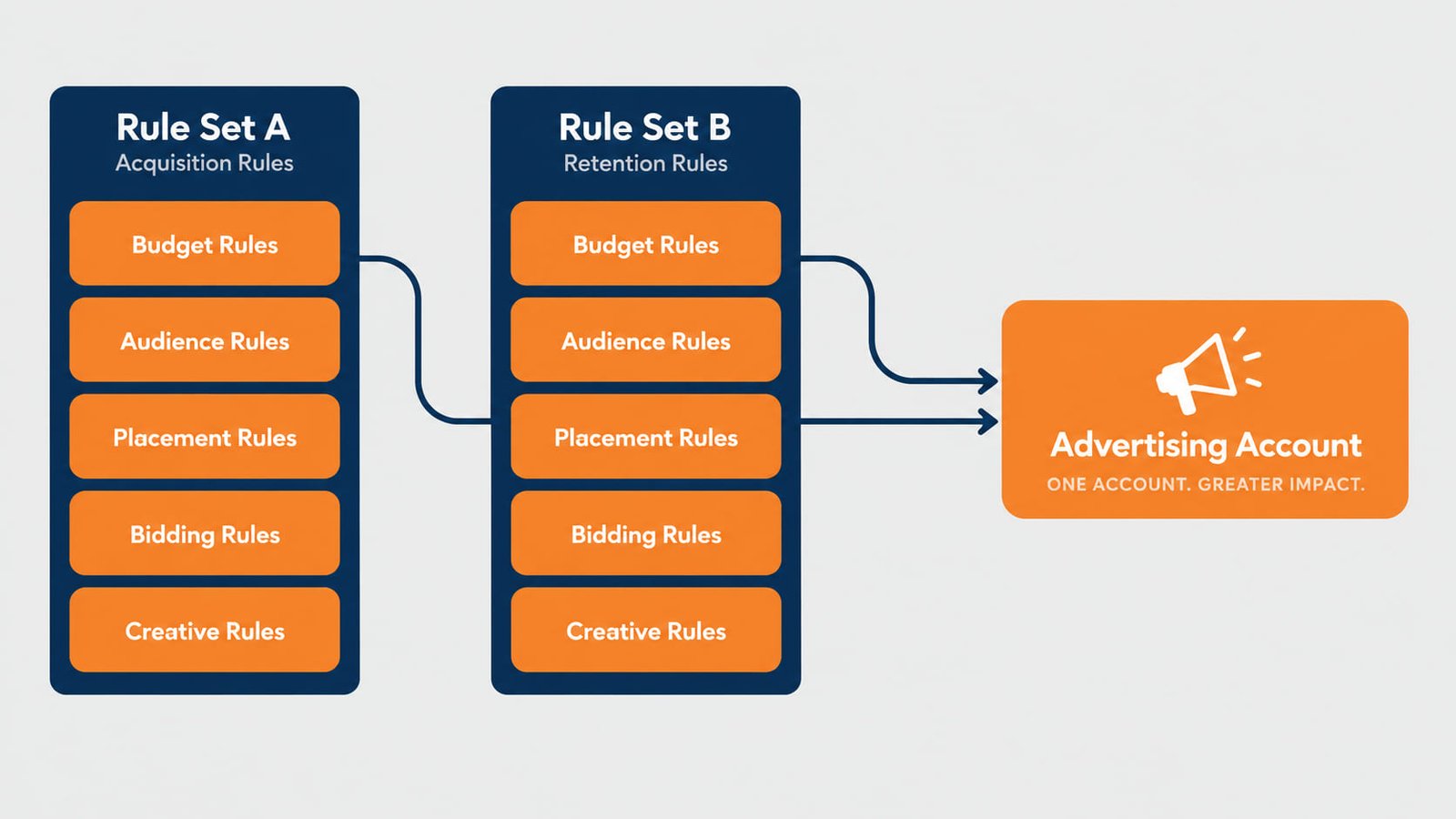
Nothing in a generalist agency’s playbook is wrong for e-commerce. Audience-first structures, aggressive remarketing, urgency in the headline and lookalikes built from the customer list are standard practice. Applied to an ADHD clinic, three of those four are policy violations on arrival.
The second failure is sequencing. Policy gets read after the disapproval, not before the build, so the clinic discovers the certification requirement in a suspension notice. By then the account has a violation on its record and the clinic is arguing from a weaker position than it needed to be in.
Third, generalist accounts optimise to the form fill, because that is the conversion the platform reports cleanly. Our client data puts 58% of London ADHD enquiries on the phone, and the phone is where the compliance exposure sits, since a recorded conversation about a suspected condition is health data.
An agency that cannot see those calls cannot govern them either. We covered what that blindness costs at the lead stage in Why 70% of your ADHD leads never book an assessment.
LegitScript certification for UK ADHD clinics
LegitScript is a third-party certification body whose Healthcare Merchant Certification Google accepts as evidence that a provider operates lawfully. Since 26 June 2025 Google has recognised it for telemedicine providers in the United Kingdom, announced here. That date matters, because accounts built before it were operating under different rules.
Not every ADHD clinic needs it. The trigger is the service, not the specialty. If your clinic prescribes or arranges medication remotely, you are a telemedicine provider for Google’s purposes and its prescription drug services policy requires certification before those ads run. An assessment-only clinic that discharges back to the GP sits outside it.
The process runs in five steps: eligibility check, documentation, application, expert review, certification, followed by ongoing monitoring. The documentation is the part clinics underestimate, since it covers business and professional licences for every clinician, ownership details, the privacy policy, and the live service descriptions and marketing materials.
Fees are billed in US dollars and quoted per website: a one-off application fee of US$975 and an annual certification fee of US$2,150. Expedited handling costs a further US$2,500 and buys only a start, since it guarantees that review begins within two business days rather than that certification arrives by any particular date.
LegitScript publishes no standard turnaround, and Google certification is a second application that follows the first. Plan in weeks, not days, and never plan a clinic launch around a certification date you do not control. Certification then has to be maintained, because monitoring continues after approval.
What Google checks on your landing page
Ads are reviewed, but so is the page behind them. Google’s destination requirements name eleven ways a landing page fails on its own, including destination experience, insufficient original content, and unverified or unacceptable phone numbers. A thin page with a booking widget and no clinical substance is a policy problem, not just a weak page.
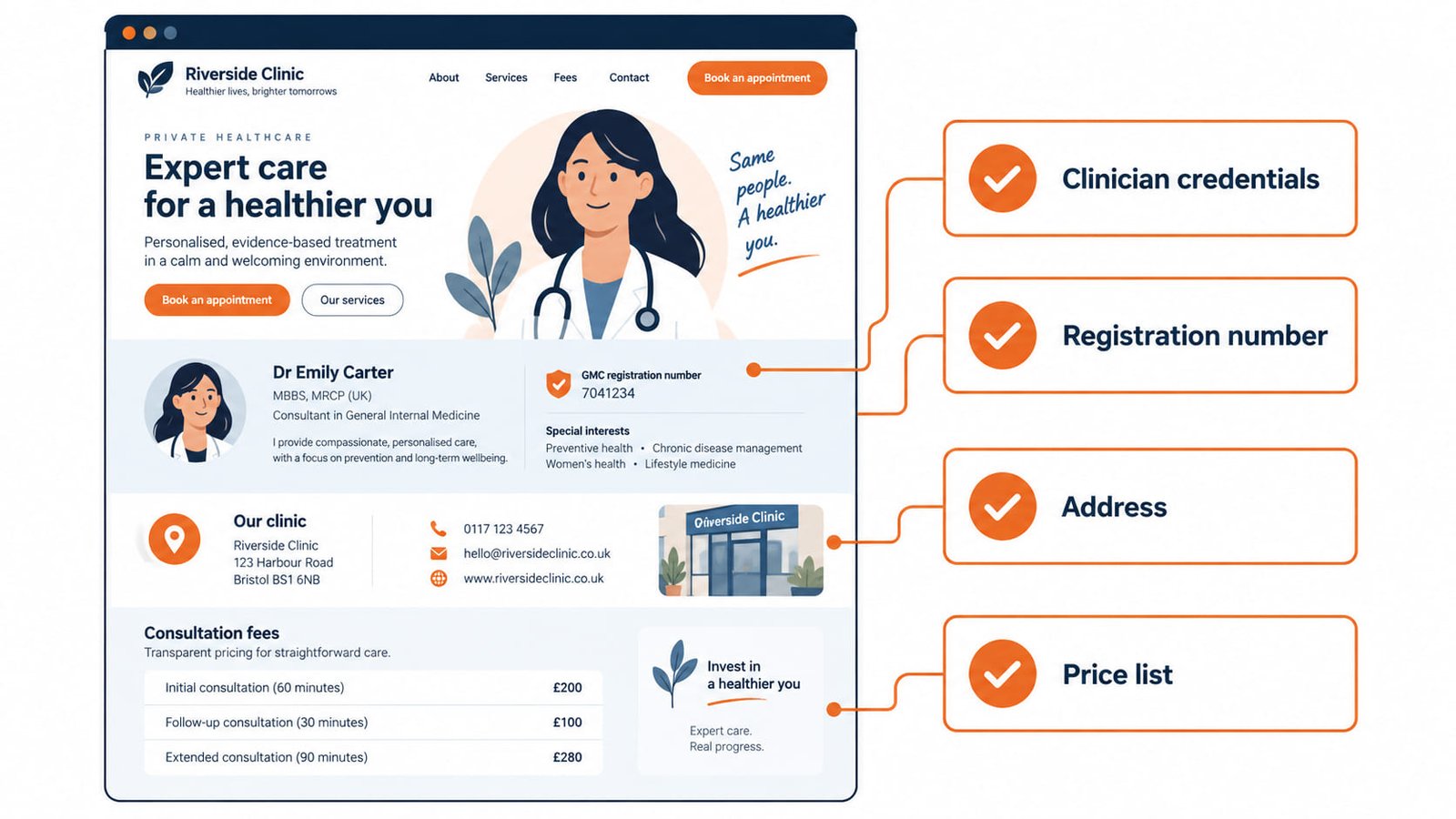
Worth being precise here, because the sector repeats it loosely: Google does not publish a rule demanding GMC numbers. UK regulators do. Treatment of disease, disorder or injury is a regulated activity under Schedule 1 of the 2014 Regulations, and certification review asks for professional licences in any case.
So the page carries both jobs at once. Named clinicians with GMC numbers, the CQC provider registration, a physical address, and the complete fee schedule covering assessment, titration and follow-up appointments. Every one of those elements also answers a question a reviewer would otherwise resolve against you.
Pricing deserves its own line. Publishing the full cost of a diagnosis pathway filters the enquiries that were never going to convert, which is the same mechanism that shapes cost per qualified assessment rather than cost per lead.
Prohibited and compliant ad copy, side by side
Most disapprovals come from a handful of repeated phrasings. The compliant rewrite is rarely weaker than the original, because specificity converts better than persuasion in a clinical category.
The first 24 hours after a suspension
This is the sequence UpMedico runs on a suspended clinical account, and the order is deliberate. Pause every campaign first, and delete nothing. Deleted ads and rewritten pages destroy the evidence a reviewer needs to see that the account has been corrected rather than emptied.
Hours one to four go to reading the notification properly. It names a specific policy. Audit the ads and the landing pages against that named policy only, capture the current state in screenshots, then work outward to the adjacent policies in the same family.
Hours four to eight are the fixes, each one logged with a timestamp. Hours eight to twenty-four are the appeal itself, filed once through Policy Manager. One complete appeal outperforms three partial ones, and a rejected appeal makes the next attempt harder.
One rule sits above the rest. Never open a second account while the first is suspended. Circumventing Google’s systems is itself treated as an egregious violation, and it converts a recoverable problem into a permanent one for the clinic and, frequently, for its directors.
Appeal template
Subject: Appeal, account [ID], suspension under [named policy]
We are a private healthcare provider registered with the Care Quality Commission under provider number [number], delivering the regulated activity of treatment of disease, disorder or injury. All assessments are carried out by clinicians on the GMC specialist register, listed with their registration numbers at [URL].
On [date] the account was suspended under [named policy]. We have made the following corrections: [list each change, with the ad or page it applies to and the time it was made]. The corrected assets are live at [URLs].
Patient safety governs how we advertise. We do not name prescription-only medicines, we make no diagnostic or outcome claims, and we publish our full fee schedule before any enquiry. We request reinstatement and will action any further correction you identify.
Ireland: where a compliant UK campaign breaks
Copying a clean London account into a Dublin one is where compliant clinics get caught. The binding constraint in Ireland is the law, not the ad platform. The Medicinal Products (Control of Advertising) Regulations 2007 prohibit advertising prescription-only medicines to the public, and the HPRA applies that to clinics and their websites, not only to manufacturers.
That forces a purely diagnostic funnel. Irish ads, landing pages and call scripts can promote assessment and diagnosis and nothing past it, with no medicine named, no titration service described and no account of what a prescriber might do afterwards. No certification releases a clinic from a national advertising prohibition.
Google’s own layer points the same way. As of September 2026 its prescription drug services policy lists the United Kingdom among the locations where certified advertisers may promote those services, and Ireland does not appear on that list. Treat Ireland as a second build, with its own ad groups, landing pages and call script.
Compliant call recording and the Call-to-Booking Framework™
UpMedico’s Call-to-Booking Framework™ combines healthcare-compliant call tracking, call recording, and structured intake analysis to identify why patient calls fail to convert, improving call-to-booking conversion by up to 20% within 90 days.
The compliance point most clinics miss is that the familiar IVR line, “calls are recorded for quality and training”, is a transparency notice. It is not consent, and an ADHD enquiry is health data.
Under UK GDPR you need a lawful basis under Article 6 and a separate Article 9 condition for special category data, with an appropriate policy document behind it. We set the retention period before the first recording exists, and recordings are deleted on that schedule rather than kept indefinitely.
Each recording is logged against the enquiry it belongs to, so a subject access request can be answered without searching the whole archive.
What this looks like with UpMedico running your Google Ads
UpMedico manages Google Ads exclusively for private healthcare clinics in the UK and Ireland. Every engagement includes compliant campaign build, keyword-level call tracking and recording, and monthly analysis through our Call-to-Booking Framework™, so you see exactly which keywords produce booked assessments and scans, not just clicks.
If your current agency reports on clicks and impressions but can’t tell you your cost per booked patient, request a 20-minute Clinical Campaign Audit. We’ll show you the gap in your own account.
Request a 20-minute Clinical Campaign AuditFrequently asked questions
Does every private ADHD clinic need LegitScript certification?
No. The requirement follows the service, not the specialty. A clinic that prescribes or arranges ADHD medication remotely is a telemedicine provider under Google’s prescription drug services policy and needs certification before those ads run in the UK. A clinic that assesses and then discharges the patient back to their GP, with no remote prescribing, falls outside it. If the clinic offers both pathways, the certified position is the safer one.
Can we remarket to people who visited our ADHD pages?
No. Health is a sensitive interest category in Google’s personalised advertising policy, and advertisers in it cannot use Customer Match, their own data segments, audience expansion or lookalike segments. That rules out remarketing lists built from symptom pages and audiences modelled on past patients. Keyword and contextual targeting remain available, with location, device and schedule controls, which is where a clinical account should be doing its work anyway.
How much warning does Google give before suspending an account?
For most violations Google sends a warning setting out the breach and the corrective steps at least seven days before suspension, and repeated breaches accumulate strikes before that point. Egregious violations carry no warning at all and suspend the account immediately, which is how clinics discover a prescription drug services problem. Google does not publish a turnaround time for appeals, so no agency can promise reinstatement by a given date.
Can we run our UK ADHD ads unchanged in Ireland?
Not unchanged, and not with light edits either. Irish campaigns are rebuilt from scratch around the assessment and diagnosis pathway, with no mention of medication, titration or ongoing prescribing, because the Medicinal Products (Control of Advertising) Regulations 2007 prohibit advertising prescription-only medicines to the public and the HPRA applies that prohibition to clinic websites and social accounts. Google’s prescription drug services policy also lists the United Kingdom among permitted locations while Ireland does not appear on it. Certification does not override a national advertising prohibition, so the Irish funnel stays diagnostic from the first ad to the confirmation email.