If your private clinic ranks on page one for its core procedures today, that position no longer carries the same value it did two years ago.
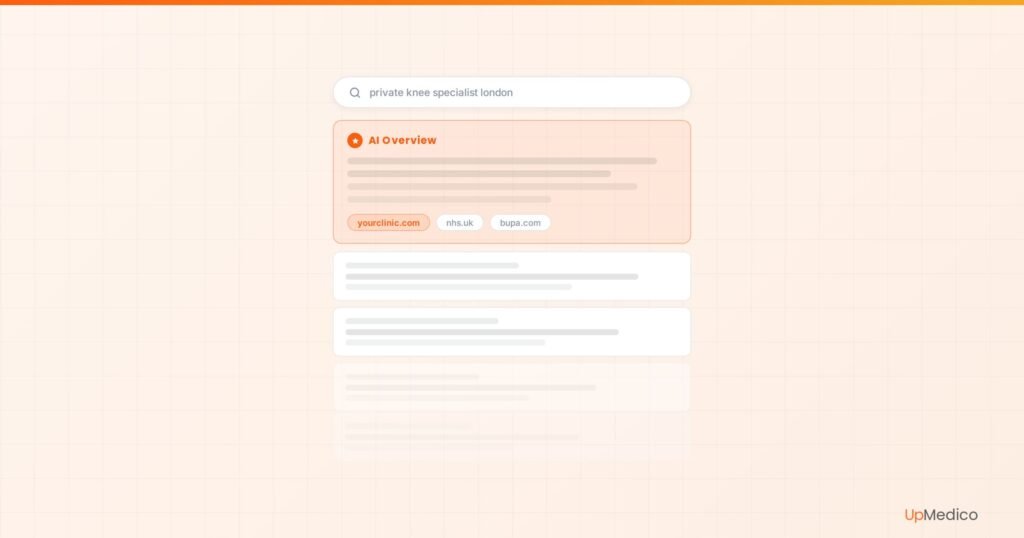
Google AI Overviews now appear on 88% of healthcare-related queries, and for treatment and procedure searches, that figure rises to 100%.
This means a patient searching for “private hip replacement London” or “gynaecologist Edinburgh self-pay” may see an AI-generated answer before reaching a single traditional organic result.
For clinics that have not adapted to this new search format, organic traffic can fall even when rankings stay stable. That gap is likely to become more visible throughout next years.
This is the challenge that Generative Engine Optimisation (GEO) for healthcare clinics is designed to solve.
GEO does not replace search engine optimisation. It adds a new layer of work focused on whether your content is extracted, cited and surfaced by AI systems, rather than simply indexed by Google.
For UK private clinic directors, understanding how GEO works and where the compliance boundaries sit, is now an operational priority.
⚠️ What UK Clinic Directors Must Understand Before Optimising for AI
Visibility in AI Overviews depends on trust signals. In healthcare, trust is also a regulatory issue.
For UK private clinics, this means AI visibility cannot be treated as a purely SEO-led activity. Before optimising for AI, clinic directors need to understand the risks already affecting private healthcare providers.
AI systems extract content from your pages and may present it as fact. If a treatment page includes unsupported outcome claims, exaggerated success rates or wording that does not meet ASA CAP Code standards, that content could appear directly inside an AI Overview.
The problem is context. A human reader may notice nuance, disclaimers or limitations on the page. An AI-generated answer may not carry those caveats in the same way.
The CAP Code prohibits healthcare claims that cannot be substantiated. Those rules still matter when Google’s systems choose to amplify your content. Audit service and treatment pages before pursuing AI visibility, not after.
One of the ways AI systems assess healthcare content is by looking at who has written or reviewed it. Pages with a named clinician, clear credentials, GMC registration where relevant and a visible review date are easier for both users and search systems to trust.
If those signals are missing, the page is less likely to be cited. But there is also another risk: if inaccurate clinical information is cited, it may appear with the added authority of an AI-generated answer.
Proper author and reviewer information supports GEO performance and adds the accountability layer expected from patient-facing clinical content under healthcare governance standards.
AI systems do not rely on one source. They pull details from your website, Google Business Profile, schema markup, healthcare directories and wider web mentions — including platforms such as Doctify, TopDoctors and WhatClinic.
If your address, opening hours, service list or clinician details differ across those sources, the risk compounds. Inconsistent data can reduce the chance of being cited, but it can also produce wrong information in AI-generated results.
Once those errors are cached or repeated by AI systems, they become harder to correct. For private clinics, local entity consistency is a core part of AI optimisation, not an admin task.
Why the AI Overview Problem Specific to Healthcare?
Zero-click search is not unique to healthcare. Seer Interactive’s analysis of 25.1 million organic impressions found that organic CTR drops from 1.62% to 0.61% when an AI Overview appears on a query. That is a 61% reduction. Paid CTR on the same queries fell by 68%.
For information-heavy sectors, this already creates a serious visibility problem. In healthcare, the impact is even greater.
There are two main reasons.
First, the searches that drive private clinic enquiries are exactly the kind of searches most likely to trigger AI Overviews.
Queries such as “private consultant for X”, “how much does Y cost in London” or “best clinic for Z near me” are high-intent, long-form and question-based. They are also highly valuable, because they often come from patients who are already comparing providers or preparing to book.
Google AI Overviews appear on 73.9% of long-tail health queries of seven words or more and on 66.9% of informational health queries. In other words, the searches that bring your best self-pay patients are also the searches most likely to be absorbed into an AI-generated answer.
Second, patient behaviour in the UK has already changed.
A Semble survey of 2,000 UK patients, published in November 2025, found that 24% now use AI tools for health guidance. The same survey found that 30% would consult AI rather than wait to see a clinician.
Among 16 to 25 year olds, 34% use ChatGPT specifically for health-related queries.
These are not hypothetical future patients. They are people researching symptoms, treatment options, costs and private providers right now. If your clinic is not included in the AI-generated answer they receive, it may never make it onto their shortlist.
The more counterintuitive point is this: AI citation can outperform a standard organic ranking.
Brands cited inside AI Overviews see 35% higher organic CTR and 91% higher paid CTR compared with non-cited brands appearing on the same results page.
For private clinics, citation is not a consolation prize for lost traffic. It is a conversion accelerator for providers with the content, trust signals and technical structure needed to earn that visibility.
Strategy 1: Build a Citation-Ready Content Architecture Around Your Specialties
AI systems do not rank pages in the same way traditional search does. They extract passages from pages they have already decided to trust.
That distinction matters because it changes the purpose of your content work. The goal is not to publish more pages. The goal is to publish pages that AI systems can extract, verify and cite.
- Opens with a direct 40–60 word answer block
- Named GMC-registered clinician as author/reviewer
- FAQPage schema marking Q&A sections
- Specific, verifiable claims (prices, wait times, credentials)
- Consistent NAP data across all directories
- Procedure pages linked to named consultant bios
- Marketing intro paragraphs before any real content
- Anonymous “our team” pages with no credentials
- No structured data or schema markup
- Vague outcome claims without substantiation
- Inconsistent clinic name/address across platforms
- Single generic “Services” page with no depth
The answer-first structure for service and treatment pages
Every service and treatment page should open with a direct answer block of 40 to 60 words. This block should answer the most common patient question about that procedure or service.
It should not read like a marketing introduction. It should not be a vague summary. It should give a clear, factual answer, written with the understanding that Google’s AI may extract that passage before a user reads the rest of the page.
For example, a private gynaecology page could open by answering: “What does a private gynaecology consultation involve and how much does it cost in the UK?”
The answer should be factual, clear and specific, with a price range where appropriate. The rest of the page can then provide the clinical detail, patient guidance and conversion content human readers need.
Condition and procedure hubs
A single service page for “Orthopaedic Surgery” is not a proper content hub.
A citation-ready hub should cover each major procedure separately, link to each relevant clinician’s bio, answer cost and access questions, and include FAQ sections marked up with FAQPage schema.
Pages with FAQPage markup are 3.2 times more likely to appear in Google AI Overviews, and independent testing found that FAQPage schema produced a 67% citation rate in AI responses for relevant queries.
For a mid-size private clinic, the practical step is to audit each specialty and map a clear hub structure:
one parent page per specialty, one page per major procedure or condition, and one bio page per named clinician.
This should not be treated as a quick content sprint. It is a deliberate architecture that should be planned over time, starting with the highest-revenue service lines.
Clinician bios as entity pages
A clinician bio page with a name, a headshot and a short paragraph about interests is not enough.
A proper entity page, supported by Physician schema, helps AI systems understand who the clinician is and why they are credible.
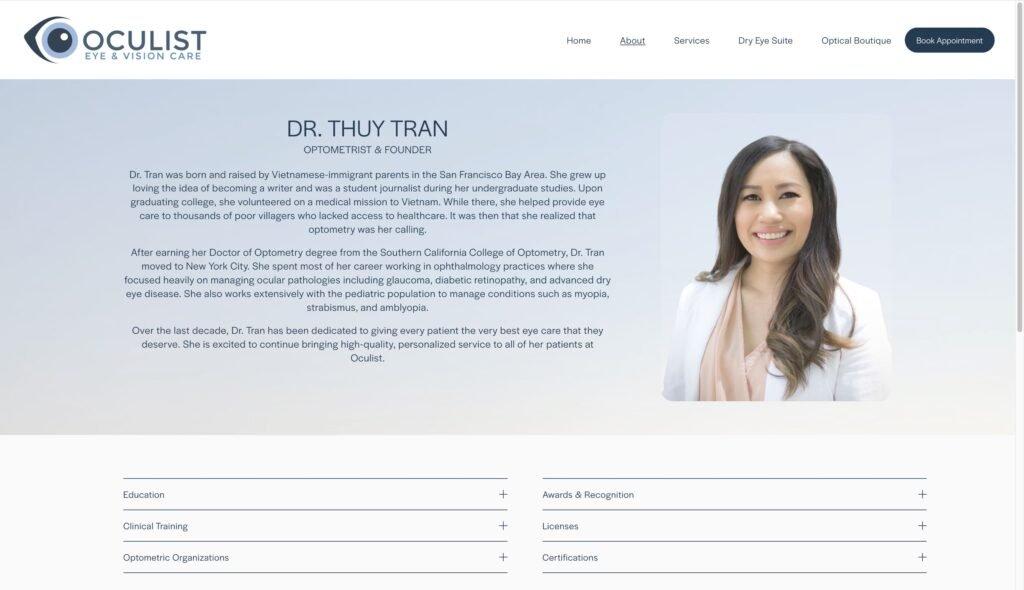
It should include the GMC registration number, primary specialty, sub-specialties, procedures performed, clinic affiliation, medical school, postgraduate qualifications, and links to published or peer-reviewed work where available.
Each of these details works as a machine-readable trust signal.
Pages with three or more complementary schema types, such as Article, Physician and FAQPage, are cited twice as often as pages using a single schema type.
Strategy 2: Make Your Structured Data Unambiguous
Structured data in healthcare is not a technical nice-to-have.
If AI systems cannot clearly verify what your clinic does, who works there and where you are located, they will rely on sources that make this information easier to understand.
The absence of schema markup does not simply reduce your chance of being cited. It can hand that visibility to a competitor that has already structured its data properly.
Core schema types every UK private clinic needs
A UK private clinic aiming for AI visibility should start with four essential schema types.
MedicalOrganization schema should be used on the homepage and location pages. This helps establish the clinic as a recognised medical entity, with a verifiable address, phone number, opening hours and specialties.
Google needs this information to place your clinic correctly in AI-generated answers for local searches such as “private dermatology clinic Manchester”. For AI systems, this works almost like a business registration layer.
Physician schema should be added to every named clinician bio page.
This connects each clinician to their credentials, specialty and clinic affiliation. It matters because AI systems answering searches such as “best private rheumatologist in Birmingham” are looking for named entities with clear expertise.
In that context, a clinic with five schema-marked consultants and clearly defined specialties gives AI systems more usable information than a competitor with a generic, unmarked “Meet Our Team” page.
FAQPage schema should be added to pages that include patient questions and answers.
This structures the content in a format AI systems can extract more easily, especially when the page answers common queries around symptoms, treatment options, costs, access, preparation or recovery.
Article schema with author markup should be used on blog posts, guides and clinical content.
This connects each article back to the clinician who wrote or reviewed it, helping complete the E-E-A-T loop. In healthcare, that connection matters because Google’s systems need to understand not just what the content says, but who is responsible for it.
Google Business Profile as a structured data source
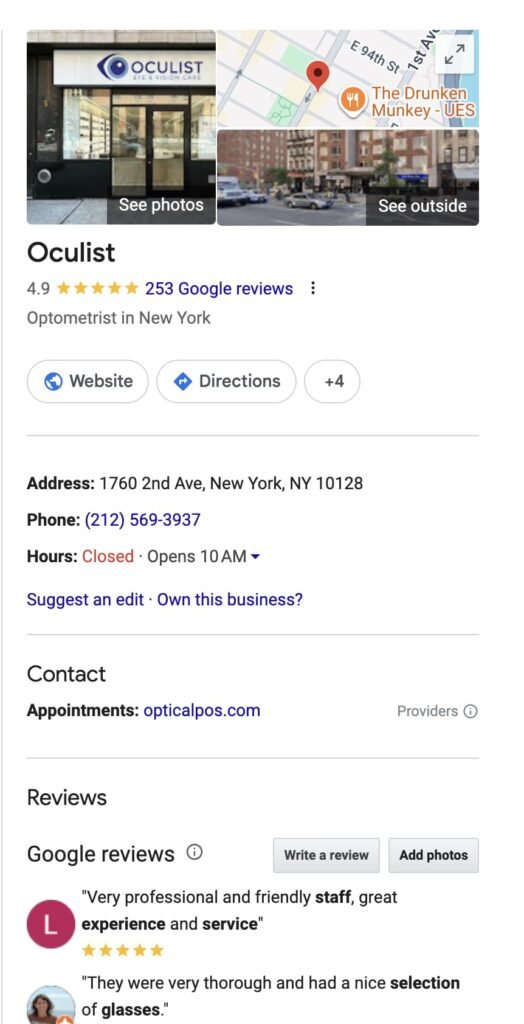
Your Google Business Profile is not just a local SEO asset. It is one of the main sources AI systems use when answering location-based healthcare queries.
Every field matters: services, specialties, accepted insurers, accessibility information and booking links should all be treated as schema-equivalent data.
When Google AI Overviews surface a list of named consultants or clinics for a local search, several signals appear to influence visibility. These include GBP review volume and rating, declared specialisms, and convenience signals such as appointment availability.
For private clinics, an incomplete profile creates an incomplete entity record. If Google cannot clearly understand what your clinic offers, where it operates and how patients can access care, AI systems are more likely to rely on competitors with cleaner, more complete data.
Strategy 3: Build Your Clinic’s Entity Authority Across the Web
AI systems do not assess your website in isolation. They compare information across multiple sources to understand whether your clinic, your clinicians and your services are credible.
A clinic that appears only on its own website, with no directory presence, no earned media mentions and no clinician visibility beyond its own domain, becomes a lower-confidence source.
By contrast, a clinic with a consistent presence across trusted external sources gives AI systems more evidence to work with. That makes it easier for them to verify the clinic as a real, credible and relevant entity.
UK healthcare directory presence
For UK private clinics, the most relevant directories include Doctify, TopDoctors, WhatClinic, the NHS Service Finder where applicable, and specialty-specific directories for areas such as dermatology, fertility and orthopaedics.
AI systems often draw from these sources when generating answers to local healthcare queries. This makes consistency essential.
At a minimum, your clinic should have the same Name, Address and Phone number (NAP) across every listing. But the stronger approach is to keep each profile complete, accurate and regularly updated.
That means aligning services, specialties, clinician names, opening hours, booking links and location details across every external profile.
Branded mentions and earned citations
Every credible mention of your clinic or clinicians helps build entity authority.
This could include coverage in a regional news outlet, a medical journal, a professional body’s website, an event page or a relevant patient forum.
This is different from traditional link-building. The goal is not simply to gain backlinks. The goal is to create multi-source corroboration that helps AI systems confirm that your clinic is real, trustworthy and worth citing.
Practical steps include making sure that speaking engagements, media appearances, research contributions and professional awards are visible online and connected back to your clinic’s website.
For example, if a consultant speaks at a Royal College event but the clinic website never mentions it, that signal remains disconnected. When the event coverage links back to the clinician’s bio or the clinic’s domain, it strengthens the wider authority of both the consultant and the clinic.
Want Your Clinic to Show Up in AI Answers?
UpMedico builds the entity signals, schema markup, and content architecture that UK private clinics need to get cited by AI.
Monitoring Your AI Visibility: What to Track
Standard Google Search Console data does not show whether your clinic is being cited in AI Overviews. It also does not tell you which queries are triggering AI-generated answers that include your brand.
This creates a real measurement gap for UK clinic marketing teams. To understand what is happening, you need a more specific monitoring process.
Start with a monthly citation audit
Choose 15 to 20 of your highest-value patient queries and test them across Google, ChatGPT, Perplexity and Gemini.
For each query, record whether your clinic, your consultants or your content appear in the generated answer. Then track those results month by month.
If your clinic ranks organically for a query but does not appear in the AI-generated answer, you have found a GEO gap. The page is indexed, but it is not yet citation-ready.
Use Search Console to separate query intent
Inside Google Search Console, segment your traffic by intent. Look at informational queries, branded queries, treatment queries and local intent queries separately.
A decline in informational traffic, while branded traffic remains stable or grows, is not necessarily an SEO failure. It may be the expected effect of AI Overview absorption.
The real question is where the replacement demand is going.
Are more patients searching for your clinic by name after seeing it cited in AI answers? Or is paid search doing most of the work? These two scenarios require different responses.
Track Google Business Profile actions separately
Your Google Business Profile should be monitored independently from website traffic.
As AI Overviews absorb more informational clicks, GBP can become the main conversion point for location-based searches. Patients may call, request directions or click to book directly from your profile, without ever visiting your website.
For this reason, a fall in website traffic does not always mean visibility is falling.
If GBP phone calls, direction requests and booking actions are increasing while organic website traffic declines, your clinic may still be gaining visibility in the AI search environment. It is simply being measured in the wrong place.
Frequently Asked Questions
Does appearing in AI Overviews replace the need for standard SEO?
Is there a compliance risk with optimising content specifically for AI extraction?
How long does it take for GEO changes to produce measurable AI citation results?
Should UK private clinics optimise for all AI platforms or focus on Google?
How does UK GDPR affect using patient reviews for AI citation purposes?
Is it worth investing in GEO if we are a single-specialty clinic with a small website?
Find Out Where Your Clinic Stands in AI Search
We audit your current citation footprint across Google AI Overviews, ChatGPT, and Perplexity, and show you exactly what to fix first.