Private healthcare in the UK is growing faster than most clinic directors anticipated. According to the IHPN’s “Going Private 2025” report by Public First, over 7 in 10 UK adults (71%) would now consider using private healthcare, a figure that has risen by nearly 10 percentage points in just two years. And according to a Benenden Health survey conducted in March 2026, 51% of 18-34 year-olds now find private healthcare cover genuinely appealing.
That demand is real. But it only translates into bookings if prospective patients can find your practice first, and “finding” has fundamentally changed.
Google still dominates search, but the results your potential patients see in 2026 look nothing like they did three years ago. AI-generated overviews sit above organic listings. ChatGPT and Perplexity answer clinical questions directly. A patient searching for “best private rheumatologist in Manchester” may never scroll to a traditional organic listing at all. They receive a synthesised answer, often without clicking through to any website.
For private clinic directors and independent consultants, this guide covers the practical steps required to build genuine AI and search visibility in 2026: what works, what creates compliance risk, and how to connect your digital presence to measurable patient growth.
⚠️ Getting This Wrong Has Real Consequences
Before covering what works, it is worth being clear about where clinics create problems for themselves. Digital visibility strategies in private healthcare are not simply a checklist of technical tasks. Missteps carry regulatory and reputational costs that are disproportionate to the original error.
Review Collection and UK GDPR
One of the most common mistakes private clinics make is encouraging patients to mention specific conditions or treatments in their online reviews. In the UK, this creates serious exposure under UK GDPR. Health data is classified as a special category of personal data under Article 9 of the UK GDPR, and even publicly posted reviews can constitute unlawful processing if they contain condition-specific information linked to an identifiable person.
Incentivising reviews, through discounts, referral rewards, or any form of quid pro quo, violates Google’s review policies and in a regulated clinical context can attract attention from the Care Quality Commission (CQC). Practices have faced reputational damage from review manipulation allegations. Your review acquisition process needs legal sign-off before it is automated or scaled.
Schema Mismatches and Entity Conflicts
Clinics that implement medical schema without ensuring their on-page content and third-party directory profiles match exactly create a credibility problem. AI systems cross-reference schema data against page content and external directories.
If your GMC-registered consultant appears under a different name or hospital affiliation on Doctify compared to your website, AI engines cannot resolve the conflict. The result: your practice is either not cited at all, or cited with inaccurate information that undermines patient trust.
CQC Compliance as a Visibility Signal
The CQC’s Single Assessment Framework expects providers to demonstrate ongoing transparency, including clear patient rights information, accurate registration details, and visible complaint procedures. Failing to display your CQC rating on your website is not just an administrative oversight.
Google’s Quality Rater Guidelines place healthcare content in the “Your Money or Your Life” (YMYL) category, meaning any sign of unreliability significantly reduces the probability of your content being surfaced. Compliance is not separate from your visibility strategy. It is part of it.
- Condition-specific reviews — Encouraging patients to name diagnoses or treatments in reviews creates UK GDPR exposure. Health data is special category data under Article 9. Any automated review process must have legal sign-off before deployment.
- Incentivised reviews — Discounts, rewards, or any quid pro quo violates Google’s review policies and can attract CQC scrutiny. Reputational damage from manipulation allegations is disproportionate to any short-term gain.
- Schema mismatches — If your consultant’s name, GMC number, or hospital affiliation differs between your website and Doctify, AI engines cannot resolve the conflict. The result is zero citation, or worse, citation with inaccurate information.
Why AI Search Has Rewritten the Rules for Private Practices?
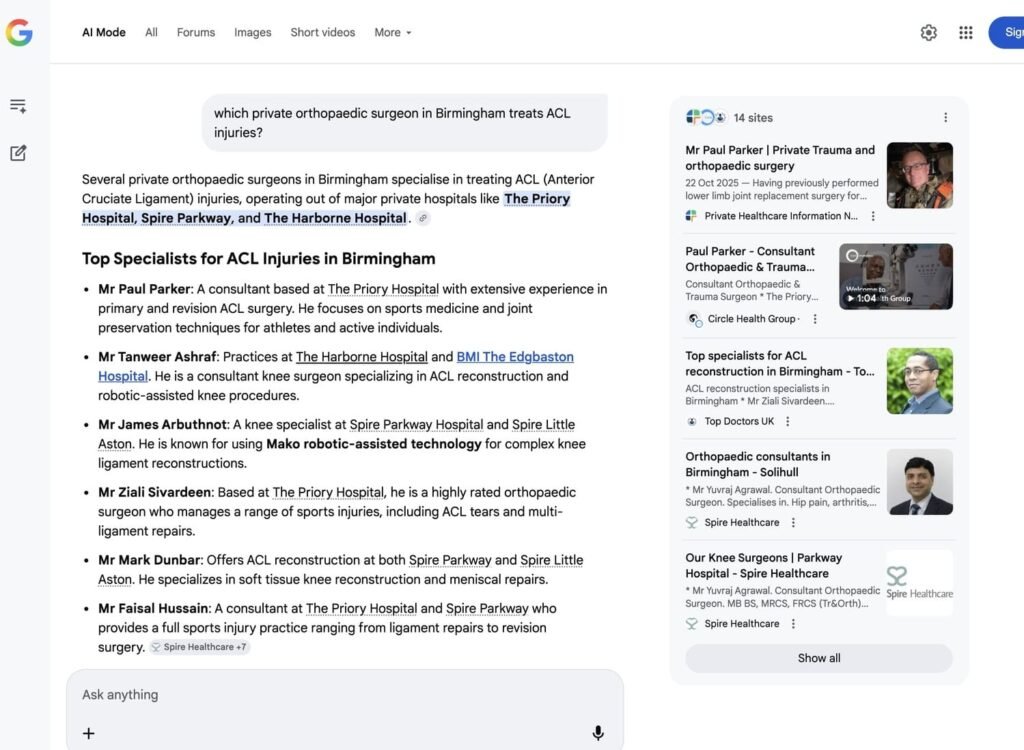
The mechanism is straightforward. Google AI Overviews now synthesise answers from existing websites, sometimes crediting the source with a link, sometimes not. Perplexity and ChatGPT field direct clinical questions in natural language. The patient who asks “which private orthopaedic surgeon in Birmingham treats ACL injuries?” may receive a confident answer without ever seeing a traditional list of organic results.
A survey of 2,000 UK patients by Semble, conducted in August 2025, found that one in four UK patients (24%) already use AI tools and social media for health guidance, and 30% would be willing to consult AI rather than wait to see a clinician. Among 16-25 year-olds, 34% are already turning to ChatGPT for health information.
This is the same demographic that the Benenden Health data identifies as the fastest-growing segment of private healthcare demand. The intersection of those two trends is where your digital strategy must now operate.
For private practices, this changes the goal. Ranking on page one is no longer a reliable objective. The objective is becoming the source that AI engines choose to cite. AI systems favour entities that are consistent, well-documented, and corroborated across multiple authoritative sources. That distinction shapes everything in the strategies that follow.
The Core Framework: Three Interdependent Foundations
Becoming visible in AI search and local results is not a single tactic. It is the result of three foundations working in combination:
- a structured, machine-readable website;
- consistent entity profiles across UK-specific directories;
- a content strategy that mirrors how patients actually ask questions.
Each foundation reinforces the others and weaknesses in any one of them limit the effectiveness of the other two.
Foundation 1: Build a Consultant-Led, AI-Ready Website
Your website is the starting point, but in 2026 it needs to do more than load quickly and present well. It must be structured so that AI systems can read, parse, and trust it, and it must anchor each of your consultants as identifiable, verifiable medical entities.
Medical schema markup is the underlying mechanism. For UK private practices, this means implementing Physician and MedicalClinic schema for each consultant and location, MedicalSpecialty and MedicalWebPage schema for service content, FAQPage schema on every question-and-answer block, and BreadcrumbList schema for site navigation.
Nested schema (for example linking a consultant entity to the procedures they perform and the clinic where they practise) helps AI engines build a coherent picture of your practice as a single trusted entity.
For UK consultants specifically, individual clinician pages carry substantial weight. Each page should include the consultant’s GMC registration number, specialty, conditions treated, hospital practising privileges and any peer-reviewed publications or clinical guideline contributions.
Foundation 2: Stack UK-Specific Directories and Reviews
Directory authority in the UK private healthcare market has its own structure, and practices that treat it as an afterthought consistently underperform in both AI citations and local search.
- Google Reviews remain the most important signal for local search and Google AI responses. But the UK has its own clinical review ecosystem that carries specific weight.
- Doctify is the primary healthcare review platform for UK specialists and consultants. A complete Doctify profile with verified patient reviews, accurate consultant credentials, and regularly updated information sends credibility signals to AI systems that aggregate medical directory data.
- Trustpilot adds clinic-level trust for non-clinical patient feedback.
- NHS Choices listings, private hospital group directories (Nuffield Health, Spire, HCA), and university hospital affiliation pages carry domain authority that transfers credibility to linked consultant profiles.
The governing principle is entity validation through consistency. AI engines cross-check your consultant’s name, GMC number, practice address, phone number, and services across every platform they index. Where the information matches perfectly, AI can resolve your practice as a single, trustworthy entity and cite it with confidence. Where it conflicts, your visibility weakens or disappears.
For compliant review acquisition, guide patients toward sharing their experience of the care they received, without prompting them to name specific diagnoses or conditions. A review describing an “efficient and thorough consultation for a shoulder problem” is both UK GDPR-appropriate and useful to AI systems.
Volume and recency both matter. Practices with a consistently high rate of recent reviews rank higher in local results and are cited more readily in AI responses.
Foundation 3: Build Specialty Content Clusters
Single blog posts no longer build topical authority. AI Overviews are synthesised from comprehensive, interconnected content hubs.
A private dermatology clinic that publishes a well-linked series of pages covering mole assessment, skin cancer diagnosis, treatment options, and aftercare creates a topical hub that AI engines read as authoritative coverage of a subject, rather than a single isolated article.
Each hub should follow the actual patient journey: the question that brings someone to search in the first place, through the diagnostic process, into treatment options, and then recovery. This structure mirrors how patients think, and it is precisely the type of organised, patient-first content that AI systems are built to surface.
Content freshness matters. AI engines and Google’s algorithms both register when pages were last updated. A content hub reviewed and refreshed quarterly, with new FAQs drawn from call logs and front-desk enquiries, signals an actively maintained and credible source.
Technical Enhancements That Amplify the Foundations
The three foundations above work more effectively when supported by the right technical infrastructure. These are not optional extras. They are the mechanisms that make the foundations visible to AI engines and patients alike.
Your Google Business Profile is your primary local anchor. Treat it as an active communication channel, not a static directory listing. Post updates and clinical content at least monthly. Add appointment booking links and include telehealth consultation options where relevant.
Google Gemini pulls directly from GBP when constructing local healthcare answers, making a well-maintained profile one of the highest-leverage actions available.
Backlink acquisition in the UK private sector should focus on hospital group websites, university medical school resources, NICE guidance commentary pages, and regional and national press coverage. A consultant quoted in the BMJ, the Health Service Journal, or a trusted regional outlet transfers meaningful domain authority to your website. One well-placed, editorially earned press mention typically outperforms dozens of lower-quality links in both traditional SEO and AI citation logic.
On-site compliance signals are not optional in a regulated sector. Display your CQC registration status clearly, include a privacy policy that explicitly references UK GDPR compliance and your data protection officer contact, and add standardised disclaimers on all clinical content stating that the information is educational and not a substitute for professional advice.These signals reduce the probability of your content being filtered out by AI quality systems, which are increasingly attentive to healthcare content reliability.
Want AI and Local Search Visibility for Your Practice?
UpMedico builds specialist SEO strategies for UK private clinics — fully compliant with CQC, GMC, and UK GDPR requirements.