If you run a private healthcare clinic today, whether you specialize in dermatology, physiotherapy, fertility, or general practice, I want you to think about a highly concerning trend you have probably noticed recently.
You are spending thousands of pounds a month on traditional SEO. Your blog posts are well-written. Your website looks beautiful. Yet, the phone is ringing slightly less than it used to. The highly qualified, private-pay patient inquiries are starting to slip through your fingers.
Why is this happening?
Because the way patients search for healthcare has completely fractured, and most clinic directors are entirely unaware of the shift.
When a prospective patient wakes up at 2:00 AM in 2026, crippled by severe sciatica or agonizing over a fertility timeline, they do not just type keywords into Google anymore. They open ChatGPT, Google Gemini, or Perplexity AI. They type out a long, highly personal, emotional question. And they expect the AI to hand them the perfect clinic on a silver platter.
Here is the terrifying truth: If your clinic is not explicitly communicating with these AI models in their native language, you do not exist to them.
They will bypass your beautiful website entirely and recommend your competitor down the street.
But there is a solution. It is a digital “VIP Pass” comprised of two specific tools: Schema Markup and llms.txt.
It sounds highly technical, but the core concept is brilliantly simple. If your clinic’s website exists to help people make informed, life-changing medical decisions, these two tools are the exact mechanism you use to guide AI systems straight to your expertise.
In this comprehensive guide, I am going to pull back the curtain and explain:
- What llms.txt and Schema Markup actually are (in plain, jargon-free English).
- Why they are the absolute lifeblood of healthcare SEO in 2026.
- The hidden, devastating risks to your revenue if you ignore them.
- Practical, immediate steps your clinic can take today.
Let’s slide right into it.
⚠️ First, a Quick but Critical Warning
Let’s be honest. Many clinics invest heavily into traditional SEO, content marketing, and beautiful landing pages. For the last ten years, that strategy worked flawlessly. You built authority, Google rewarded you, and patients booked appointments.
But the game has changed overnight. AI-generated answers are rapidly becoming the very first stop for high-intent patients searching online.
And here is the catch that is catching web developers off-guard: AI systems do not casually browse your whole website like a human would. They do not care about your stunning homepage video or your clever navigation menus. They are data-hungry machines that scan rapidly, grabbing what they can from specific, easily digestible pages.
Without Schema Markup and an llms.txt file, there is a very high probability they are completely ignoring your most valuable content. Worse, they might be grabbing outdated information from an old blog post and presenting it to a patient completely out of context.
In the healthcare sector, that is not just an inconvenience—it is an absolute liability.
If a conversational AI model grabs an outdated treatment description, or completely skips over your newly launched, state-of-the-art service page, the result is instantaneous:
- Misinformation: Patients receive the wrong medical advice associated with your brand.
- Missed Opportunities: High-value patients are routed to competitors who optimized for AI.
- Fewer Inquiries: Your calendar develops empty gaps that are incredibly hard to fill.
This isn’t about gaming a system. It is about taking control. It is about making absolutely certain that when an AI speaks about your medical specialty, it is using your accurate, authoritative voice.
The Power of Schema Markup: The Language of Trust
Before we discuss text files, we must talk about the absolute foundation of modern medical search visibility. We have to talk about Schema Markup.
Imagine walking into a foreign country where you do not speak the language, trying to explain that you are a highly qualified, board-certified doctor. You might show them your diploma, but if they cannot read it, they will not trust you.
To search engines and AI crawlers, your website’s text is that foreign language.
Schema Markup is the universal translator. It is a specific, invisible type of code (usually formatted as JSON-LD) that you add to the backend of your website. It tells the machines exactly what your content means, not just what it says.
In 2026, healthcare SEO practically demands specific schema types. When you use structured data tags like MedicalClinic, MedicalSpecialty, Physician, and FAQPage, you are explicitly hardcoding your authority into the web. You are telling Google and OpenAI, “This is a verified, licensed medical facility. Here are our exact specialties. Here are our verified patient ratings. Here are the credentials of our lead surgeons.”
If you want your clinic to show up as a trusted, verified source when AI systems compile answers about local healthcare options, implementing healthcare-specific Schema Markup is no longer an optional luxury—it is a mandatory baseline.
So, what exactly is llms.txt?
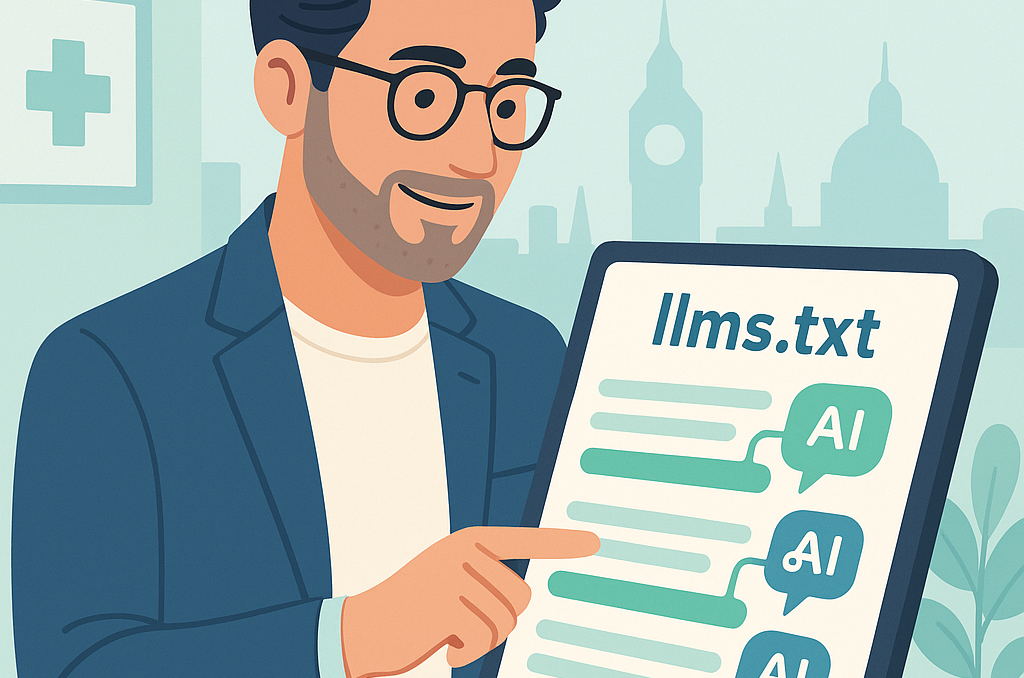
If Schema Markup is the universal translator, think of llms.txt as the VIP map.
It is a remarkably simple, plain .txt file that you place at the very root of your website (for example, yourclinic.com/llms.txt). Inside this file, you do one thing: you list the exact URLs of the pages you want AI systems to read first.
That is it. No complex coding. No massive website redesigns. Just a highly curated, easily accessible list of your absolute best medical content.
Here is exactly how it works in the real world:
Let’s say you run a private dermatology clinic in Manchester. You have written a thoughtful, incredibly detailed, evidence-based guide on navigating adult acne treatments and the timeline for seeing results.
Now, someone sits on their couch and asks ChatGPT: “What is the typical process for treating severe adult acne in the UK, and how long does a private consultation take?”
If your brilliant guide is buried deep in your website’s complex architecture, the AI model will hit a wall and miss it entirely. But if that exact URL is listed cleanly in your llms.txt file, the AI model is significantly more likely to prioritize it. It will pull from your expertise, quote your doctors, and—most importantly—link directly back to your clinic as the authoritative source.
That is visibility in the modern AI answer layer. And I promise you, that is exactly where your most lucrative future patients are searching today.
Understanding the Tools: The Anatomy of AI SEO
To make this perfectly clear, we need to look at how these two powerful tools work together to create an impenetrable digital fortress for your clinic. They are not competing strategies; they are two halves of the same brilliant whole.
Real-World Clinic Example 🏥
Let me tell you about a private specialist clinic in North London that learned this the hard way.
They had done everything right. They had written dozens of highly accurate, medically reviewed blog posts and service pages. However, the clinic directors noticed a maddening trend: AI systems like ChatGPT kept quoting their local competitors. Competitors who had thinner, older, and far less accurate content.
The North London clinic was practically invisible to the AI.
After partnering with an expert marketing team to inject MedicalClinic Schema Markup into their site, and uploading a simple llms.txt file listing just 8 of their strongest, most recently updated URLs, everything shifted.
Within weeks, the results were undeniable:
- Their deep treatment guides started appearing regularly as cited sources in AI tools like Perplexity and ChatGPT.
- Inquiries from highly specific, non-branded searches (like “how to treat long-term sciatica without invasive surgery in London”) surged dramatically.
- Time-on-site for referred traffic went through the roof, proving that the patients arriving at their site were already pre-sold and deeply engaged with the content.
This was not a fifty-thousand-pound website overhaul. It was a strategic, surgical technical pivot using a few lines of code and a small text file.
| Feature | Schema Markup (The Translator) | llms.txt (The Map) |
|---|---|---|
| What is it physically? | Invisible structured data code (JSON-LD) injected directly into your website’s HTML. | A remarkably simple plain text file uploaded to your site’s root directory. | 
| Primary Purpose | Categorizes and translates your medical content into structured data that machines instantly trust. | Acts as a direct, frictionless map to guide AI crawlers exclusively to your highest-converting content. | 
| Direct SEO Impact | Massive for Google. Generates eye-catching rich snippets and improves traditional search rankings. | Low for traditional Google search, but highly influential for securing visibility inside conversational AI answers. | 
| Key Healthcare Uses | Verifying precise medical conditions, clinic operating details, and specific physician credentials. | Highlighting your comprehensive medical guides, patient FAQs, and detailed treatment breakdowns. | 
3 Things Your Clinic Can Do Right Now
You do not need to wait for your competitors to figure this out. You can take control of your AI visibility today. Here are the three simple steps you must take.
✅ 1. Choose your absolute best content
Look through your current website objectively. Pick 5 to 10 pages that represent your absolute best medical work. These pages must be:
- 100% medically accurate and recently updated.
- Written in plain, empathetic English that is easy for a worried patient to understand.
- Directly answering the most common questions your receptionists hear every single day.
Examples:
- “How long does a private dermatology consultation take, and what happens during it?”
- “When should you consider CBT for severe anxiety versus medication?”
- “A complete guide to fertility treatment options for women over 40.”
✅ 2. Create an llms.txt file
This is wonderfully simple. You can use Notepad on Windows or TextEdit on a Mac. Create a new, blank file. Simply paste the full URLs of the pages you just selected, placing exactly one URL per line.
It should look exactly like this:
texthttps://yourclinic.com/fertility/ivf-timeline-guide
https://yourclinic.com/blog/cbt-vs-medication-anxiety
https://yourclinic.com/services/private-physiotherapy-assessment
✅ 3. Upload it to your website’s root directory
This means placing the file so it can be accessed perfectly at: yourclinic.com/llms.txt.
If you have a web developer or an IT agency, they can do this in approximately two minutes. If you manage your own site on platforms like WordPress, there are simple file manager plugins or FTP tools that make this process completely painless.
Bonus: 2 Elite Technical Upgrades for Maximum Leverage
If you want to absolutely dominate the AI search landscape, here are two advanced strategies the top 1% of clinics are using right now.
Markdown Summaries (.md)
AI models love simplicity. You can create stripped-down, text-only versions of your medical pages in markdown (.md) format, and list those specific files in your llms.txt instead. This entirely strips away your website’s menus, pop-ups, footers, and visual clutter. It serves the AI pure, unadulterated medical intelligence, helping the systems read and digest your core information much faster.
texthttps://yourclinic.com/md/ivf-timeline-guide.md
Smart Bot Control
If you are worried about rogue AI bots aggressively scraping your entire site, stealing your intellectual property, or chewing up your server bandwidth, you have total control. You can block aggressive bots via your website’s robots.txt file, while selectively allowing the helpful, traffic-driving AI systems to read only the markdown files you explicitly list in your llms.txt. This way, they read exactly what you want them to read, and absolutely nothing else.
Quick FAQ ❓
Q: Are Schema Markup and llms.txt officially required by Google or OpenAI?
Schema Markup is highly recommended by Google and is practically mandatory if you want to rank well in competitive local healthcare searches. While llms.txt is technically still optional, major AI systems are aggressively starting to look for it. The early adopters who implement it now are capturing the lion’s share of the market.
Q: Does llms.txt actually help with traditional Google SEO?
Not directly. It is not a standard Google ranking factor. However, it heavily dictates how AI systems display your content in conversational, zero-click answers. In 2026, that is rapidly becoming the primary source of high-intent, ready-to-book patient traffic.
Q: Can this system be abused or gamed by my competitors?
Like any marketing innovation, people will try. But AI systems still rigorously check for overall content quality, domain authority, and context. Listing low-quality, keyword-stuffed garbage pages in an llms.txt file, or using fake Schema reviews, will not help a clinic—it will actively trigger algorithmic penalties that destroy their visibility. Authenticity always wins.
Q: What if my clinic doesn’t have a massive blog or long-form content?
That is perfectly fine. Even just listing your primary service pages, your detailed doctor profiles, and your contact page helps immensely. Focus on extreme clarity, deep medical relevance, and answering the basic logistical questions patients have right before they book a consultation.
Final Thought: AI Search is Here. Do Not Wait.
We are no longer living in the search environment of 2022. The world has moved on.
People still use traditional Google searches, yes. But a massive, highly affluent demographic is turning to AI systems directly to bypass the ads, the clutter, and the noise.
When a prospective patient asks an AI about their health, that system does not care how beautiful your waiting room is. It looks for data that is highly structured, perfectly mapped, and instantly understandable.
Implementing Schema Markup and an llms.txt file is your golden opportunity to make that data consumption effortless for them. Think of it as plugging a massive, neon spotlight into your most helpful, revenue-generating medical content.
We Can Help You Build the Ultimate AI Advantage
At Upmedico, led by Angelo Rosati, we understand that you did not go to medical school to worry about JSON-LD code or root directory text files.
We combine deep data-driven marketing, AI expertise, and healthcare innovation to help clinics like yours completely adapt to the bleeding edge of AI search trends. We do far more than just manage Google Ads and HubSpot; we build digital infrastructures that actively capture patients from platforms like ChatGPT and Perplexity.
We work closely with elite healthcare providers across the UK and globally to ensure that when a patient asks an AI a question, it is your trusted clinic that provides the answer.
Want to see exactly how an AI-optimized Schema and llms.txt strategy could multiply your clinic’s growth in 2026?
Get in touch through our contact page right now. Let’s make absolutely certain your clinic’s expertise gets the massive online attention it deserves.
Sources:
Google Help: Provides extensive guidance and best practices that can help infer the performance of your website.