If your private clinic currently runs Google Ads, there is a reasonable chance your campaigns are generating leads, but not all of them are good ones. You are likely paying more per lead than you were 12 months ago and your reporting may not be telling you the full story.
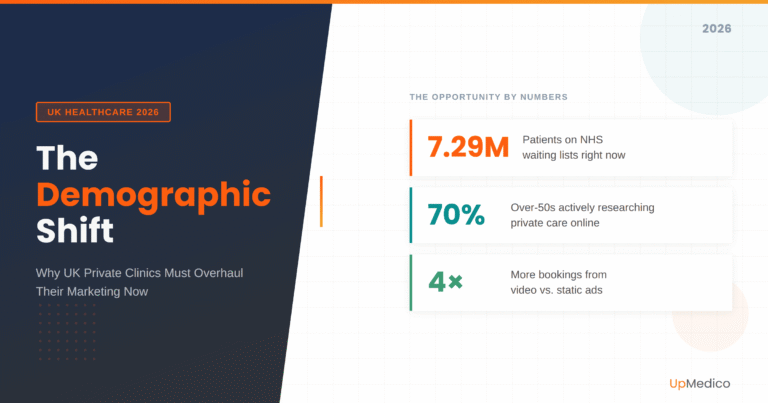
The UK private healthcare market reached $13.75 billion in 2024 and is projected to grow to $18.56 billion by 2033. NHS waiting lists are a structural demand driver: the proportion of individuals accessing private healthcare rose from 9% in 2023 to 16% in 2025 and 71% of British adults say they would consider private treatment if they needed care. These are real, measurable patients actively searching online for what your clinic offers.
But demand alone does not make a Google Ads campaign efficient. The cost of reaching that demand is rising. Healthcare now commands the highest cost per thousand impressions of any industry on Google and without a structured optimisation framework, clinic directors absorb that cost without proportional return.
This checklist is built for the realities of UK private healthcare in 2026: dual patient pathways (self-pay and insured), Consent Mode V2 obligations, RSA structure, specialty-specific negative keyword management and a lead quality scoring model that improves your campaigns over time.
⚠️ Compliance Risks to Address Before You Optimise
Any conversation about Google Ads optimisation in healthcare has to start here. The risks are not theoretical. Small oversights in tracking setup or data handling can create significant compliance exposure and silently corrupt your campaign performance data.
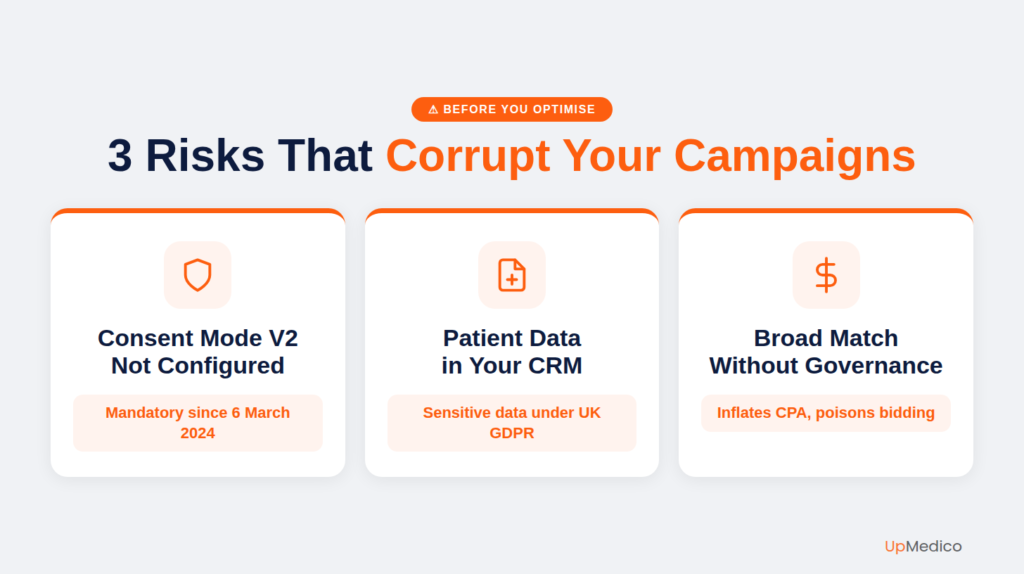
Consent Mode V2 Is Not Optional
Google Consent Mode V2 has been mandatory since 6 March 2024 for all advertisers operating in the UK and EEA who use Google Ads, GA4 or Google Tag Manager.
If your clinic’s website does not have a certified Consent Management Platform (CMP) correctly configured with the ad_user_data and ad_personalization parameters, you are likely tracking conversions inaccurately, limiting your remarketing audiences and potentially breaching data privacy regulations.
Failing to implement Consent Mode V2 means Google blocks collection of new audience data from UK users and restricts data sharing with Google Ads. In practice, your smart bidding strategy trains on incomplete data, your reported CPA figures may be artificially low and your campaigns are less competitive than the dashboard suggests.
Healthcare Data Carries Extra Obligations
Patient inquiries submitted via contact forms are not ordinary marketing data. Form completions indicating a patient is seeking a consultation for a specific condition fall under sensitive health data categories in the context of UK GDPR.
Any data passed from your CRM to Google through offline conversion import must be anonymised and processed in a way that does not expose patient-identifiable health information. This is especially relevant for clinics in mental health, fertility, dermatology and oncology-adjacent services.
Broad Match Without Governance Is a Budget Drain
A single broad match keyword like “knee pain” can attract queries from physiotherapy students, NHS triage guides, personal injury solicitors and people researching general wellbeing. Every one of those clicks costs money and distorts your conversion data.Clinics that run broad match campaigns without an active negative keyword strategy subsidise irrelevant traffic, inflate CPA and teach smart bidding the wrong signals compounding the problem with every passing week.
What Google Ads Optimisation Actually Means for UK Private Clinics?
Optimisation is not a one-time configuration. It is a continuous process of narrowing the gap between who you are reaching and who you actually want to treat. For UK private clinics, that definition has a specific structural dimension: two distinct patient pathways running simultaneously.
The Self-Pay and Insured Distinction
Self-pay patients are price-sensitive and comparison-driven, typically converting from high-intent searches with explicit cost language: “private knee consultation cost London,” “MRI scan price UK” or “how much does a dermatologist appointment cost.”
Insured patients search differently. They are often looking for approved providers or checking insurer acceptance: “Bupa approved physiotherapist Manchester” or “AXA Health recognised cardiologist”.These two patient types should not share the same campaign, the same landing page or the same conversion tracking setup. Combining them distorts your Quality Score, your CPA benchmarks and your ability to allocate budget intelligently. Separating campaign structures by payment pathway is the foundation of any serious optimisation programme.
UK Benchmark Data by Specialty
Understanding where your clinic sits relative to market benchmarks is essential before you can assess whether your campaigns are performing well or poorly. UK-specific paid search data from analysis of over £5.5 million in healthcare ad spend shows meaningful variation across specialties:
- General Practice: average CPA approximately £24, CTR approximately 7.8%
- Dermatology: CTR approximately 7.0%, moderate competition
- Fertility: CPC above £2.60, benchmark CPA approximately £46
- Cosmetic and Aesthetic services: CPAs above £60, reflecting longer patient decision cycles
The overall UK healthcare paid search average CPA rose from £42.18 to £47.91, a 13.6% year-on-year increase. If your clinic’s CPA is above specialty benchmarks and climbing without corresponding improvement in lead quality, the problem is structural, not budgetary.
| Specialty | Avg. CPA | CTR | CPC | Competition |
|---|---|---|---|---|
| General Practice | ~£24 | 7.8% | — | Low |
| Dermatology | — | 7.0% | — | Moderate |
| Fertility | ~£46 | — | >£2.60 | High |
| Cosmetic & Aesthetic | >£60 | — | — | High |
| UK Healthcare Avg. | £47.91 | — | — | — |
* Based on analysis of over £5.5M in UK healthcare ad spend. Average CPA rose 13.6% YoY (from £42.18 to £47.91). Cosmetic CPAs reflect longer patient decision cycles.
Strategy 1: Build a Specialty-Specific Negative Keyword Library
The most reliable near-term lever to reduce wasted spend is a structured negative keyword library, built before a campaign goes live and maintained on a monthly basis.
Most generic advice covers the obvious exclusions: “free”, “jobs”, “salary”, “training”, “how to become”. In healthcare, the list needs to go several layers deeper, because many clinical terms attract academic, NHS-specific and non-commercial queries.
Implementation Steps
Start with the Google Search Terms Report. Filter for queries with zero conversions over a rolling 30-day period and spend above your target CPA. Those represent confirmed budget waste.
Segment the results by specialty and build tailored exclusion lists:
- Orthopaedic and musculoskeletal services: exclude anatomy terms, NHS physiotherapy referral guides and personal injury legal searches. Key negatives: “anatomy”, “NICE guidelines”, “NHS referral”, “compensation claim”, “personal injury”.
- Dermatology: exclude skincare product queries, DIY treatment searches and training terms. Key negatives: “cream for”, “home remedy”, “dermatology degree”, “how to treat at home”, “over the counter”.
- Fertility: exclude NHS eligibility queries, research articles and forum searches. Key negatives: “IVF on NHS criteria”, “fertility diet”, “natural fertility”, “fertility forums”, “free IVF”.
Add these exclusions as shared negative lists at account level, then layer specialty-specific negatives at campaign level. Review and expand the lists monthly.
Performance Max campaigns in particular shift the query landscape rapidly and lists that were accurate three months ago may already be outdated.
The Lead Quality Scoring Model
Reducing junk leads requires more than blocking irrelevant queries. It also requires scoring the leads that do arrive.
A practical scoring model for UK private clinics should track three core metrics:
- Call connect rate: the percentage of inbound calls where a live conversation took place
- Form-to-consultation rate: how many completed forms resulted in a booked appointment
- Pathway confirmation: whether the inquiry is a self-pay or insured patient
Assign numerical values to each outcome and import those values back into Google Ads as offline conversions with weighted values. This signals to your smart bidding strategy that a confirmed consultation is worth substantially more than a form completion and it reorients campaign optimisation toward actual patients rather than surface-level engagement.
Strategy 2: Set Up Consent-Safe Conversion Tracking with Offline Imports
Most private clinic campaigns are optimised against web-based proxies: form submissions, call click events or booking page views. These are noisy signals. A form submission might be a repeat patient, a competitor checking your pricing or a genuine new inquiry.
If your campaign treats all of these equally, smart bidding learns from an imprecise signal.
Connecting Confirmed Appointments to Google Ads
Offline conversion import allows you to measure what happens after an ad click, once the interaction moves into your clinic’s operating systems.
The process works as follows:
- Google assigns a unique click ID (GCLID) to every ad click. Your CRM captures this ID alongside the inquiry.
- When a defined outcome occurs, such as a confirmed booking, you export the relevant GCLID with the conversion timestamp back to Google Ads.
- Google attributes that confirmed outcome to the original ad, keyword and bidding decision.
This produces a CPA figure based on actual patients rather than form completions and gives your smart bidding strategy substantially higher-quality data to work from.
Service providers implementing offline conversion tracking have reported a 20% increase in qualified bookings over three-month implementation periods, with improvement in campaign quality even without budget increases.
Maintaining Data Continuity Through Consent Mode V2
A meaningful proportion of your website visitors will decline analytics and advertising cookies. Without Consent Mode V2 correctly implemented, those visitors disappear from your attribution model entirely.
With it, Google uses modelled conversions to fill the gap, maintaining the statistical integrity of your data even when direct tracking is unavailable. This matters particularly in healthcare, where privacy-conscious patients are more likely than average to decline cookie consent.
Implementation requires a Google-certified CMP such as Cookiebot, OneTrust or Didomi, correctly passing ad_user_data and ad_personalization signals through Google Tag Manager. Clinics using outdated consent banners or no CMP should treat this as a priority fix before any further bidding or budget optimisation.
Strategy 3: Segment Landing Pages by Patient Journey Stage
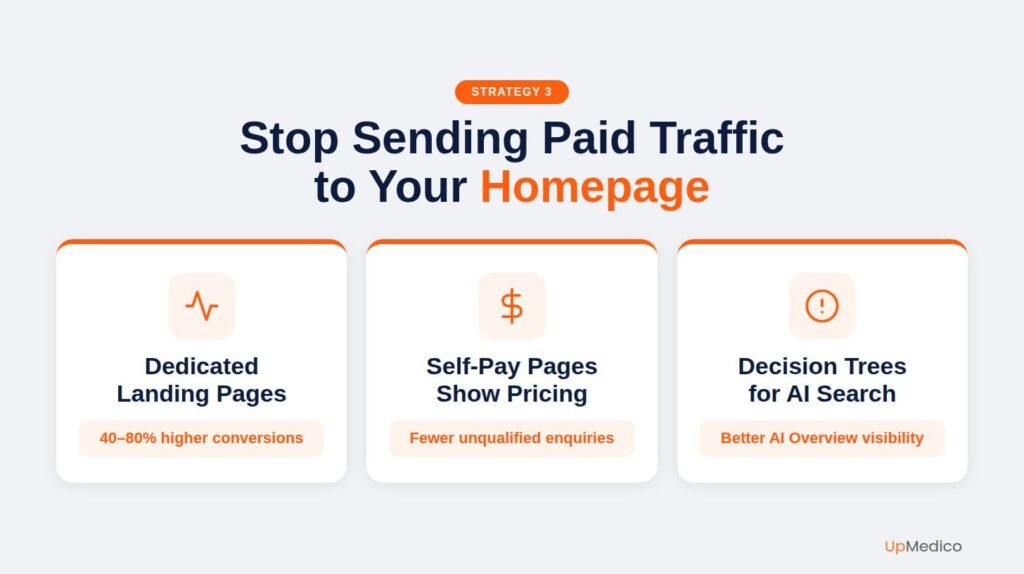
Directing paid traffic to your homepage is the single most common structural error in private clinic Google Ads accounts. Homepage content serves many audiences at once, which means it serves no specific audience particularly well.
A patient searching “private MRI scan Manchester” is at a very different stage of decision-making compared to one searching “what is an MRI scan”. Your ad copy should match the intent of the former and your landing page should continue that conversation without interruption.
Building Service-Specific Pages for Each Patient Pathway
For each primary service line, build a dedicated landing page that matches the ad group supporting it.
Within the first visible section, the page should confirm that the patient has found what they searched for, provide a clear conversion path (phone number, booking widget or contact form above the fold), and address the two questions that private healthcare patients consistently ask first: how much will this cost, and how quickly can I be seen.
- Self-pay landing pages should include transparent pricing or a clearly stated price range. This reduces calls from patients outside your fee range, improves your form-to-consultation rate, and reduces wasted time for your reception team.
- Insured pages should list accepted insurers prominently and explain the referral process clearly, since many insured patients are uncertain whether they need a GP letter before booking.
-
Transparent pricing or price range
-
Speed of access — same-week availability
-
No referral required — stated clearly
-
Accepted insurer logos prominently displayed
-
Referral process explained — GP letter or not
-
Pre-authorisation guidance
Decision Tree Content for AI and High-Research Queries
For landing pages targeting higher-funnel search terms, a decision tree structure helps patients self-qualify and improves engagement.
A fertility clinic might include a short decision path: “Are you looking for initial advice, IVF treatment. or fertility preservation?”. Each path leads to a distinct conversion action, and each choice provides segmentation data for follow-up.
This structure also supports AI search summarisation. When AI Overviews process your landing page content, clearly formatted decision trees and FAQ blocks are more likely to surface in featured placements than undifferentiated prose.
Technical Enhancements: RSA, Smart Bidding and Capacity Pacing
With structural and compliance foundations in place, several technical configurations directly improve campaign efficiency without requiring additional budget.
Responsive Search Ads for UK Healthcare
Responsive Search Ads (RSAs) are the default and recommended Google Ads format in 2025. They allow you to provide up to 15 headlines and 4 descriptions, from which Google’s machine learning selects the most relevant combination for each query and device.
For UK private clinics, this flexibility is valuable across specialties where patient language varies considerably: “private physio”, “physiotherapy appointment”, and “musculoskeletal specialist” describe the same need but attract different people.
To use RSAs effectively, provide genuine headline variety. Include at least two headlines with your location, at least two with service-specific language, and at least two that address cost or speed: “Same-week appointments available” or “Transparent pricing, no referral needed”.
Pin your most critical headline (clinic name or primary service) to position one so it always appears. Review asset performance reports monthly and replace any headline rated “Low” consistently.
Smart Bidding and Clinic Capacity Pacing
Smart bidding strategies including Target CPA and Maximise Conversions require consistent conversion volume to perform reliably. The practical threshold is at least 30 conversions per campaign per month. Below that, enhanced CPC bidding typically outperforms fully automated strategies.
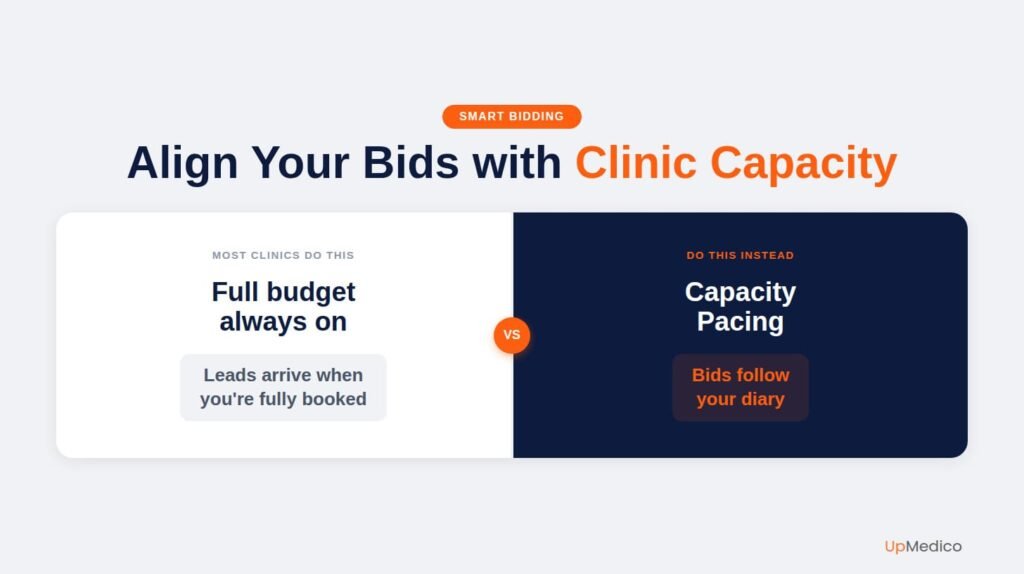
One adjustment that most clinic campaigns never make is capacity pacing: aligning bid modifiers and daily budgets with actual appointment availability. If your orthopaedic consultant is booked three weeks out, continuing to generate new leads at full budget creates a patient experience backlog and damages conversion rates downstream.
Scheduling temporary bid reductions during high-capacity periods and increasing them when availability opens improves the timing and quality of new patient flow without changing the campaign’s core structure.
GA4 Integration for Full-Funnel Attribution
Connecting Google Ads to GA4 with correctly configured conversion events gives you cross-channel visibility that paid search data alone cannot provide. GA4 allows you to track assisted conversions: the role your paid campaigns play in journeys that may begin with a paid click, continue through organic search or email, and complete weeks later.
In private healthcare, where decision cycles for elective procedures often span several weeks, last-click attribution significantly undervalues Google Ads’ contribution. Full-funnel attribution gives clinic directors a more accurate picture of what their ad spend is actually producing.
Reviewing your campaigns or starting from scratch?
UpMedico provides Google Ads management, conversion tracking, GA4 setup, landing page design, and clinic growth strategy — built specifically for UK private healthcare.