Running Google Ads for an aesthetic clinic in the UK is not the same as running ads in any other sector. The compliance rules are strict, the ad policies are specific and the cost benchmarks are shaped by a market that has grown noticeably more competitive in the past eighteen months.
If your campaigns are underperforming or if you have never quite been certain whether your ads are fully compliant, this article is written for you.
What follows is a structured, practical guide to building a Google Ads account that generates high-quality consultation bookings, stays within ASA and CAP guidelines, and performs at a level your clinic can actually sustain.
We will cover account architecture, the specific language rules that trip up most aesthetic clinics, realistic UK cost benchmarks by treatment and the technical systems that separate efficient campaigns from expensive ones.
Why This Matters in 2026?
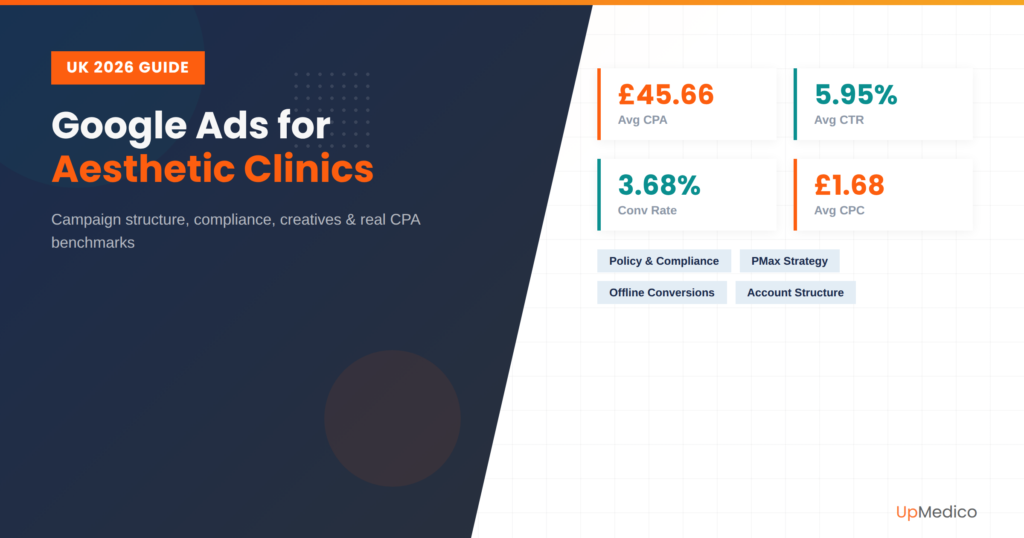
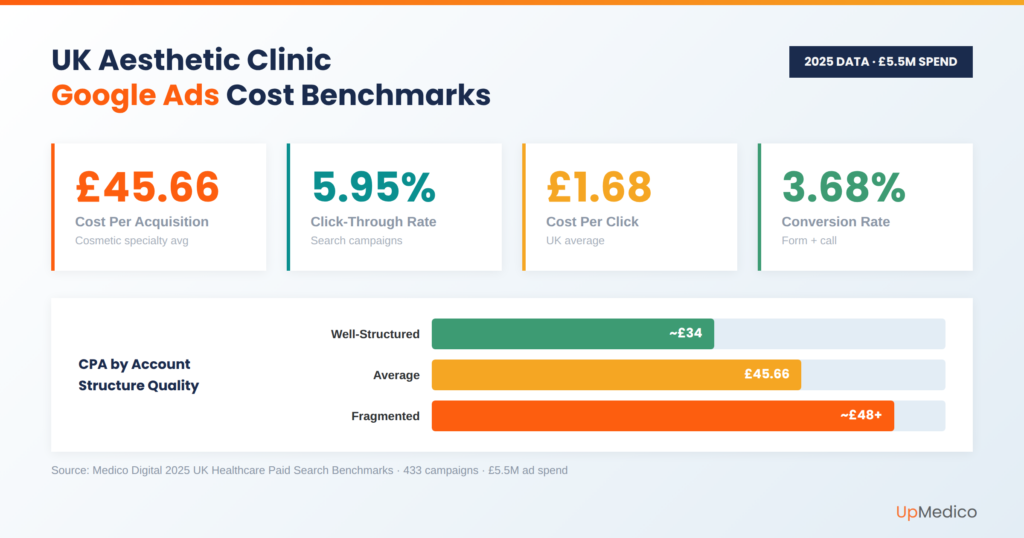
The UK aesthetic market is growing, but so is ad competition. According to real campaign data from Medico Digital’s 2025 UK Healthcare Paid Search Benchmarks, built from over £5.5 million in UK healthcare ad spend, the average cost per acquisition for cosmetic campaigns now sits at £45.66, with a conversion rate of 3.68% and a click-through rate of 5.95%. These numbers are real and UK-specific, not global averages.
What makes this period particularly important for clinic directors is not just the cost increase. It is the growing gap between clinics that have structured their accounts properly and those running fragmented, low-volume campaigns.
Medico Digital’s data shows that poorly structured accounts are paying roughly double the cost per enquiry compared to well-organised accounts at scale. That is not a minor efficiency gap. Over twelve months, it is the difference between a campaign that sustains itself and one that drains budget with little return.
⚠️ The Compliance Risks Most Clinics Underestimate
Before building a single campaign, you need to understand what you can and cannot say. This is where many UK aesthetic clinics make expensive mistakes, either by having ads disapproved repeatedly or, worse, by running ads that breach CAP Code regulations without realising it.
Prescription-Only Medicines Cannot Be Advertised to the Public
The most significant constraint is straightforward. Botulinum toxin products including Botox, Dysport and Bocouture are prescription-only medicines (POMs). Under CAP Code Rule 12.12, these products cannot be advertised to the public in any form, whether on Google, in social media, on leaflets or on landing pages. This applies to brand names, generic descriptions and implied references alike.
The ASA has made clear through multiple adjudications that phrases such as “anti-wrinkle injections” and “wrinkle-relaxing treatments” are also treated as indirect advertising of a POM. If a visitor clicks an ad and lands on a page that then describes botulinum toxin, the entire journey may be considered non-compliant, even if your ad itself avoided the term entirely.
What You Can Advertise?
The compliant approach is to advertise the consultation, not the treatment. Your ads and landing pages should promote the process of assessment and expert advice, making clear that any treatment decision will be made following a clinical consultation. This is not a semantic workaround. It is the legitimate and legally defensible position under CAP guidance, and the ASA has confirmed it is acceptable when the consultation is genuinely what is being promoted.
“In regulated aesthetics marketing, the consultation is not a compliance workaround — it is the genuine product. When clinics shift their messaging to promote access to expert clinical assessment, they often see a simultaneous improvement in both regulatory standing and conversion quality. Patients who book a consultation rather than a treatment are better informed, better prepared, and far more likely to become long-term clients.”
— Angelo, CEO of UpMedico
Before/After Content and Consent
If you plan to use patient photographs in your ads or on landing pages, documented consent must be in place before the images are used in any marketing context. The ASA has adjudicated cases where the underlying compliance issue was not the claim being made but the absence of verified consent for the photographs used. In practice, this means your consent forms need a specific marketing use clause and your records need to confirm it was signed.
Restricted Terms: A Practical Copy Bank
To avoid repeated ad disapprovals, it is worth building an internal list of terms to avoid across all ad copy and landing pages. The following should be treated as high-risk in UK aesthetic advertising:
- “Botox”, “Dysport”, “Bocouture” and all botulinum toxin brand names
- “Anti-wrinkle injections” and “wrinkle-relaxing injections”
- Any claim implying guaranteed results (“eliminates”, “removes permanently”)
- Language implying personal inadequacy (“fix your”, “finally correct your”)
- Before/after images used without documented patient consent
Compliant alternatives include: “consultation for muscle-relaxing treatments”, “skin rejuvenation assessment”, “specialist facial aesthetics consultation” and “explore your treatment options with a qualified practitioner.”
Understanding the UK Aesthetic Google Ads Landscape
The challenge with Google Ads for aesthetic clinics is that demand exists and is often high-intent, but the gap between a well-run account and a poorly structured one is significant. Most clinics either target keywords that are too broad or run a single campaign covering all their treatments. Neither approach works reliably.
Google Ads is effective for aesthetic clinics precisely because it reaches people at the moment they are actively searching. Unlike social media advertising, which interrupts a passive scroll, search ads appear when a patient has already decided to look for information. That intent is valuable. Wasting it on poor account structure is an unnecessary cost.
UK Cost Benchmarks by Treatment Type
Understanding what you should expect to pay is essential before setting budgets. Based on Medico Digital’s UK-specific dataset of 433 Google Ads Search campaigns, the cosmetic specialty (which includes aesthetic clinic campaigns) benchmarks at:
| Metric | UK Cosmetic (2025) |
|---|---|
| Click-Through Rate | 5.95% |
| Cost Per Click | £1.68 |
| Conversion Rate | 3.68% |
| Cost Per Acquisition | £45.66 |
For context, well-structured accounts at scale are achieving CPAs significantly below this level, while fragmented accounts are averaging closer to £48 per acquisition. The data clearly shows that account consolidation and campaign structure are the single biggest levers available to most clinics.
Actionable Strategy 1: Build a Treatment-Cluster Account Structure
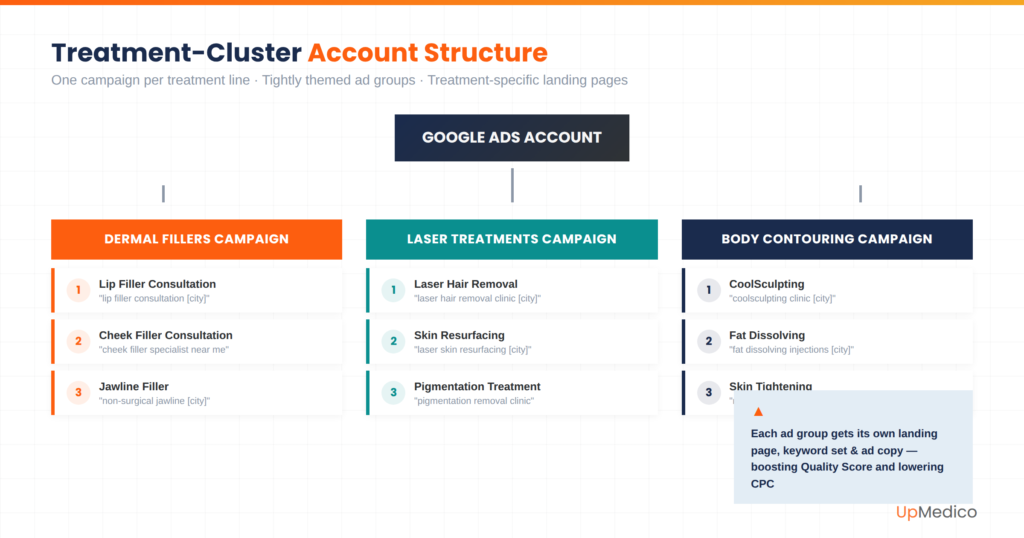
The most common structural mistake aesthetic clinics make is blending all their treatments into one or two campaigns. This dilutes relevance, raises cost per click and makes it nearly impossible to optimise individual treatment lines.
The Treatment Cluster Approach
Each campaign should be built around one specific treatment or a tightly related group of treatments. A campaign for dermal filler consultations should contain ad groups, keywords and landing pages that all relate only to dermal fillers. A separate campaign handles laser skin treatments. Another covers body contouring. Nothing bleeds across.
Within each campaign, your ad groups should be tightly themed. If your laser campaign covers pigmentation, resurfacing and hair removal, those should be separate ad groups, each with their own tailored ad copy and keyword lists. This improves Google’s quality score for each group, which directly lowers your cost per click.
Keyword Strategy: Intent Filtering Over Volume
Focus on high-intent, location-modified search phrases rather than broad category terms. Compare these two approaches:
- Broad: “aesthetic clinic London” (high volume, mixed intent)
- High-intent: “dermal filler consultation Harley Street”, “skin resurfacing clinic Manchester”, “non-surgical jawline treatment Birmingham”
The second group costs more per click in some cases, but converts at a meaningfully higher rate because the searcher has already defined the treatment and location they want. Use phrase match and exact match types rather than broad match to control which searches trigger your ads.
Building a Negative Keyword List
Equally important is what you exclude. Add negative keywords that filter out searches unlikely to convert: “free”, “DIY”, “training course”, “supplies”, “how much does it hurt” and any searches related to treatment kits or home devices. Running clean exclusion lists from the start protects budget and improves lead quality.
Actionable Strategy 2: Define the Boundary Between Search and Performance Max
Performance Max campaigns have become a standard Google recommendation. For aesthetic clinics, they require careful management, not blanket adoption.
What Performance Max Can and Cannot Do for Aesthetic Clinics
Performance Max (PMax) places your ads across Search, Display, YouTube, Gmail and Discover using Google’s machine learning to find conversions. In theory, this sounds efficient. In practice, for regulated healthcare categories, it introduces several risks that clinic directors need to manage directly.
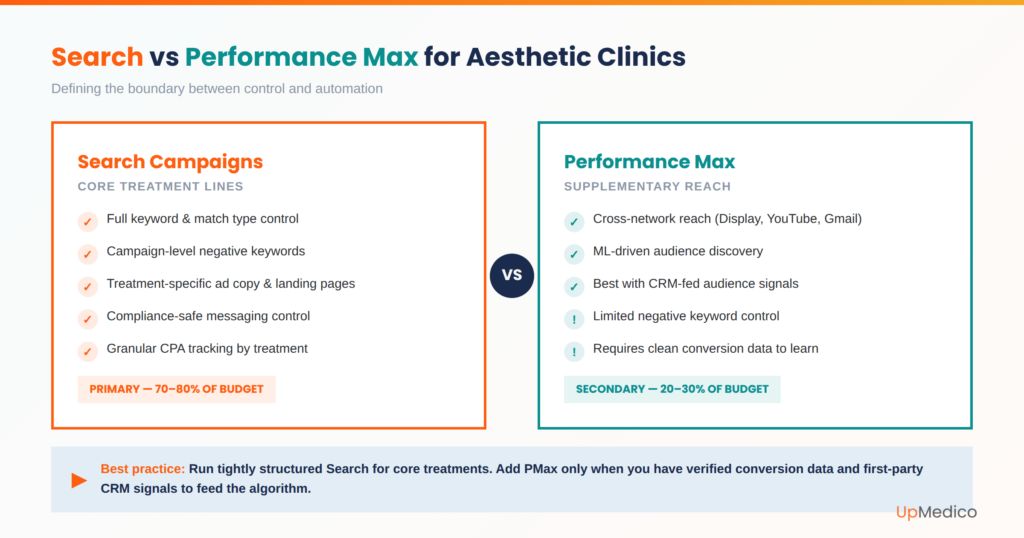
PMax campaigns do not allow negative keyword lists at the campaign level in the same way traditional search campaigns do. This means your budget may serve against irrelevant queries or audiences unless you use account-level negative keywords and provide very tightly defined audience signals. For aesthetic clinics dealing with sensitive content restrictions, that lack of granular control matters.
The practical boundary most well-managed aesthetic clinic accounts use: run tightly structured Search campaigns for your core treatment lines, where you control every keyword and match type, and limit PMax to specific use cases where you have clear, verified conversion data to feed the algorithm.
Feeding PMax the Right Signals
If you do run Performance Max, provide it with first-party audience signals from your CRM, specifically lists of patients who have already completed consultations or booked treatments. This directs the algorithm toward people who resemble your actual converters rather than guessing from broad signals.
“One of the most consistent findings across the aesthetic clinic accounts we support is that Performance Max underperforms until it has been given clean, first-party data to learn from. The algorithm is only as good as the signals you feed it. Clinics that integrate their CRM data from the outset give PMax a genuine advantage; those that leave it to guess tend to see inflated spend with little return.”
— Angelo, CEO of UpMedico
Actionable Strategy 3: Import Offline Conversions to Reflect Real Clinic Outcomes
Most aesthetic clinic Google Ads accounts measure success by form submissions or phone calls. That is an incomplete picture and it often leads to optimising for the wrong thing.
A patient who fills out a form but never shows up for a consultation has zero clinical value. A form submission from someone who books, attends and converts to a £2,000 treatment has substantial value. Without connecting your CRM data back to Google Ads, your bidding algorithms are treating both the same.
Setting Up Offline Conversion Import
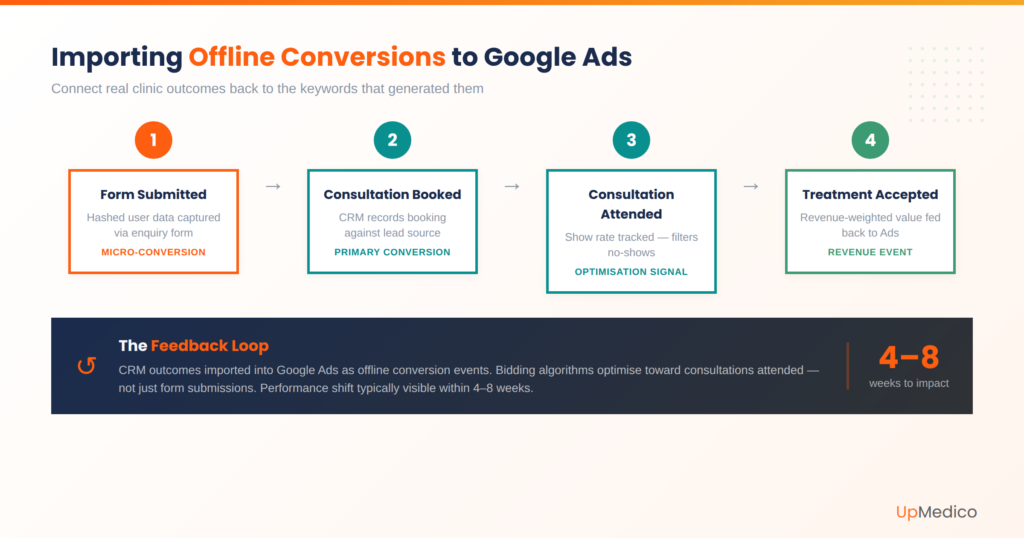
Google’s enhanced conversions for leads allows you to import CRM outcomes back into your Google Ads account, matching consultation bookings, show rates and treatment acceptances back to the specific ads and keywords that generated them.
The process involves:
- Tagging your enquiry forms to capture hashed user data (email address)
- Exporting consultation and booking outcomes from your clinic management software or CRM at regular intervals
- Importing those outcomes into Google Ads as offline conversion events
- Setting your bidding strategy to optimise toward consultations attended, not form submissions
This single change often produces a meaningful shift in campaign performance within four to eight weeks, because the algorithm stops directing budget toward clicks that generate submissions but few actual consultations.
Lead Quality Stages to Track
Map your CRM stages to Google Ads conversion events:
- Form submitted (micro-conversion, secondary signal only)
- Consultation booked (primary conversion event)
- Consultation attended (secondary optimisation signal)
- Treatment accepted (revenue-weighted conversion, optional)
This structure gives your campaigns real clinical feedback rather than digital activity metrics.
Technical Infrastructure That Makes Campaigns Sustainable
The technical setup behind your campaigns is not optional complexity. It is the difference between accounts that improve over time and accounts that plateau.
Call Tracking and Form Attribution
Many aesthetic clinic bookings happen by phone, not form. If you are not using dynamic call tracking, you are attributing zero value to a significant portion of your conversions.
Dynamic number insertion (DNI) assigns unique phone numbers to visitors based on the campaign that brought them. This connects phone bookings back to keywords and ad groups, giving your account complete attribution.
Location Targeting for UK Cities
For clinics in London, Manchester or Birmingham, the location strategy matters more than most clinic directors realise. London in particular requires sub-city targeting. A clinic in Marylebone is not competing for the same patients as one in Canary Wharf, even though both are “London”.
Configure radius targeting from your clinic postcode at an appropriate distance (typically 5 to 15 miles depending on urban density) and test bid adjustments by postcode area once you have enough data to identify where your best patients are located.
Governance and Oversight
If your campaigns are managed externally, establish a governance process: monthly reporting on CPA by treatment cluster, review of ad copy against the restricted terms list, and quarterly compliance audits of landing page content against current CAP guidance. The CAP Code is updated, and what was considered compliant phrasing eighteen months ago may no longer be sufficient.