Your rankings are holding. Your agency’s monthly report looks healthy. Green arrows, upward trends, positive language across the board. And yet, patient enquiry volume has dipped and no one can quite explain why.
This is the defining paradox of UK private clinic SEO in 2026. The rankings stayed. The traffic did not.
The cause is not a penalty, a technical fault or a competitor’s surge. It is Google’s AI Mode, a fundamental shift in how search works that renders traditional ranking reports incomplete at best and misleading at worst. For clinic directors managing budgets against patient acquisition targets, understanding this shift is now a commercial necessity, not a technical nicety.
⚠️ What Clinic Owners Get Wrong About AI Mode (And Why It Matters)
Before exploring what to do, it is worth naming the risks of getting this wrong.
The most common mistake is treating AI Mode as another algorithm update, something to wait out while making minor content tweaks. It is not. AI Mode is a structural change to how patients access health information and clinics that misread it will continue to produce SEO reports that look reassuring while patient acquisition quietly erodes.
There are also specific compliance risks that emerge at this intersection of AI search and healthcare marketing.
ASA and CAP Code exposure
When AI Mode surfaces your clinic in an answer, it may pull claims from your website, including any language about outcomes, wait times or comparisons with NHS services. The ASA’s CAP Code applies to digital marketing claims regardless of how a patient encounters them.
If your content contains unsubstantiated comparative statements, AI-surfaced visibility actually increases your exposure, because those claims reach a wider audience faster.
CQC governance implications
The Care Quality Commission expects registered providers to ensure their public communications are accurate and do not mislead patients. An outdated service page that AI Mode surfaces as a citation is still your content, and your responsibility.
UK GDPR and analytics dark data
As AI Mode clicks increasingly route through Google’s ecosystem, your ability to trace patient journeys through GA4 diminishes. Clinics making budget decisions based on last-click attribution are working with structurally incomplete data. This is not a minor reporting inconvenience: it is a governance and ROI accountability issue.The safe position is to audit your content proactively, not reactively, and to restructure your reporting before your next board meeting.
- ASA & CAP Code: Unsubstantiated comparative claims (outcomes, wait times, NHS comparisons) reach a wider audience faster when surfaced by AI.
- CQC governance: An outdated service page cited by AI Mode is still your content and your responsibility under CQC registered provider obligations.
- UK GDPR & analytics: AI Mode clicks increasingly route through Google’s ecosystem, creating structurally incomplete GA4 data — a governance and ROI accountability issue.
What AI Mode Actually Does to Healthcare Search?
Google’s AI Mode is not an upgrade to traditional search results. It is a parallel experience that generates a synthesised answer to a patient’s query, drawing from multiple sources simultaneously, before displaying any clickable links.
For UK patients, this changes everything about the research phase of care decisions. A query like “private cardiologist Leeds” still triggers the local pack. But a query like “do I need a private cardiologist or can I self-refer for chest pain” now generates an AI-composed answer that may cite three different sources, none of which require a click to read.
This distinction matters enormously for private clinics. The queries that drive new patient acquisition (“private MRI scan near me”, “how much does a private gynaecologist appointment cost”, “private paediatric consultant Manchester”) tend to have local intent, and Google has deliberately kept AI Overviews off local provider queries.
BrightEdge’s analysis confirmed that by December 2025, 0% of local and provider-intent queries displayed AI Overviews. That is a meaningful protection for clinic-level SEO.
But the informational queries that feed the top of your patient funnel (condition explanations, procedure comparisons, cost guides) are now almost entirely AI territory. BrightEdge data shows AI Overview presence on treatment and procedure queries reached 100% by December 2025, up from 45% in 2023. Every one of those queries that previously sent research-phase patients to your blog now answers the question inside Google.
The mechanism is Google’s query fan-out technique. Rather than matching a patient’s search to a single set of keyword-optimised pages, Google’s AI breaks the query into dozens of sub-intents, explores a broad range of content, and compiles a synthesised answer. Your content is no longer competing for position one. It is competing to be cited inside an AI-generated answer, a fundamentally different objective.
Strategy 1: Restructure Your Money Pages Around Patient Pathway Logic
The deepest strategic error most UK private clinics have made is building service pages around internal categories rather than patient decision logic. A page titled “Cardiology Services” is organised for the clinic. A page that answers the question “What should I expect from a private cardiology consultation?” is organised for the patient and for AI.
Google’s query fan-out means that when a patient searches for anything related to chest pain, private cardiology, ECG access, or second opinion consultations, the AI is assembling answers from pages that cover each of those sub-intents.
If your cardiology page only describes your consultants and pricing, it addresses one sub-intent. A well-structured page addresses the full pathway: symptom recognition, the triage question (GP referral vs self-referral), what the consultation involves, what tests might follow, likely costs and what happens next.
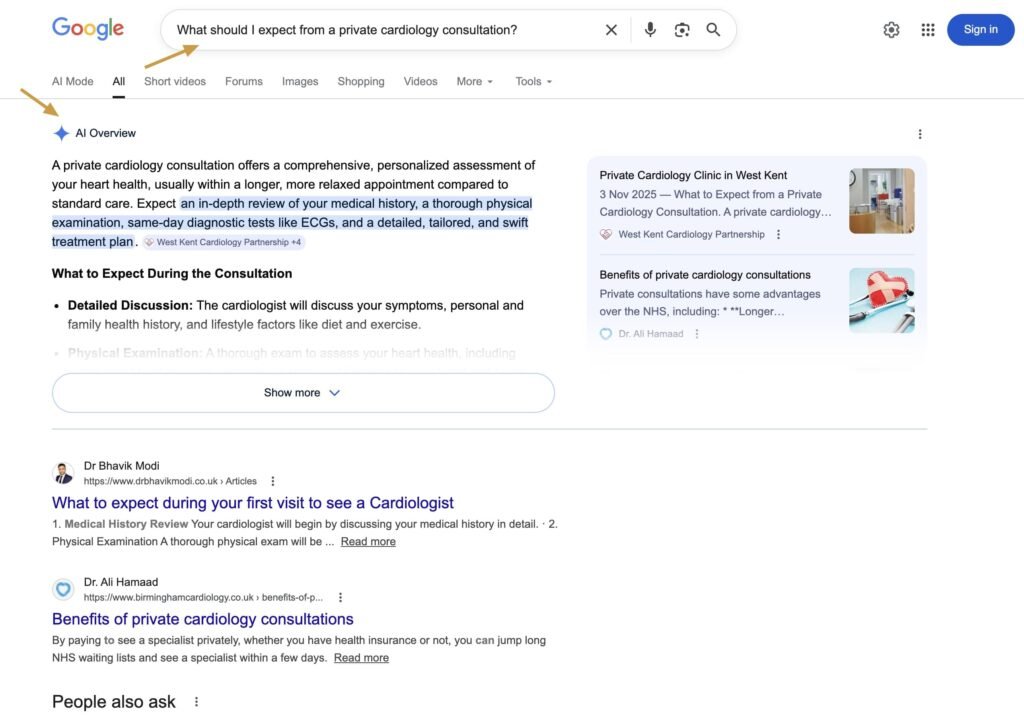
Building AI Snippet-Ready Content Architecture
For each of your top ten commercial pages, the restructuring should follow a clear patient pathway: Symptom or concern → condition or diagnosis → test or investigation → treatment or management → what to expect → cost and access.
Each stage of this pathway should have its own clearly labelled section, with a direct, plain-English answer in the first one to two sentences.
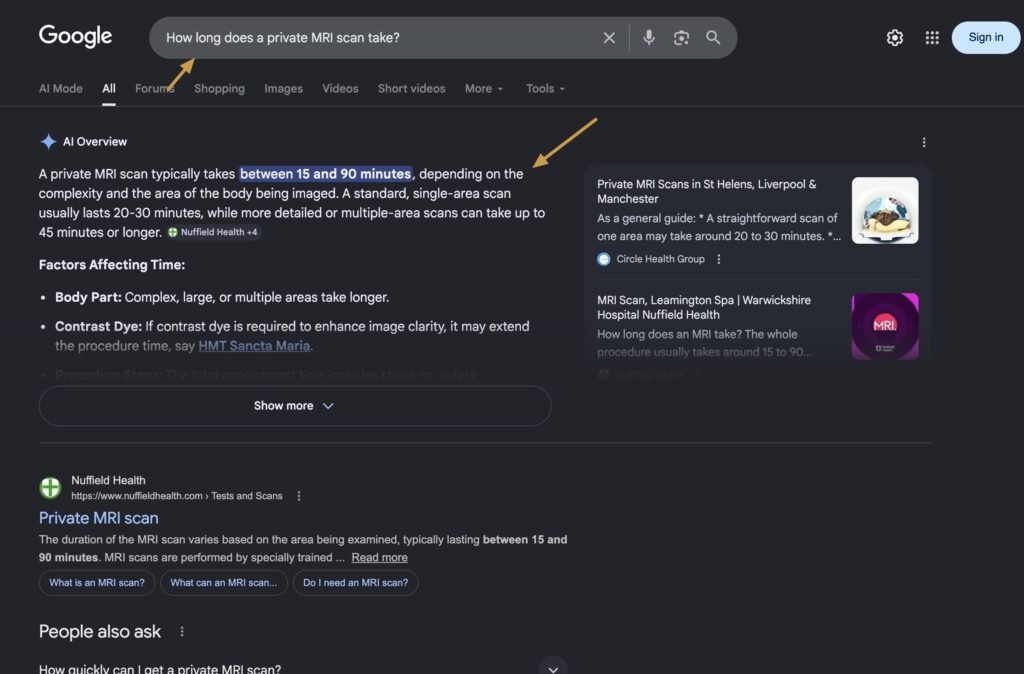
Google’s AI systems, and patients, reward content that gets to the point before adding nuance. Headers should be written as questions patients actually ask, not as clinical labels. “How long does a private MRI scan take?” performs better than “MRI Duration.”
This structure also makes your content suitable for FAQPage schema markup, which signals to Google that your content is organised to answer specific questions: a positive signal for AI citation candidacy.
Clinician Profile Pages as SEO Assets
This is a widely under-exploited area in UK private clinic marketing. A clinician’s profile page is not just a staff listing. For AI Mode, it is an E-E-A-T signal, a local search anchor and a content asset that can rank independently for consultant-level queries.
Profiles should include the clinician’s subspecialty focus areas written in patient language, conditions they treat, the typical patient journey through their service, any published research or professional memberships and patient-facing commentary on their approach.
Platforms like Doctify and TopDoctors already surface this kind of information; your own site should match and exceed it. A private cardiologist in Leeds whose profile page is thin and generic is losing AI citation opportunities to the same consultant’s well-maintained Doctify listing.
Strategy 2: Protect and Expand Your Local SEO Footprint
Here is the genuinely good news for UK private clinic directors: local search remains traditional SEO territory. Google’s decision to keep AI Overviews off local provider queries is one of the most consequential choices it has made for clinic marketing and it should reshape where you allocate budget.
A patient searching “private dermatologist near me”, “private physiotherapy Birmingham”, or “same day GP appointment London” is still seeing a local pack and organic results, not an AI-generated answer. The click-through value from these queries remains intact, which makes local SEO investment directly defensible in commercial terms.
Google Business Profile as a First-Party Asset
Your Google Business Profile is now one of your most important marketing properties, not a secondary citation. Clinics that treat GBP as a one-time setup exercise are leaving patient acquisition on the table.
For AI Mode specifically, SE Ranking’s analysis of 1.3 million AI Mode citations found that Google Business Profiles are frequently cited directly in AI responses to local queries. This means your GBP listing content, including services, Q&A responses, reviews and posts, can surface inside AI Mode answers even when your website does not.
The UK Directory Ecosystem and AI Citations
Doctify, TopDoctors, WhatClinic and Private Health UK are not just referral platforms. They are citation sources that AI Mode draws from when constructing answers to queries about UK private healthcare. A clinic that maintains strong, up-to-date profiles across these directories is more likely to appear in AI-synthesised answers than one that relies solely on its own website.
This matters because AI Mode does not privilege your website over third-party directories, it privileges the most accurate, credible, and structured information it can find. Keeping your directory listings accurate and review-rich is now part of your SEO strategy, not separate from it.
Strategy 3: Build a Content Refresh Programme, Not a Publishing Calendar
Most UK private clinics that invest in content marketing approach it as a publishing exercise: brief an article, publish it, move to the next one. In an AI Mode environment, this approach produces diminishing returns. The clinics that will maintain visibility are those that systematically maintain the quality and accuracy of existing content, not just those that produce the highest volume of new content.
Research from multiple industry studies shows that healthcare websites are experiencing 20 to 30% year-on-year declines in traffic to clinical information pages even while rankings remain stable. The traffic is not declining because content is poor, it is declining because AI Mode is answering the question before the patient clicks. The response is not to publish more of the same content. It is to make your existing content the most credible, complete, and AI-citable source on each topic.
The Content Refresh Criteria
Prioritise pages for refresh based on three factors: commercial value (does this page drive enquiries or bookings?), query coverage (does the page address all the sub-intents a patient might have?), and E-E-A-T signals (does the page demonstrate clinical expertise, specific authorship, and cited evidence?).
A practical refresh for a high-value service page should involve adding the author’s name and credentials, dating the content with a last-reviewed note, adding a concise FAQ block at the foot of the page, ensuring every statistic links to its source, and reviewing the heading structure to ensure it maps to patient questions rather than clinic categories.
A quarterly refresh schedule for your top ten commercial pages is a realistic and defensible priority. These pages are responsible for the majority of your patient acquisition. Keeping them current, well-structured, and E-E-A-T-compliant is a higher-value activity than publishing new blog content that may receive minimal AI attention.
What to Measure in GA4 and Search Console: A Practical Framework
Traditional SEO reporting is structurally incomplete in an AI Mode environment. Rankings and traffic remain useful, but they are no longer sufficient. Clinic directors who receive monthly reports showing stable rankings need to understand what those reports are not telling them.
The Metrics That Still Matter
In Google Search Console, the core signals remain valuable with important caveats. Monitor impressions and clicks for your top commercial queries, but track them separately for informational and local queries. Informational queries (symptom pages, procedure explanations, cost guides) should be expected to show declining CTR as AI Overviews absorb more of the engagement. If impressions are stable but clicks are falling on these pages, AI Overviews are the cause, not content quality.
What You Cannot Measure Directly
AI Mode clicks are recorded in Search Console under the “Web” search type, but they cannot currently be filtered separately from traditional organic clicks. This means your click data is now a blend of AI-referred and traditional-referred visits that you cannot cleanly separate. Clinics should note this limitation explicitly in their reporting, particularly when comparing periods before and after AI Mode’s UK rollout.
For approximating AI citation impact, monitor branded search volume through Search Console as a proxy for awareness. Track direct traffic trends separately from organic. Use manual testing of your top 30 queries in Google to check whether AI Overviews cite your content. Document and screenshot these tests monthly, this creates a directional record even where hard attribution is unavailable.
Review Platform Data as a Leading Indicator
Your review volume and average rating on Google, Doctify and TopDoctors are inputs into both your local search ranking and AI Mode citation quality. Clinics with consistently high review velocity tend to perform better in local pack results. Track monthly review volume per location as a KPI alongside your traditional SEO metrics.
A 30-Day Action Plan for UK Private Clinics
The following is a prioritised sequence for a private clinic that wants to adapt to AI Mode without overhauling its entire marketing operation in one go.
- Pull your top 10 commercial pages and top 30 queries from Search Console
- Identify queries with stable impressions but declining clicks — these are AI-affected
- Document GBP completeness and review volume across all platforms
- Audit clinician profile quality on-site and on Doctify / TopDoctors
- Complete each location’s GBP: all services listed, Q&A populated, photos updated
- Publish a monthly GBP post to signal activity
- Update listings on Doctify, TopDoctors, and WhatClinic for accuracy
- Respond to every unanswered review
- Restructure your 3 highest-value service pages around patient pathway logic
- Add author name, credentials, and “last reviewed” date to each page
- Add a FAQ block of 5–7 patient questions with concise plain-English answers
- Rewrite H2s/H3s as questions patients actually ask
- Implement FAQPage schema on restructured pages
- Add MedicalCondition / MedicalTest schema where applicable
- Update SEO reporting template: impressions vs clicks by query type, branded search volume trend, review volume per location
- Document AI citation status from manual testing of top 30 queries
This is not a one-time exercise. The clinics that will sustain visibility through the continued rollout of AI Mode are those that treat content quality and local authority as ongoing operational commitments.
Is Your Clinic Visible in AI Search?
Our team audits your SEO footprint, identifies AI Mode blind spots, and builds a prioritised action plan — specific to your clinic and specialty.
Is my clinic’s local SEO still working the same way as before AI Mode?
How do I know if AI Overviews are responsible for my traffic decline?
Do I need to change my content strategy entirely?
Can Doctify or TopDoctors replace my website in AI answers?
Will reviews affect how AI Mode surfaces my clinic?
What schema markup should I prioritise for a private clinic?
LocalBusiness and MedicalOrganization schema if not already in place. Then prioritise FAQPage schema on any page with a FAQ block, MedicalCondition on condition-specific pages, MedicalTest on diagnostic service pages, and Review schema where your review data meets the validity criteria. Physician schema for individual consultant profiles is also worth implementing, particularly if your consultant profiles are standalone pages with structured information.