Something fundamental has shifted in how patients find healthcare. Not long ago, a private clinic’s digital presence meant a well-ranked website, a Google Business Profile and a steady stream of positive reviews. That still matters, but it’s no longer the whole picture.
Today, a patient searching “private GP near me with same-day appointments” or “consultant dermatologist London for eczema” is increasingly likely to see an AI-generated summary before they encounter a single traditional link.
Google’s AI Overviews now dominate the top of health-related search results. Perplexity, ChatGPT and Gemini handle more health queries than ever. According to a survey of 2,000 UK patients, 1 in 4 (24%) are now turning to AI and social media for health guidance, a figure that has risen rapidly over the past eighteen months.
For clinic directors, that shift has a direct operational implication. If your practice isn’t appearing in AI-generated answers, you’re not in the consideration set, regardless of where you rank on page one.
This article explains what Generative Engine Optimisation (GEO) means for UK healthcare providers, why traditional SEO alone is no longer sufficient, and what a practical, compliance-aware approach looks like in 2026. You’ll find an entity-building playbook, an AI answer eligibility checklist, schema recommendations, and a case study from a private hospital group that built meaningful AI visibility in 8 weeks.
⚠️ The Compliance Risk in Doing Nothing
Before getting into strategy, it’s worth naming the exposure clearly.
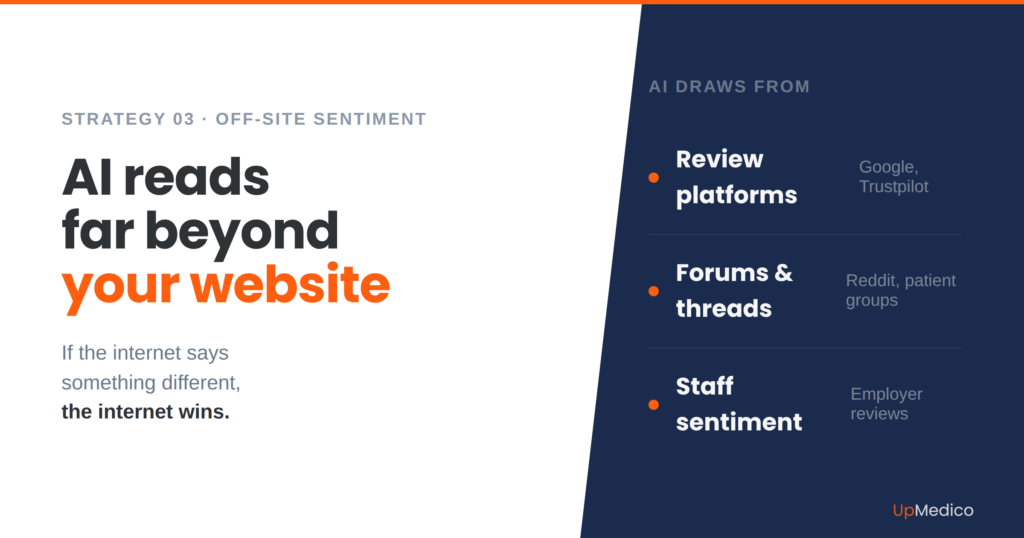
UK healthcare providers operate under Advertising Standards Authority (ASA) rules, CAP codes, CQC governance, and UK GDPR obligations. AI-generated recommendations are subject to none of those frameworks. They draw from wherever they find credible signals, including review platforms, Reddit threads, news articles, Glassdoor, and third-party directories.
That creates a real vulnerability. If a patient searches “private orthopaedic surgeon London” and the AI surfaces sentiment from a two-year-old forum thread criticising your clinic’s billing department, your carefully maintained website content is irrelevant in that moment. The AI doesn’t distinguish between what you’ve published and what others have written about you, and the patient reading the AI summary has no reason to investigate further.
Small missteps compound over time. A pattern of unaddressed negative reviews, inconsistent information across directories, or thin clinician profiles can quietly accumulate into a perception problem that AI surfaces at scale. The compliance risk also cuts the other way.
Clinics that respond to AI visibility pressure by publishing speculative clinical claims or misleading outcome statistics will find themselves both at regulatory risk and algorithmically penalised. Google classifies health searches as Your Money or Your Life (YMYL) queries, and AI models apply elevated scrutiny to content in that category.
The practical message is this: GEO requires proactive reputation management, accurate clinical content, and structured off-site signals. Shortcuts don’t work here.
What GEO Actually Means for Healthcare?
Generative Engine Optimisation is the practice of structuring your digital presence so that AI models can understand, trust and cite your organisation when answering patient queries.
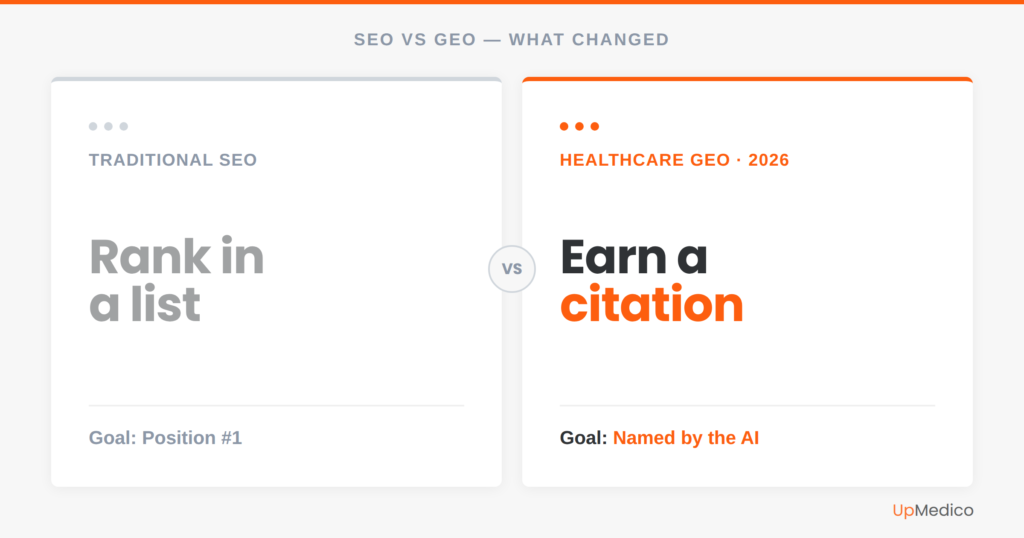
That’s a different objective from traditional SEO. Where traditional SEO competed for position in a ranked list, GEO competes for inclusion in a synthesised answer. The AI doesn’t present 10 results. It writes a paragraph, names two or three providers and moves on. Critically, 62% of AI Overview citations go to sources not ranking on page one, which means SEO ranking and AI citation are separate outcomes that require separate strategies.
The signals AI models use to form those answers are broader than keyword relevance. They include the depth and specificity of your published clinical content, the sentiment and volume of patient reviews across multiple platforms, your consistency across authoritative third-party citations, the clarity of your schema markup, and whether your clinicians, conditions, and procedures exist as recognisable entities in the AI’s knowledge base.
For UK providers, that last point matters particularly. CQC registration status, GMC Specialist Register listings and NHS affiliation all function as authority signals that AI models draw on when assessing credibility. A private clinic with CQC registration and clinicians listed on the GMC Specialist Register starts from a stronger trust baseline than one without those signals explicitly connected in its content and schema.
GEO vs. Traditional SEO: Core Differences for UK Clinics
| Dimension | Traditional SEO | Healthcare GEO (2026) |
|---|---|---|
| Primary goal | Rank in a list | Earn citation in an AI answer |
| Primary signals | Keywords, backlinks | Entities, authority, sentiment |
| Content format | Keyword-optimised pages | Structured, modular, citation-ready |
| Measurement | Rankings, CTR | Presence, perception, AI referral traffic |
| UK-specific trust | Domain authority | CQC, GMC, NHS affiliation, review credibility |
| Off-site relevance | Low | High (Reddit, Trustpilot, Glassdoor all matter) |
“In healthcare marketing, the brands that will win AI visibility are those that have invested in genuine clinical authority: accurate credentials, transparent outcomes, and consistent reputation signals across every platform a patient might encounter. GEO isn’t a technical shortcut; it’s the digital expression of the trust your clinic has already earned.”
— Angelo, CEO of UpMedico
3 Strategies for UK Healthcare GEO
The following strategies are sequenced by foundational priority. Entity building comes first because nothing else performs well without it.
Strategy 1: Build Clinician and Condition Entities
AI models respond to entities. An entity is a recognisable, real-world thing: a person, a medical condition, a procedure, a location. When a patient searches “consultant cardiologist London atrial fibrillation,” the AI cross-references its knowledge of what a consultant cardiologist is, which London-based clinicians have credible digital footprints and what conditions they’re known to treat.
Most UK private clinics are invisible in this matching process because they have never built individual clinician pages with sufficient depth.
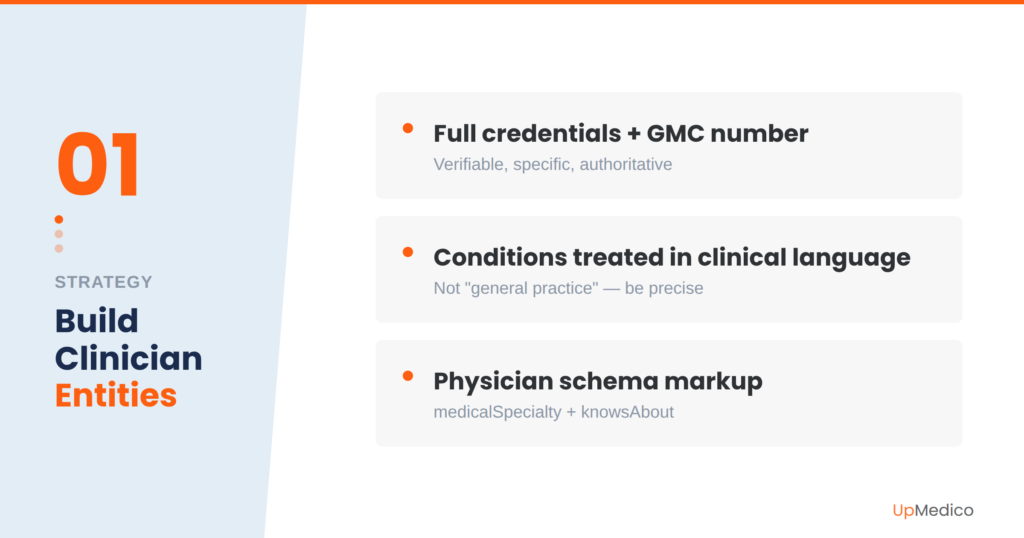
A biography with a headshot and three bullet points doesn’t establish an entity. An effective entity page includes full clinical credentials (including GMC registration number and specialty), the specific conditions treated using precise clinical language, any published content or peer-reviewed contributions where they exist, attributed patient testimonials linked to specific procedures and correct schema markup using Physician, MedicalWebPage, and MedicalCondition vocabulary.
Clinician Entity Pages
Implementation Steps
-
1
Audit your current clinician pages. Identify which practitioners have thin or generic profiles — under 300 words is a clear warning sign.
-
2
Map conditions: for each clinician, identify which conditions they treat and check whether your site has a corresponding condition hub page with clinical depth.
-
3
Write or commission long-form clinician profiles (minimum 600 words) covering clinical scope, training history, GMC registration and a named set of conditions treated.
-
4
Apply Physician schema with
medicalSpecialty,affiliationandknowsAboutproperties populated accurately. -
5
Cross-reference each clinician’s GMC listing to ensure that what your content states matches the public register exactly.
Observable outcome: AI models queried for “best [specialty] consultant [city]” begin citing your clinicians by name, rather than defaulting to competitor pages or NHS aggregators.
Strategy 2: Build Condition and Procedure Hubs with AI-Answer Eligibility
Content structure directly affects AI citation eligibility. 82.5% of content cited in AI results comes from deep-linked long-form content, not short landing pages optimised for keywords. That carries a direct structural implication for how UK clinics organise their web presence.
The practical model is a topic cluster. Each cluster centres on a core condition or procedure page (the hub) supported by satellite articles covering specific patient questions, clinical nuances, cost transparency, aftercare guidance and comparison content.
The hub page earns AI citation eligibility because it answers a broad patient query comprehensively. The satellite articles capture the conversational, long-tail queries that AI Overviews increasingly handle.
For a private dermatology clinic in London, a cluster might look like this:
- Hub: “Consultant Dermatologist London: What to Expect” (700-900 words, MedicalWebPage schema)
- “How much does a private dermatology appointment cost in London?” (transparent pricing page, FAQPage schema)
- “Eczema vs psoriasis: how a consultant makes the clinical distinction?” (explainer, MedicalCondition schema)
- “What happens at a patch testing appointment?” (procedure guide, HowTo schema where appropriate)
- “Dr [Name]: Consultant Dermatologist specialising in inflammatory skin conditions” (entity page, Physician schema)
Each page in this cluster should be written so that a 150-300 word excerpt can stand alone as an AI summary without requiring surrounding context. That means opening each section with the key claim, supporting it with evidence or clinical specificity immediately, and removing vague preambles.
Just 5.4% of AI results contain the exact keyword of a query, which means writing for intent and clinical specificity, not keyword density.
Content Architecture
Implementation Steps
-
1
Identify your top five services or specialties by patient inquiry volume.
-
2
Map the 6 to 8 most common patient questions for each service, using Google Search Console query data and actual patient enquiry logs.
-
3
Build or restructure hub and satellite pages around those questions.
-
4
Apply relevant schema to each page type.
-
5
Track AI citation frequency monthly using prompts that mirror patient queries.
Strategy 3: Manage Off-Site Sentiment Proactively
Traditional SEO focused almost entirely on your own website. GEO requires equal attention to what’s being said about you elsewhere, because AI models form impressions from the full breadth of available digital signals.
This isn’t theoretical. AI platforms have been observed pulling from Glassdoor when generating care quality recommendations, surfacing Reddit criticisms of billing practices even when the practice’s own website promises seamless payment, and weighting employer review sentiment when patients ask questions about staff continuity and care culture.
If your AI sentiment tells a different story than your website, your website loses.
Off-Site Sentiment & Reviews
Implementation Steps
-
1
Run monthly AI prompts: “What are the best [specialty] clinics in [city]?” and “What do patients say about [clinic name]?” Record the sources the AI draws from.
-
2
Identify recurring negative sentiment themes. If billing, waiting times, or communication appear repeatedly, address those issues operationally before attempting to manage them digitally.
-
3
Build a systematic review collection process that targets patients who’ve had positive experiences in exactly the areas where AI sentiment is weakest.
-
4
Update your Google Business Profile with clinically specific service categories, accurate Q&A content, and consistent review responses. Emerging evidence suggests that GBP image optimisation — including contextually labelled images rather than generic photographs — influences AI Overview inclusion for local searches.
-
5
Monitor Glassdoor alongside patient-facing review platforms. AI models have been observed using staff satisfaction data when generating provider recommendations, particularly for queries that touch on care quality.
Technical Infrastructure for AI Visibility
Getting GEO right requires a technical foundation that makes your content legible to AI models, not just to traditional crawlers.
Core performance requirements remain unchanged: fast page load, logical site architecture, clean URL structures, and strong internal linking between clinician pages, condition hubs, and location pages. But several additions are now necessary for healthcare GEO specifically.
Schema vocabulary is the most direct technical lever. For UK healthcare providers, the priority schema types are:
- MedicalOrganization or MedicalClinic for location pages,
- Physician for all clinician profiles,
- MedicalCondition for condition and symptom pages,
- MedicalWebPage for clinical content (with audience and medicalAudience properties populated),
- FAQPage for patient FAQ sections,
- Speakable on select high-authority pages where content is structured for direct quotation.
Healthcare pages with comprehensive schema markup see up to 82% higher click-through rates compared to pages without structured data.
Beyond schema, two additions deserve immediate attention. The first is LLMS.txt, a recently emerging convention that gives AI crawlers explicit guidance on which pages should be used as citation sources. This is the AI-era equivalent of robots.txt and should now be part of your standard site configuration.
The second is Google Business Profile depth. GBP optimisation for AI visibility goes beyond name, address and phone number consistency. Add service categories with clinical specificity, update the Q&A section with accurate booking and clinical information and ensure that your review response practice is consistent and professionally worded, since AI models read the texture of those responses, not just the star rating.
GEO optimisation methods have been shown to boost source visibility by up to 40% in generative engine responses when implemented systematically. These are not marginal gains in a market where AI citation increasingly determines whether a patient considers your clinic at all.
“The clinics seeing the strongest AI visibility gains in 2026 are not necessarily the largest or the most established: they’re the ones that have been most deliberate about connecting their clinical authority to the technical signals AI models rely on. Schema, off-site sentiment, and entity depth aren’t optional extras; they’re the infrastructure of modern patient acquisition.”
— Angelo, CEO of UpMedico
Case Study: An AI Visibility Sprint
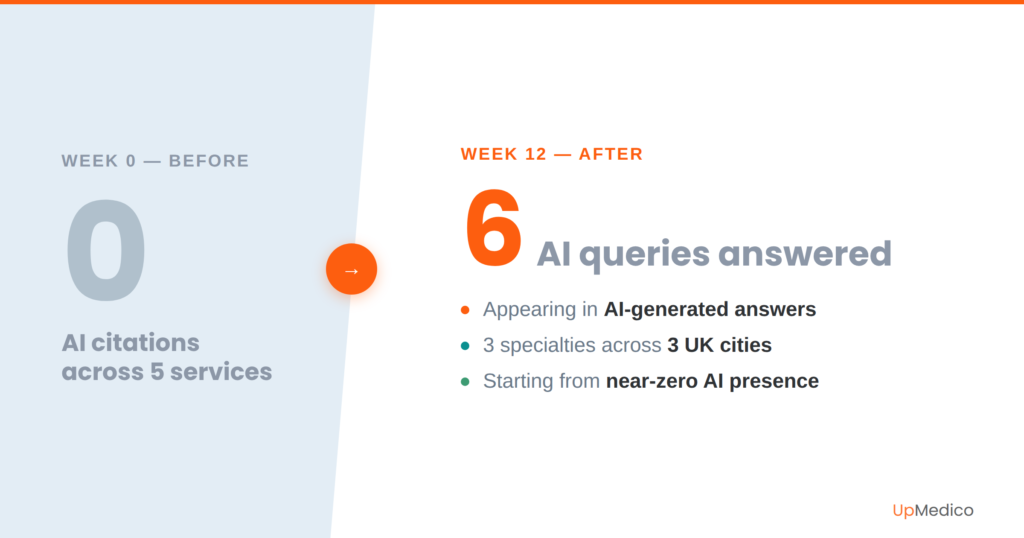
A mid-sized private hospital group with sites across 3 UK cities had strong SEO rankings, but near-zero presence in AI-generated answers. When their marketing director ran AI prompts for their top five service lines, competitors, NHS trusts and even non-branded health information sites were returned ahead of them.
The team ran an eight-week AI visibility sprint structured around three workstreams. In weeks 1 and 2, they audited their twelve most senior clinicians and found that nine had profile pages under 200 words. They built comprehensive entity pages for each, added Physician schema aligned to GMC specialty data, and cross-referenced each clinician’s conditions of expertise against the hospital’s service pages to identify content gaps.
In weeks 3 through 6, they built condition hubs for their top 3 specialties (orthopaedics, cardiology and dermatology), each supported by four to six satellite pages written in modular, AI-answer-eligible format. Every hub page included MedicalWebPage schema and a FAQPage section built from actual patient enquiry logs rather than assumed questions.
In weeks 7 and 8, they addressed sentiment. Reviews mentioning specific consultants were identified and prioritised for GBP visibility. A targeted review generation campaign focused specifically on patients who had recently completed treatment in the areas showing the weakest AI sentiment. Two senior clinicians contributed short-form clinical commentary to the hospital blog, establishing first-party expert signals that AI models could attribute by name.
By week 12, prompt testing showed the group appearing in AI Overviews and ChatGPT citations for six of their target queries, including “private cardiologist London atrial fibrillation” and “orthopaedic consultant Birmingham knee replacement.”
AI Answer Eligibility Checklist
Use this checklist to assess your content infrastructure before running AI visibility prompts. Items you cannot check are your highest‑priority actions.
Tip: Prioritise items that are unchecked for your first 4–6 week GEO sprint.